A - Numerical Skills/Pre-Algebra

Solution
\[ \begin{aligned} & (72 - 9) \div 3 \cdot 2 + 2 \\ &= 63 \div 3 \cdot 2 + 2 \\ &= 21 \cdot 2 + 2 = 42 + 2 = 44 \end{aligned} \]In scientific notation, \(3.0 \times 10^{-5} + 4.0 \times 10^{-4} =\)
Solution
\[ \begin{aligned} 3.0 \times 10^{-5} + 4.0 \times 10^{-4} &= 3.0 \times 10^{-1} \times 10^{-4} + 4.0 \times 10^{-4} \\ &= 0.3 \times 10^{-4} + 4.0 \times 10^{-4} = 4.3 \times 10^{-4} \end{aligned} \]

Solution
\[ \begin{aligned} & \frac{2}{3} + \left(\frac{1}{2} + \frac{1}{6}\right) - \left(\frac{1}{3} + \frac{3}{4}\right) \\ &= \frac{2}{3} + \left(\frac{3}{6}+\frac{1}{6}\right) - \left(\frac{4}{12}+\frac{9}{12}\right) \\ &= \frac{2}{3} + \frac{4}{6} - \frac{13}{12} = \frac{8}{12} + \frac{8}{12} - \frac{13}{12} = \frac{3}{12} = \frac{1}{4} \end{aligned} \] Numerator = \(1\).

Solution
\[ \begin{aligned} & \frac{1}{5} + \left(\frac{4}{3} \div \frac{3}{5}\right) - \left(\frac{1}{4} \times \frac{4}{5}\right) \\ &= \frac{1}{5} + \left(\frac{4}{3} \times \frac{5}{3}\right) - \frac{1}{5} \\ &= \frac{1}{5} + \frac{20}{9} - \frac{1}{5} = \frac{20}{9} = 2\frac{2}{9} \end{aligned} \]A shop owner decreased the selling price of a pair of shoes from $25 to $22. By what percentage was the price decreased?
Solution
\[ \text{Change} = 25 - 22 = 3,\quad \text{Percent change} = \frac{3}{25} = \frac{12}{100} = 12\% \]\(\displaystyle \frac{2}{5} + 0.4 + 10\% =\)
Solution
\[ 0.4 = \frac{2}{5},\quad 10\% = \frac{1}{10},\quad \frac{2}{5}+\frac{2}{5}+\frac{1}{10} = \frac{4}{5}+\frac{1}{10} = \frac{9}{10} \]Linda worked for 8 hours at $6.20 per hour. She bought two boxes of chocolate at $12.50 each and three boxes of cookies at $4.25 each. How much money does Linda have left?
Solution
\[ \text{Earned} = 8 \times 6.20 = 49.60,\quad \text{Spent} = 2\times12.50 + 3\times4.25 = 25 + 12.75 = 37.75 \] \[ \text{Left} = 49.60 - 37.75 = 11.85 \]Jhon bought \(2\frac{1}{4}\) pounds of blue cheese, 2.75 pounds of Cheddar cheese and \(4\frac{1}{2}\) pounds of goat cheese. Total pounds?
Solution
\[ 2\frac{1}{4} + 2.75 + 4\frac{1}{2} = \frac{9}{4} + \frac{11}{4} + \frac{9}{2} = \frac{9}{4} + \frac{11}{4} + \frac{18}{4} = \frac{38}{4} = 9\frac{1}{2} \]In a factory, \(\frac{2}{5}\) of workers earn more than $12 per hour. Those earning $12 or less are 120. How many earn more than $12?
Solution
Let \(x\) be total workers. \(\frac{3}{5}x = 120 \Rightarrow x = 200\). Workers earning more: \(\frac{2}{5}\times200 = 80\).40% of students have no siblings. Of the remaining, \(\frac14\) have exactly one sibling. What fraction have more than one sibling?
Solution
\[ \text{Remaining} = 60\% = 0.6,\quad \text{Exactly one} = \frac14\times0.6 = 0.15 \] \[ \text{More than one} = 1 - 0.4 - 0.15 = 0.45 = \frac{9}{20} \]A) 300 B) 100 C) 200 D) 400 E) 120
A) \(\frac{3xy}{2z}\) B) \(\frac{2z}{3xy}\) C) \(\frac{2yz}{3x}\) D) \(6xyz\) E) \(\frac{3yz}{2xy}\)
A) 80.5 B) 6.5 C) 80.2 D) 80.3 E) 81.4
A) 25 B) 40 C) 25000 D) 250 E) 2500
A) \(\sqrt{7}\) B) 5 C) \(2-\sqrt{3}\) D) 0 E) 1
B - Algebra
A) -8 B) -10 C) 8 D) 6 E) -6
A) -10 B) -30 C) -20 D) -15 E) -22
A) \(\frac18\) B) 8 C) \(\frac14\) D) 4 E) 2
A) \(L(P-L)\) B) \(L(P-2L)\) C) \(\frac{L}{2}(P-2L)\) D) \(\frac{L}{2}(P+2L)\) E) \(L(P/2-2L)\)
A) \(0.625x - 1000\) B) \(0.75x - 1000\) C) \(0.5x - 1000\) D) \(x-1000\) E) \(0.5x-100\)
A) \((x+4)(7x-1)\) B) \((x-2)(7x+2)\) C) \((x+2)(7x-2)\) D) \((x-4)(7x+1)\) E) \(x(7x-27-4)\)
A) \(x^3 - y^3\) B) \(x^3 - y^3 -2xy\) C) \(x^3 - y^3 - 3x^2y + 3xy^2\) D) \(x^3 - y^3 +2xy\) E) \(x^3 - y^3 - 3x^2y + 3xy^2\)
A) 75 mph B) 74 mph C) 150 mph D) 149 mph E) 76 mph
A) I & II B) II & III C) III & IV D) I & IV E) IV & II
A) \(-(t+1)^2\) B) \(-(t-2)^2\) C) \(-t^2\) D) \(-(t-3)^2\) E) \(-(t+3)^2\)
A) 0 B) \(2x\) C) \(2y\) D) \(x+y\) E) \(-2y\)
A) -4 B) \(-\frac14\) C) -20 D) \(-\frac54\) E) 0
A) \(\frac{2}{2-x}\) B) 0 C) \(\frac{2}{x-2}\) D) \(\frac{1}{x-2}\) E) 2
A) 0 B) 1 C) 2 D) 3 E) 4
C - College Algebra
A) 32 B) 16 C) 64 D) 128 E) 256
A) 1 B) -1 C) 0 D) 3 E) 2
A) 0 B) 1 C) -1 D) undefined E) -3
A) \((-4,\infty)\) B) \([-4,\infty)\) C) \((4,\infty)\) D) \([4,\infty)\) E) \([0,\infty)\)
A) \(-2x+1\) B) \(-2x+3\) C) \(x+1\) D) \(-2x+2\) E) \(2x+1\)
A) I,II only B) II only C) II,IV only D) I,III only E) III,IV only
A) -1 B) 1 C) \(i\) D) \(-i\) E) 0
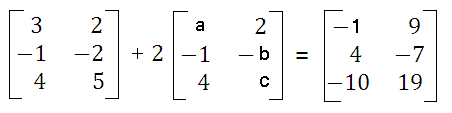
A) \(a=-2,b=\frac52,c=\frac{15}{2}\) B) \(a=-\frac32,b=\frac52,c=7\) C) \(a=-2,b=\frac52,c=7\) D) \(a=2,b=\frac52,c=7\) E) \(a=-2,b=\frac52,c=-\frac{15}{2}\)
A) 58 B) 58.25 C) 5.75 D) 57.5 E) 32.5
D - Geometry
Line \(T_1 \parallel T_2\), \(L_1 \parallel L_2\). Angle \(i = 127^\circ\). Find angle \(f\).

A) \(2x^2\) B) \(0.5x^2\) C) \(x^2\) D) \(3x^2\) E) Cannot be calculated
A) 5 B) \(20\pi\) C) \(10\pi\) D) \(15\pi\) E) \(5\pi\)
A) 5 B) 10 C) 25 D) \(25\pi\) E) \(5\pi^2\)
\(EB \perp AC\), \(FC \perp AC\), \(AF=15\), \(AB=x\). Find \(x\).

A) 30 cm B) 100 cm C) \(20+10\sqrt{2}\) cm D) \(20+2\sqrt{10}\) cm E) \(20+\sqrt{10}\) cm
\(AB\) diameter of semicircle, \(C\) on semicircle, \(o\) incenter of \(\triangle ABC\). Find \(\angle AoB\).

A) \(W=x\) B) \(W=2x\) C) \(W=x-5\) D) \(W=x-10\) E) \(W=x+10\)
A) 20 m B) \(10\sqrt{2}\) m C) 100 m D) \(50\sqrt{2}\) m E) 10 m
E - Trigonometry
A) \(\frac13\) B) \(\frac{1}{\sqrt{8}}\) C) \(\frac{1}{10}\) D) \(\frac{1}{\sqrt{10}}\) E) 1
A) \(60^\circ\) B) \(1380^\circ\) C) \(690^\circ\) D) \(2070^\circ\) E) \(180^\circ\)
A) 30 cm B) \(40\sqrt{3}\) cm C) \(20(1+\sqrt{3})\) cm D) \(30(1+\sqrt{3})\) cm E) \(10(1+\sqrt{3})\) cm
Graph of \(y = \cos\left(\frac12 x\right)\)?

A) \(\frac{\pi}{2}\) B) \(\frac{5\pi}{2}\) C) \(\frac{2\pi}{3}\) D) \(\frac{\pi}{3}\) E) \(\frac{\pi}{6}\)
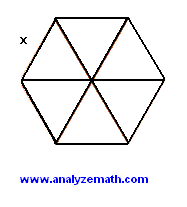
Regular hexagon area \(100\ \text{cm}^2\). Side length \(x\)?