Tangent lines problems and their solutions, using first derivatives, are presented.
In what follows, \( C \) represents the constant of integration where applicable.
Worked Examples
Problem 1
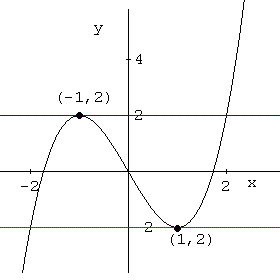
Find all points on the graph of \( y = x^3 - 3x \) where the tangent line is parallel to the x-axis (or horizontal tangent line).
Show Solution to Problem 1
Lines parallel to the x-axis have a slope equal to \( 0 \). The slope of a tangent line to the graph of \( y = x^3 - 3x \) is given by the first derivative \( y' \):
\[ y' = 3x^2 - 3 \]We find all values of \( x \) for which \( y' = 0 \):
\[ 3x^2 - 3 = 0 \implies x^2 = 1 \implies x = -1 \text{ and } x = 1 \]We substitute these \( x \)-coordinates back into the original equation \( y = x^3 - 3x \) to find the corresponding \( y \)-coordinates:
- For \( x = -1 \): \( y = (-1)^3 - 3(-1) = -1 + 3 = 2 \implies (-1, 2) \)
- For \( x = 1 \): \( y = (1)^3 - 3(1) = 1 - 3 = -2 \implies (1, -2) \)
The points at which the tangent lines are parallel to the x-axis are \( (-1, 2) \) and \( (1, -2) \).
Problem 2
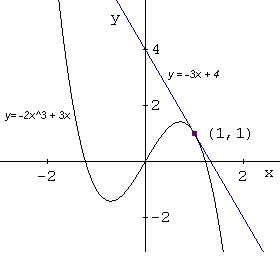
Find the constants \( a \) and \( b \) so that the line \( y = -3x + 4 \) is tangent to the graph of \( y = ax^3 + bx \) at \( x = 1 \).
Show Solution to Problem 2
To find \( a \) and \( b \), we need two equations. First, the point of tangency lies on both the curve \( y = ax^3 + bx \) and the tangent line \( y = -3x + 4 \) at \( x = 1 \). Thus, their \( y \)-coordinates at \( x = 1 \) are equal:
\[ a(1)^3 + b(1) = -3(1) + 4 \implies a + b = 1 \]Second, the slope of the tangent line is \( -3 \), which must equal the first derivative \( y' \) of \( y = ax^3 + bx \) at \( x = 1 \):
\[ y' = 3ax^2 + b \]At \( x = 1 \):
\[ 3a(1)^2 + b = -3 \implies 3a + b = -3 \]We solve the system of equations:
- \( a + b = 1 \)
- \( 3a + b = -3 \)
Subtracting the first equation from the second gives \( 2a = -4 \implies a = -2 \). Substituting \( a = -2 \) into \( -2 + b = 1 \) yields \( b = 3 \).
Conclusion: \( a = -2 \) and \( b = 3 \).
Problem 3
Find conditions on \( a \) and \( b \) so that the graph of \( y = a e^x + bx \) has NO tangent line parallel to the x-axis (horizontal tangent).
Show Solution to Problem 3
The slope of a tangent line is given by the first derivative \( y' \) of \( y = a e^x + bx \):
\[ y' = a e^x + b \]To find points with a horizontal tangent line, we set \( y' = 0 \):
\[ a e^x + b = 0 \implies e^x = -\frac{b}{a} \]Since the exponential function \( e^x > 0 \) for all real numbers \( x \), this equation has no real solutions when \( -\dfrac{b}{a} \le 0 \). Therefore, the graph has no horizontal tangent line if \( \dfrac{b}{a} \ge 0 \) (i.e., \( a \) and \( b \) have the same sign or \( b = 0 \)).
Exercises & Solutions
-
Find all points on the graph of \( y = x^3 - 3x \) where the tangent line is parallel to the line \( y = 9x + 4 \).
Show Solution to Exercise 1
Set \( y' = 3x^2 - 3 = 9 \implies 3x^2 = 12 \implies x^2 = 4 \implies x = \pm 2 \).
Evaluating \( y \) at \( x = 2 \) and \( x = -2 \) gives the points \( (2, 2) \) and \( (-2, -2) \).
-
Find \( a \) and \( b \) so that the line \( y = -2 \) is tangent to the graph of \( y = ax^2 + bx \) at \( x = 1 \).
Show Solution to Exercise 2
Using conditions at \( x = 1 \): \( a(1)^2 + b(1) = -2 \) and \( 2a(1) + b = 0 \).
Solving the system gives \( a = 2 \) and \( b = -4 \).
-
Find conditions on \( a \), \( b \), and \( c \) so that the graph of \( y = ax^3 + bx^2 + cx \) has ONLY ONE tangent line parallel to the x-axis (horizontal tangent line).
Show Solution to Exercise 3
The derivative is \( y' = 3ax^2 + 2bx + c = 0 \). For exactly one horizontal tangent, the quadratic must have a discriminant of zero:
\[ \Delta = (2b)^2 - 4(3a)(c) = 0 \implies 4b^2 - 12ac = 0 \]