Espacio Nulo y Nulidad de una Matriz
Definición del Espacio Nulo de una Matriz
El espacio nulo de una m × n matriz A es el conjunto de todas las soluciones x de la ecuación homogénea
A x = 0
donde x es un vector columna con n filas y 0 es un vector columna cero con n filas.
El espacio nulo de la matriz A se denota como "Null A" .
Null A es un subespacio de ℝ n y los vectores x están en ℝ n .
Usando notación de conjuntos escribimos: 
La nulidad de la matriz A es la dimensión de Null A , que es igual al número de vectores en Null A .
Propiedades del Espacio Nulo
Sea A una matriz m × n .
- El espacio nulo de una matriz dada A nunca está vacío ya que x = 0 es una solución trivial a la ecuación homogénea A x = 0 .
- Null A es un subespacio de ℝ n
-
Todos los elementos de Null A son vectores en ℝ n.
Ejemplos con Soluciones
Ejemplo 1
¿Cuál de los vectores
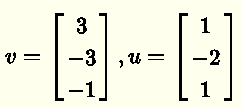 es un elemento de Null A dado que
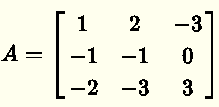
Solución del Ejemplo 1
De la definición anterior, cualquier elemento de Null A debe ser una solución de la ecuación homogénea A x = 0 . Por lo tanto,
para determinar si un vector dado es un elemento de Null A , simplemente verificamos si es una solución de la ecuación homogénea.
Verificar el vector v
Evaluar el producto A v
 \( \)\( \)\( \)
Simplificar
\( = \begin{bmatrix}
0\\\
0 \\
0
\end{bmatrix}
\)
Por lo tanto, dado que \( \; A v \; \) es igual a \( 0 \), el vector \( v = \begin{bmatrix}
3\\
-3\\
-1
\end{bmatrix} \) es una solución de la ecuación homogénea \( A x = 0 \) y, por consiguiente, es un elemento de Null \( A \).
Verificar el vector \( u \)
Evaluar el producto \( A u \)
\( \begin{bmatrix}
1 & 2 & -3\\
-1 & -1 & 0\\
-2 & -3 & 3
\end{bmatrix}
\begin{bmatrix}
1\\
-2\\
1
\end{bmatrix}
=
\begin{bmatrix}
(1)(1) + (2)(-2) + (-3)(1)\\\
(-1)(1) + (-1)(-2) + (0)(1) \\
(-2)(1) + (-3)(-2) + 3(1)
\end{bmatrix}
\)
Simplificar
\( = \begin{bmatrix}
-4\\\
1\\
7
\end{bmatrix}
\)
Por lo tanto, dado que \( \; A u \;\) NO es igual a \( 0 \), el vector \( u = \begin{bmatrix}
1\\
-2\\
1
\end{bmatrix} \) NO es una solución de la ecuación homogénea \( A x = 0 \) y, por lo tanto, NO es un elemento de Null \( A \).
Ejemplo 2
a) Encuentre Null A dado que \( A = \begin{bmatrix}
1 & 2 \\
0 & 0
\end{bmatrix} \)
b) Encuentre 3 elementos que estén en Null A.
Solución del Ejemplo 2
a)
Para encontrar Null A, necesitamos resolver la ecuación \( A x = 0 \) donde \( x \) es un vector en \( \mathbb{R}^2 \)
Sea \( x = \begin{bmatrix}
x_1\\
x_2
\end{bmatrix} \)
Necesitamos resolver
\( \begin{bmatrix}
1 & 2 \\
0 & 0
\end{bmatrix}
\begin{bmatrix}
x_1\\
x_2
\end{bmatrix}
= \begin{bmatrix}
0\\
0
\end{bmatrix}
\)
Escriba la matriz aumentada de la ecuación \( A x = 0 \)
\( \begin{bmatrix}
1 & 2 & | & 0\\
0 & 0 & | & 0
\end{bmatrix} \)
Resuelva lo anterior. \( x_2 \) es una variable libre y
\( x_1 = - 2 x_2 \)
Por lo tanto, el conjunto solución se puede escribir de la forma
\( x = x_2 \begin{bmatrix}
-2\\
1
\end{bmatrix} \) , donde \( x_2 \in \mathbb{R} \)
Cualquier valor real de \( x_2 \) da un elemento en Null \( A \).
Por lo tanto, Null \(A\) es el subespacio generado por \( \begin{bmatrix}
-2 \\
1
\end{bmatrix} \)
b)
Tenga en cuenta que para \( x_2 = 0 \), tenemos la solución trivial \( x = 0 \begin{bmatrix}
-2\\
1
\end{bmatrix} =
\begin{bmatrix}
0\\
0
\end{bmatrix}
\)
Se pueden obtener más elementos de Null \( A \) asignando diferentes valores a la variable libre \( x_2 \).
Sea \( x_2 = -1\), por lo tanto, el elemento correspondiente de Null \( A \): \( x = -1 \begin{bmatrix}
-2\\
1
\end{bmatrix} =
\begin{bmatrix}
2\\
-1
\end{bmatrix}
\)
Sea \( x_2 = 2\), por lo tanto, el elemento correspondiente de Null \( A \): \( x = 2 \begin{bmatrix}
-2\\
1
\end{bmatrix} =
\begin{bmatrix}
-4\\
2
\end{bmatrix}
\)
Sea \( x_2 = \dfrac{1}{2} \), por lo tanto, el elemento correspondiente de Null \( A \): \( x = \dfrac{1}{2} \begin{bmatrix}
-2\\
1
\end{bmatrix} =
\begin{bmatrix}
-1\\
\dfrac{1}{2}
\end{bmatrix}
\)
Como ejercicio, compruebe que los tres elementos \( \begin{bmatrix}
2\\
-1
\end{bmatrix} , \begin{bmatrix}
-4\\
2
\end{bmatrix}
,
\begin{bmatrix}
-1\\
\dfrac{1}{2}
\end{bmatrix} \) obtenidos arriba son soluciones de la ecuación \( A x = 0 \).
Ejemplo 3
a) Encuentre Null A y la nulidad de \( A \) dado que \( A = \begin{bmatrix}
1 & 2 & -1 \\
1 & -1 & 1 \\
3 & 0 & 1
\end{bmatrix} \)
Solución del Ejemplo 3
Sea \( x = \begin{bmatrix}
x_1 \\
x_2\\
x_3
\end{bmatrix} \) la solución de \( A x = 0 \)
Necesitamos resolver el sistema
\( \begin{bmatrix}
1 & 2 & -1 \\
1 & -1 & 1 \\
3 & 0 & 1
\end{bmatrix}
\begin{bmatrix}
x_1 \\
x_2\\
x_3
\end{bmatrix}
= \begin{bmatrix}
0\\
0\\
0
\end{bmatrix}
\)
Escriba la matriz aumentada de la ecuación anterior.
\(
\begin{bmatrix}
1 & 2 & -1 & | & 0\\
1 & -1 & 1 & | & 0\\
3 & 0 & 1 & | & 0
\end{bmatrix}
\)
Reduzca por filas usando el método de Gauss Jordan
\(
\begin{bmatrix}
1 & 0 & \dfrac{1}{3} & | & 0\\
0 & 1 & -\dfrac{2}{3} & | & 0\\
0 & 0 & 0 & | & 0
\end{bmatrix}
\)
\( x_3 \) es la variable libre.
\( x_2 = \dfrac{2}{3} x_3 \)
\( x_1 = -\dfrac{1}{3} x_3 \)
La solución \( x \) se puede escribir como
\( x = x_3 \begin{bmatrix}
-\dfrac{1}{3} \\
\dfrac{2}{3} \\
1
\end{bmatrix} \)
Por lo tanto, Null \(A\) es el subespacio generado por \( \begin{bmatrix}
-\dfrac{1}{3} \\
\dfrac{2}{3} \\
1
\end{bmatrix} \)
Nulidad de \( A \) = el número de vectores en Null \(A\) = 1
Ejemplo 4
a) Encuentre Null A y la nulidad de \( A \) dado que \( A = \begin{bmatrix}
3 & -2 & -1 & 0 & 2\\
1 & -2 & 1 & -2 & 4\\
-4 & 4 & 0 & 2 & -6
\end{bmatrix} \)
Solución del Ejemplo 4
El sistema a resolver es
\( A x = 0 \)
que se puede escribir como
\( \begin{bmatrix}
3 & -2 & -1 & 0 & 2\\
1 & -2 & 1 & -2 & 4\\
-4 & 4 & 0 & 2 & -6
\end{bmatrix}
\begin{bmatrix}
x_1 \\
x_2\\
x_3\\
x_4\\
x_5
\end{bmatrix}
= \begin{bmatrix}
0\\
0\\
0
\end{bmatrix}
\)
Primero escribimos la matriz aumentada del sistema anterior
\(
\begin{bmatrix}
3 & -2 & -1 & 0 & 2 & | & 0\\
1 & -2 & 1 & -2 & 4 & | & 0\\
-4 & 4 & 0 & 2 & -6 & | & 0
\end{bmatrix}
\)
Reducimos por filas la matriz anterior
\(
\begin{bmatrix}
1 & 0 & -1 & 1 & -1 & | & 0\\
0 & 1 & -1 & \dfrac{3}{2} & -\dfrac{5}{2} & | & 0 \\
0 & 0 & 0 & 0 & 0 & | & 0
\end{bmatrix}
\)
Resolvemos el sistema correspondiente a la matriz aumentada
Las variables libres son: \( x_3, \;x_4, \;x_5 \), por lo tanto
La segunda fila da: \( x_2 = x_3 - \dfrac{3}{2} x_4 + \dfrac{5}{2} x_5 \)
La primera fila da: \( x_1 = x_3 - x_4 + x_5 \)
El vector solución \( x \) está dado por
\( x = \begin{bmatrix}
x_3 - x_4 + x_5 \\
x_3 - \dfrac{3}{2} x_4 + \dfrac{5}{2} x_5 \\
x_3 \\
x_4 \\
x_5
\end{bmatrix}
\)
que se puede escribir como
\( x = x_3 \begin{bmatrix}
1\\
1\\
1\\
0 \\
0
\end{bmatrix}
+
x_4 \begin{bmatrix}
- 1\\
- \dfrac{3}{2}\\
0 \\
1\\
0
\end{bmatrix}
+
x_5 \begin{bmatrix}
1\\
\dfrac{5}{2} \\
0 \\
0 \\
1
\end{bmatrix}
\)
Null A = Span \( \left\{ \begin{bmatrix}
1\\
1\\
1\\
0\\
0
\end{bmatrix}
,
\begin{bmatrix}
-1\\
-\dfrac{3}{2}\\
0\\
1\\
0
\end{bmatrix}
,
\begin{bmatrix}
1\\
\dfrac{5}{2}\\
0\\
0\\
1
\end{bmatrix}
\right\}
\)
La nulidad de \( A \) es igual al número de vectores en la base de Null \( A \) = 3.
Como ejercicio, seleccione cualquier valor real para \( x_3, \; x_4\) y \( x_5 \), calcule el vector \( x = x_3 \begin{bmatrix}
1\\
1\\
1\\
0 \\
0
\end{bmatrix}
+
x_4 \begin{bmatrix}
- 1\\
- \dfrac{3}{2}\\
0 \\
1\\
0
\end{bmatrix}
+
x_5 \begin{bmatrix}
1\\
\dfrac{5}{2} \\
0 \\
0 \\
1
\end{bmatrix}
\) y verifique que es una solución del sistema \( A x = 0 \).
Más Referencias y Enlaces