
Mostramos que cuando realizamos operaciones elementales de fila en sistemas de ecuaciones representados por
Comenzamos con el sistema dado en forma matricial
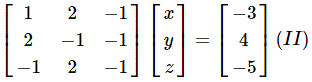
.gif) Intercambie las filas (1) y (3) y reescriba el sistema como
Intercambie las filas (1) y (3) y reescriba el sistema como
 Consideremos ahora la matriz identidad

Intercambiamos la fila (1) y (3) en  para obtener la matriz elemental
  dada por
 y multiplicamos ambos lados del sistema (I) por de la siguiente manera

Multiplique las matrices, usando la asociatividad en el lado izquierdo, y simplifique para obtener

que es el sistema de ecuaciones (II) obtenido anteriormente al intercambiar las filas (1) y (3) en el sistema (I).
Conclusión : Intercambiar las filas (1) y (3) es equivalente a multiplicar (por la izquierda) los dos lados del sistema por la matriz elemental
obtenida de la matriz identidad .
Consideremos ahora el sistema de ecuaciones (II) y multipliquemos la fila (3) por 2 para obtener
\( \)\( \) \( \)
\[ \begin{bmatrix} 1 & 2 & -1 \\ 2 & -1 & -1 \\ -2 & 4 & - 2 \end{bmatrix}
\begin{bmatrix} x \\ y \\ z \end{bmatrix} = \begin{bmatrix} -3 \\ 4 \\ -10 \end{bmatrix} (III) \]
Tome \( I_3 \) multiplique su tercera fila por 2 para obtener la matriz elemental \( E_2 = \begin{bmatrix} 1 & 0 & 0 \\ 0 & 1 & 0 \\ 0 & 0 & 2 \end{bmatrix} \) y multiplique ambos lados del sistema (II) por \( E_2 \) de la siguiente manera:
\[ \begin{bmatrix} 1 & 0 & 0 \\ 0 & 1 & 0 \\ 0 & 0 & 2 \end{bmatrix} \begin{bmatrix} 1 & 2 & -1 \\ 2 & -1 & -1 \\ -1 & 2 & - 1 \end{bmatrix}
\begin{bmatrix} x \\ y \\ z \end{bmatrix} = \begin{bmatrix} 1 & 0 & 0 \\ 0 & 1 & 0 \\ 0 & 0 & 2 \end{bmatrix} \begin{bmatrix} -3 \\ 4 \\ -5 \end{bmatrix} \]
Use la asociatividad, multiplique y simplifique lo anterior para obtener
\[ \begin{bmatrix} 1 & 2 & -1 \\ 2 & -1 & -1 \\ -2 & 4 & - 2 \end{bmatrix}
\begin{bmatrix} x \\ y \\ z \end{bmatrix} = \begin{bmatrix} -3 \\ 4 \\ -10 \end{bmatrix} \]
que es exactamente el sistema de ecuaciones (III).
Conclusión: Multiplicar la fila (3) por 2 es equivalente a multiplicar los dos lados del sistema por la matriz elemental \( E_2 = \begin{bmatrix} 1 & 0 & 0 \\ 0 & 1 & 0 \\ 0 & 0 & 2 \end{bmatrix}\) obtenida de la matriz identidad \( I_3 \).
Consideremos ahora el sistema de ecuaciones (III), multiplique la fila (1) por - 2 y súmela a la fila (2) para obtener:
\[ \begin{bmatrix} 1 & 2 & -1 \\ 0 & - 5 & 1 \\ -2 & 4 & - 2 \end{bmatrix}
\begin{bmatrix} x \\ y \\ z \end{bmatrix} = \begin{bmatrix} -3 \\ 10 \\ -10 \end{bmatrix} (IV) \]
Tome \( I_3 \) multiplique su fila (1) por - 2 y súmela a la fila (2) para obtener \( E_3 = \begin{bmatrix} 1 & 0 & 0 \\ -2 & 1 & 0 \\ 0 & 0 & 1 \end{bmatrix} \) y multiplique ambos lados del sistema (III) por \( E_3 \) de la siguiente manera:
\[ \begin{bmatrix} 1 & 0 & 0 \\ -2 & 1 & 0 \\ 0 & 0 & 1 \end{bmatrix} \begin{bmatrix} 1 & 2 & -1 \\ 2 & -1 & -1 \\ -2 & 4 & - 2 \end{bmatrix}
\begin{bmatrix} x \\ y \\ z \end{bmatrix} = \begin{bmatrix} 1 & 0 & 0 \\ -2 & 1 & 0 \\ 0 & 0 & 1 \end{bmatrix} \begin{bmatrix} -3 \\ 4 \\ -10 \end{bmatrix} \]
Use la asociatividad, multiplique y simplifique lo anterior para obtener
\[ \begin{bmatrix} 1 & 2 & -1 \\ 0 & - 5 & 1 \\ -2 & 4 & - 2 \end{bmatrix}
\begin{bmatrix} x \\ y \\ z \end{bmatrix} = \begin{bmatrix} -3 \\ 10 \\ -10 \end{bmatrix} \]
que es exactamente el sistema de ecuaciones (IV).
Conclusión: Sumar la fila (1) multiplicada por - 2 a la fila (2) es equivalente a multiplicar los dos lados del sistema por la matriz elemental \( E_3 = \begin{bmatrix} 1 & 0 & 0 \\ -2 & 1 & 0 \\ 0 & 0 & 1 \end{bmatrix}\) obtenida de la matriz identidad \( I_3 \).
Una de las ventajas de usar matrices elementales es que su inversa se puede obtener sin cálculos pesados.
Inversa de la Matriz Elemental E1
En los ejemplos anteriores, obtuvimos la matriz elemental \( E_1 \) al intercambiar las filas (1) y (3), la inversa de \( E_1 \) se obtiene de I3 al intercambiar las filas (3) y (1); por lo tanto, la inversa de \( E_1 \) está dada por
\[ E_1^{-1} = \begin{bmatrix} 0 & 0 & 1 \\ 0 & 1 & 0 \\ 1 & 0 & 0 \end{bmatrix} \]
Ahora comprobamos que
\( E_1 \cdot E_1^{-1} = E_1^{-1} \cdot E_1^ = I_3 \)
\[ E_1 \cdot E_1^{-1} = \begin{bmatrix} 0 & 0 & 1 \\ 0 & 1 & 0 \\ 1 & 0 & 0 \end{bmatrix} \cdot \begin{bmatrix} 0 & 0 & 1 \\ 0 & 1 & 0 \\ 1 & 0 & 0 \end{bmatrix} = \begin{bmatrix} 1 & 0 & 0 \\ 0 & 1 & 0 \\ 0 & 0 & 1 \end{bmatrix}\]
No hay necesidad de comprobar que \( E_1^{-1} \cdot E_1^ = I_3 \) porque \( E_1 = E_1^{-1} \).
Inversa de la Matriz Elemental E2
En los ejemplos anteriores, obtuvimos la matriz elemental \( E_2 \) al multiplicar la fila (3) por 2, la inversa de \( E_2 \) se obtiene de I3 al dividir la fila (3) por 2; por lo tanto, la inversa de \( E_2 \) está dada por
\[ E_2^{-1} = \begin{bmatrix} 1 & 0 & 0 \\ 0 & 1 & 0 \\ 0 & 0 & 1/2 \end{bmatrix} \]
Ahora comprobamos que
\( E_2 \cdot E_2^{-1} = E_2^{-1} \cdot E_2^ = I_3 \)
\[ E_2 \cdot E_2^{-1} = \begin{bmatrix} 1 & 0 & 0 \\ 0 & 1 & 0 \\ 0 & 0 & 2 \end{bmatrix} \cdot \begin{bmatrix} 1 & 0 & 0 \\ 0 & 1 & 0 \\ 0 & 0 & 1/2 \end{bmatrix} = \begin{bmatrix} 1 & 0 & 0 \\ 0 & 1 & 0 \\ 0 & 0 & 1 \end{bmatrix}\]
\[ E_2^{-1} \cdot E_2^ = \begin{bmatrix} 1 & 0 & 0 \\ 0 & 1 & 0 \\ 0 & 0 & 1/2 \end{bmatrix} \cdot \begin{bmatrix} 1 & 0 & 0 \\ 0 & 1 & 0 \\ 0 & 0 & 2 \end{bmatrix} = \begin{bmatrix} 1 & 0 & 0 \\ 0 & 1 & 0 \\ 0 & 0 & 1 \end{bmatrix}\]
Inversa de la Matriz Elemental E3
En los ejemplos anteriores, obtuvimos la matriz elemental \( E_3 \) al multiplicar la fila (1) por - 2 y sumarla a la fila (2). La inversa de \( E_3 \) se obtiene de I3 al multiplicar la fila (1) por - 2 y restarla de la fila (2); por lo tanto, la inversa de \( E_3 \) está dada por
\[ E_3^{-1} = \begin{bmatrix} 1 & 0 & 0 \\ 2 & 1 & 0 \\ 0 & 0 & 1 \end{bmatrix} \]
Ahora comprobamos que
\( E_3 \cdot E_3^{-1} = E_3^{-1} \cdot E_3^ = I_3 \)
\[ E_3 \cdot E_3^{-1} = \begin{bmatrix} 1 & 0 & 0 \\ -2 & 1 & 0 \\ 0 & 0 & 1 \end{bmatrix} \cdot \begin{bmatrix} 1 & 0 & 0 \\ 2 & 1 & 0 \\ 0 & 0 & 1 \end{bmatrix} = \begin{bmatrix} 1 & 0 & 0 \\ 0 & 1 & 0 \\ 0 & 0 & 1 \end{bmatrix}\]
\[ E_3^{-1} \cdot E_3^ = \begin{bmatrix} 1 & 0 & 0 \\ 2 & 1 & 0 \\ 0 & 0 & 1 \end{bmatrix} \cdot \begin{bmatrix} 1 & 0 & 0 \\ -2 & 1 & 0 \\ 0 & 0 & 1 \end{bmatrix} = \begin{bmatrix} 1 & 0 & 0 \\ 0 & 1 & 0 \\ 0 & 0 & 1 \end{bmatrix}\]