Cambio de Base - Ejemplos con Soluciones
Matrices de Cambio de Coordenadas
Dadas dos bases
 para un espacio vectorial V , la matriz de cambio de coordenadas de la base B a la base A se define como [1]
 donde
donde
 son los vectores columna que expresan las coordenadas de los vectores
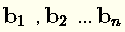 con respecto a la base A .
De manera similar
 se define por
 Se puede demostrar que

Aplicaciones de las Matrices de Cambio de Coordenadas
Si A y B son bases para un espacio vectorial V y x es un vector en V , entonces [1]

donde
 se definen arriba.
Ejemplos con Soluciones
Ejemplo 1
\( \) \( \) \( \) \( \)
Dadas las bases \( A = \left\{
\begin{bmatrix}
1 \\
2 \\
\end{bmatrix}
,
\begin{bmatrix}
-2 \\
-3 \\
\end{bmatrix}
\right\}
\)
y
\( B = \left\{
\begin{bmatrix}
2 \\
1 \\
\end{bmatrix}
,
\begin{bmatrix}
1 \\
3 \\
\end{bmatrix}
\right\}
\)
para un espacio vectorial \( V \),
a) encontrar la matriz \( P_{A \leftarrow B} \)
b) encontrar la matriz \( P_{B \leftarrow A} \)
c) mostrar que las matrices \( P_{A \leftarrow B} \) y \( P_{B \leftarrow A} \) son inversas entre sí.
Solución al Ejemplo 1
Sea \( A = \left\{
\begin{bmatrix}
1 \\
2 \\
\end{bmatrix}
,
\begin{bmatrix}
-2 \\
-3 \\
\end{bmatrix}
\right\}
= \{ a_1 , a_2 \}
\)
y
\( B = \left\{
\begin{bmatrix}
2 \\
1 \\
\end{bmatrix}
,
\begin{bmatrix}
1 \\
3 \\
\end{bmatrix}
\right\}
= \{ b_1 , b_2 \}
\)
a)
\( P_{A \leftarrow B} = \left[ \;\; [ \textbf{b}_1]_A \;\; [\textbf{b}_2]_A \;\; \right] \)
Sean \( k_1 \), \( k_2 \), \( k'_1 \), \( k'_2 \) constantes tales que
\( b_1 = k_1 a_1 + k_2 a_2 \) y \( b_2 = k'_1 a_1 + k'_2 a_2 \) (I)
Por lo tanto
\( [ \textbf{b}_1]_A = \begin{bmatrix} k_1 \\ k_2 \\ \end{bmatrix} \) y \( [ \textbf{b}_2]_A = \begin{bmatrix} k'_1 \\ k'_2 \\ \end{bmatrix} \)
Ahora necesitamos encontrar \( k_1 \), \( k_2 \), \( k'_1 \), \( k'_2 \) resolviendo las ecuaciones en (I) arriba, que en forma matricial se escriben como
\( [ a_1 \quad a_2 ] \begin{bmatrix} k_1 & k'_1\\ k_2 & k'_2\\ \end{bmatrix} = [b_1 \quad b_2] \)
La matriz aumentada de lo anterior es
\( \begin{bmatrix} 1 & -2 \; | \; 2 & 1\\ 2 & -3 \; | \; 1 & 3\\ \end{bmatrix} \)
Reducir por filas lo anterior a
\( \begin{bmatrix} 1 & 0 \; | \; -4 & 3\\ 0 & 1 \; | \; -3 & 1\\ \end{bmatrix} \) (II)
Por lo tanto
\( P_{A \leftarrow B} = \begin{bmatrix} k_1 & k'_1\\ k_2 & k'_2\\ \end{bmatrix} = \begin{bmatrix} -4 & 3\\ -3 & 1\\ \end{bmatrix} \)
Nota que omitiendo los detalles anteriores, para encontrar la matriz de cambio de coordenadas \( P_{A \leftarrow B} \), se reduce por filas la matriz
\( [ A \; | \; B ] \), formada por las columnas de la base \( A \) y las columnas de la base \( B \), a la forma \( [ I \; | \; P_{A \leftarrow B} ] \) donde \( I \) es la matriz identidad como se muestra arriba en (II).
b)
De manera similar a lo anterior, pero omitiendo los detalles, encontramos la matriz de cambio de coordenadas \( P_{B \leftarrow A} \) en dos pasos:
1) formar la matriz \( [ B \; | \; A ] \) usando las columnas de la base \( B \) y las columnas de la base \( A \) de la siguiente manera
\( \begin{bmatrix} 2 & 1 \; | \; 1 & -2 \\ 1 & 3 \; | \; 2 & -3 \\ \end{bmatrix} \)
2) reducir por filas lo anterior para obtener
\( \begin{bmatrix} 1 & 0 \; | \; \dfrac{1}{5} & -\dfrac{3}{5}\\ 0 & 1 \; | \; \dfrac{3}{5} & -\dfrac{4}{5}\\ \end{bmatrix} \)
Habiendo reducido por filas la matriz \( [ B \; | \; A ] \) a la forma \( [ I \; | \; P_{B \leftarrow A} ] \), podemos escribir
\( P_{B \leftarrow A} = \begin{bmatrix} \dfrac{1}{5} & -\dfrac{3}{5}\\ \dfrac{3}{5} & -\dfrac{4}{5}\\ \end{bmatrix} \)
c)
Para mostrar que \( P_{A \leftarrow B} \) y \( P_{B \leftarrow A} \) son inversas entre sí, necesitamos mostrar que sus productos son iguales a la matriz identidad.
\( P_{A \leftarrow B} \times P_{B \leftarrow A} = \begin{bmatrix} -4 & 3\\ -3 & 1\\ \end{bmatrix} \times \begin{bmatrix} \dfrac{1}{5} & -\dfrac{3}{5}\\ \dfrac{3}{5} & -\dfrac{4}{5}\\ \end{bmatrix} = \begin{bmatrix} 1 & 0\\ 0 & 1\\ \end{bmatrix} \)
y
\( P_{B \leftarrow A} \times P_{A \leftarrow B} = \begin{bmatrix} \dfrac{1}{5} & -\dfrac{3}{5}\\ \dfrac{3}{5} & -\dfrac{4}{5}\\ \end{bmatrix} \times \begin{bmatrix} -4 & 3\\ -3 & 1\\ \end{bmatrix} = \begin{bmatrix} 1 & 0\\ 0 & 1\\ \end{bmatrix} \)
Ejemplo 2
Dadas las bases \( A = \left\{
\begin{bmatrix}
1 \\
1 \\
0 \\
0
\end{bmatrix}
,
\begin{bmatrix}
1 \\
0\\
2\\
-1
\end{bmatrix}
,
\begin{bmatrix}
1 \\
-1\\
-1\\
2
\end{bmatrix}
\right \}
\)
y
\( B = \left\{
\begin{bmatrix}
2 \\
0 \\
-1 \\
2
\end{bmatrix}
,
\begin{bmatrix}
0 \\
1 \\
3 \\
-3
\end{bmatrix}
,
\begin{bmatrix}
3 \\
1 \\
4 \\
-2
\end{bmatrix}
\right \}
\)
para un espacio vectorial \( V \) y el vector \( x = \begin{bmatrix} 5 \\ 2 \\ 6 \\ -3 \end{bmatrix} \) en \( V \).
a) Encontrar la matriz \( P_{A \leftarrow B} \)
b) Encontrar la matriz \( P_{B \leftarrow A} \)
c) Mostrar que las matrices \( P_{A \leftarrow B} \) y \( P_{B \leftarrow A} \) son inversas entre sí.
d) Encontrar \( [x]_A \) y \( [x]_B \) directamente usando la definición de coordenadas.
e) Verificar las fórmulas \( [x]_A = P_{A \leftarrow B} [x]_B \) y \( [x]_B = P_{B \leftarrow A} [x]_A \) dadas arriba.
Solución al Ejemplo 2
a)
\( P_{A \leftarrow B} \) se encuentra reduciendo por filas la matriz aumentada (ver ejemplo 1 arriba)
\( \begin{bmatrix} 1 & 1 & 1 &|& 2 & 0 & 3\\ 1 & 0 & -1 &|& 0 & 1 & 1 \\ 0 & 2 & -1 &|& -1 & 3 & 4\\ 0 & -1 & 2 &|& 2 & -3 & -2 \end{bmatrix} \)
Reducir por filas a
\( \begin{bmatrix} 1 & 0 & 0 &|& 1 & 0 & 1\\ 0 & 1 & 0 &|& 0 & 1 & 2 \\ 0 & 0 & 1 &|& 1 & -1 & 0\\ 0 & 0 & 0 &|& 0 & 0 & 0 \end{bmatrix} \)
Por lo tanto
\( P_{A \leftarrow B} = \begin{bmatrix} 1 & 0 & 1\\ 0 & 1 & 2 \\ 1 & -1 & 0\\ \end{bmatrix} \)
b)
\( P_{B \leftarrow A} \) se encuentra reduciendo por filas la matriz aumentada (ver ejemplo 1 arriba)
\( \begin{bmatrix} 2 & 0 & 3 &|& 1 & 1 & 1\\ 0 & 1 & 1 &|& 1 & 0 & -1 \\ -1 & 3 & 4 &|& 0 & 2 & -1 \\ 2 & -3 & -2 &|& 0 & -1 & 2 \end{bmatrix} \)
Reducir por filas a
\( \begin{bmatrix} 1 & 0 & 0 &|& 2 & -1 & -1\\ 0 & 1 & 0 &|& 2 & -1 & -2 \\ 0 & 0 & 1 &|& -1 & 1 & 1\\ 0 & 0 & 0 &|& 0 & 0 & 0 \end{bmatrix} \)
Por lo tanto
\( P_{B \leftarrow A} = \begin{bmatrix} 2 & -1 & -1\\ 2 & -1 & -2 \\ -1 & 1 & 1 \end{bmatrix} \)
c)
Es suficiente mostrar que su producto de \( P_{A \leftarrow B} \) y \( P_{B \leftarrow A} \) da la matriz identidad.
\( \begin{bmatrix} 1 & 0 & 1\\ 0 & 1 & 2 \\ 1 & -1 & 0\\ \end{bmatrix} \times \begin{bmatrix} 2 & -1 & -1\\ 2 & -1 & -2 \\ -1 & 1 & 1 \end{bmatrix} = \begin{bmatrix} 2 & -1 & -1\\ 2 & -1 & -2 \\ -1 & 1 & 1 \end{bmatrix} \times \begin{bmatrix} 1 & 0 & 1\\ 0 & 1 & 2 \\ 1 & -1 & 0\\ \end{bmatrix} = \begin{bmatrix} 1 & 0 & 0\\ 0 & 1 & 0 \\ 0 & 0 & 1\\ \end{bmatrix} \)
d)
Para encontrar las coordenadas de \( x \) en la base \( A \) escritas como \( [x]_A \), necesitamos reducir por filas
\( \begin{bmatrix} 1 & 1 & 1 &|& 5\\ 1 & 0 & -1 &|& 2 \\ 0 & 2 & -1 &|& 6 \\ 0 & -1 & 2 &|& -3 \end{bmatrix} \)
Reducir por filas para resolver
\( \begin{bmatrix} 1 & 0 & 0 &|& 2\\ 0 & 1 & 0 &|& 3 \\ 0 & 0 & 1 &|& 0 \\ 0 & 0 & 0 &|& 0 \end{bmatrix} \)
Por lo tanto
\( [x]_A = \begin{bmatrix} 2\\ 3 \\ 0 \\ \end{bmatrix} \)
Para encontrar las coordenadas de \( x \) en la base \( B \) escritas como \( [x]_B \), necesitamos reducir por filas
\( \begin{bmatrix} 2 & 0 & 3 &|& 5\\ 0 & 1 & 1 &|& 2 \\ -1 & 3 & 4 &|& 6 \\ 2 & -3 & -2&|& -3 \end{bmatrix} \)
Reducir por filas para resolver
\( \begin{bmatrix} 1 & 0 & 0 &|& 1\\ 0 & 1 & 0 &|& 1 \\ 0 & 0 & 1 &|& 1 \\ 0 & 0 & 0 &|& 0 \end{bmatrix} \)
Por lo tanto
\( [x]_B = \begin{bmatrix} 1\\ 1 \\ 1 \\ \end{bmatrix} \)
e)
Calculamos el producto \( P_{A \leftarrow B} \cdot [x]_B \)
\( \begin{bmatrix} 1 & 0 & 1\\ 0 & 1 & 2 \\ 1 & -1 & 0\\ \end{bmatrix} \cdot \begin{bmatrix} 1\\ 1 \\ 1 \\ \end{bmatrix} = \begin{bmatrix} 2\\ 3 \\ 0 \\ \end{bmatrix} \)
y podemos ver que \( P_{A \leftarrow B} \cdot [x]_B = [x]_A \)
Calculamos el producto \( P_{B \leftarrow A} \cdot [x]_A \)
\( \begin{bmatrix} 2 & -1 & -1\\ 2 & -1 & -2 \\ -1 & 1 & 1 \end{bmatrix} \cdot \begin{bmatrix} 2\\ 3 \\ 0 \\ \end{bmatrix} = \begin{bmatrix} 1\\ 1 \\ 1\\ \end{bmatrix} \)
y podemos ver que \( P_{B \leftarrow A} \cdot [x]_A = [x]_B \)
Más Referencias y Enlaces
- Álgebra Lineal - Preguntas con Soluciones
- Álgebra Lineal y sus Aplicaciones - 5ª Edición - David C. Lay, Steven R. Lay, Judi J. McDonald
- Introducción al Álgebra Lineal - Quinta Edición (2016) - Gilbert Strang
- Álgebra Lineal Hecha Correctamente - tercera edición, 2015 - Sheldon Axler
- Álgebra Lineal con Aplicaciones - 2012 - Gareth Williams
- Álgebra Lineal Elemental - 7ª Edición - Howard Anton y Chris Rorres