|
|
|
Factors that might make mathematics difficult to learn and to teach are discussed and examples given. What to do to improve your understanding of mathematics is also discussed.
Unlike most other school and academic subjects, mathematics is a hierarchical subject where learning and understanding of new concepts and skills strongly depends on a deep understanding of mathematical concepts and skills acquired in the past.
"One cannot run before he/she can walk".
For example, a learner will find it extremely difficult to solve an equation of the form 2(x + 3) = 3(x - 4) if he/she:
- does not know what is an equation,
- cannot manipulate (expand, group, ...) algebraic expressions such as 2(x + 3),
- does not know how to use math theorems and properties to isolate the unknown x,
- does not know how to check a solution to an equation.
What if the learner knows all the necessary concepts and skills, does that mean that he/she can solve the above equation without any difficulties? Not necessarily. The learner also need to be self confident.
What to do if you think that skills and concepts are needed to understand a certain topic?
- If possible try to do the follwing before the intended topic is studied.
- Identify all the concepts and the skills that may be needed in the course you are taking and review them thoroughly working on the definitions, theorems, properties and also the skills needed to solve questions and problems related to these skills. Solve as many examples as possible
Example: If the present topic is about rational functions which are defined as the ratio of two polynomial functions, you need to review
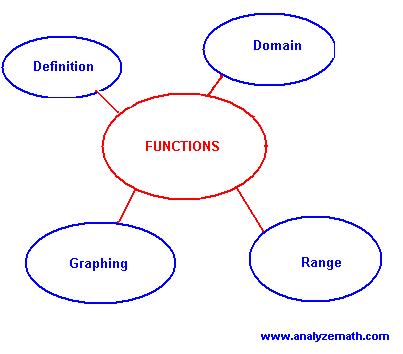
- the concept of functions with domain, range, graph, ...
- polynomial functions with factoring,...

- ratios and rational expressions,...

Try to activate and connect ALL what you know to the concept being studied by constructing new knowledge during the lesson (or lecture) of the intended topic.
|
|