|

Custom Search
|
|
A moving charge q of velocity v in a magnetic field B experiences a force F perpendicular to both v and B and whose magnitude is given by: (v, B and F are vectors).
where θ is the angle between v and B.
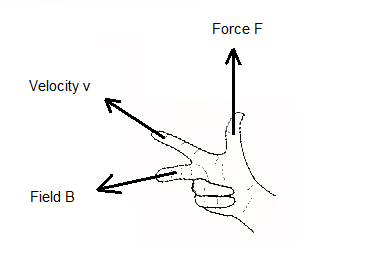
For a positive charge, the direction of the force F is given by the right hand rule as shown below.
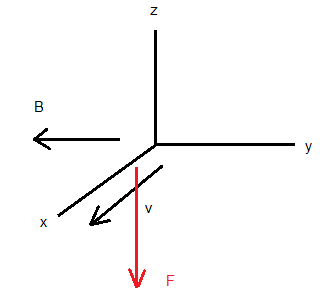
Example 1: In a 3-d (x,y,z) system of axes, a proton moving along the positive x - axis at a velocity of 1.3×10⁵ m/s, enters a magnetic field whose magnitude is 0.22 ×10⁻⁵ Tesla and field lines are directed along the negative y - axis. What is a) the magnitude and b) direction of the force acting on the moving proton?
Solution:
Example 2: An upward force of 2.5×10⁻¹⁰ N acts on an electron while traveling in a magnetic field of 7.5×10⁻³ T directed to the East. a) What is the magnitude and b) direction of the velocity of the electron if it is moving perpendicular to the magnetic field?
Solution:
= 2.1×10¹¹ m/s First use vectors to draw an upward force F and a magnetic field B to the East (given above). 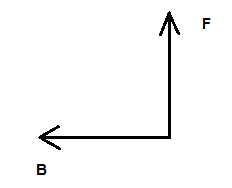
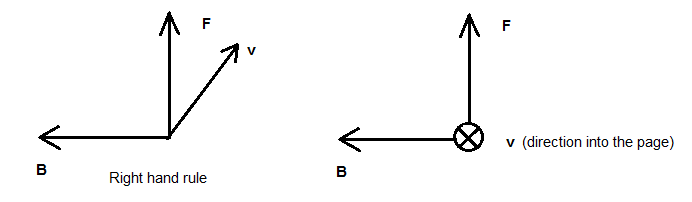
Example 3: The figure below shows that the velocity v of a moving negative charge is directed into the page. A magnetic field B is directed downward. What is the direction of the force F acting on the charge? 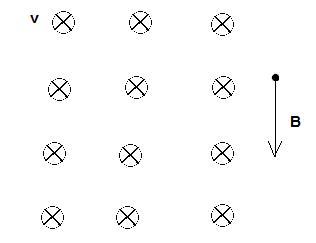
Solution: Draw vectors v (into the page) and B and use the right hand rule and take the opposite direction because the charge is negative as shown in the left side of the figure. On the right, the convention that a vector into the page is represented by a cross is used. 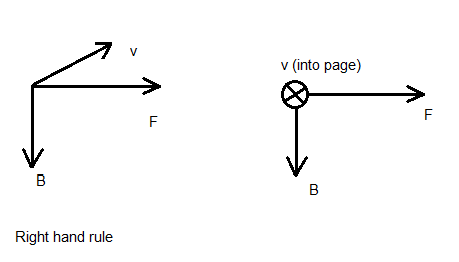
Example 4: What is the direction of the force acting on a negative charge moving downward in a magnetic field directed into the page as shown in the figure below? 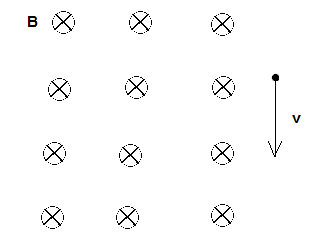
Solution: Draw vectors v and B (into the page) then use the right hand rule. Because the charge is negative take the opposite direction given by the rule as shown below. On the right, the convention that a vector into the page is represented by a cross is used. 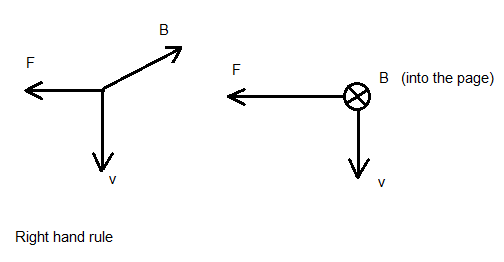
Example 5: What is the direction of the force acting on a positive charge moving out of the page in a magnetic field directed to the West as shown in the figure below? 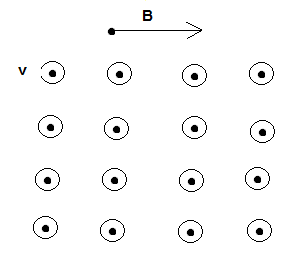
Solution: Draw vectors v (out of the page as shown in the given figure) and B then use the right hand rule as shown below. On the right, the convention that a vector out of the page is represented by a dot is used. 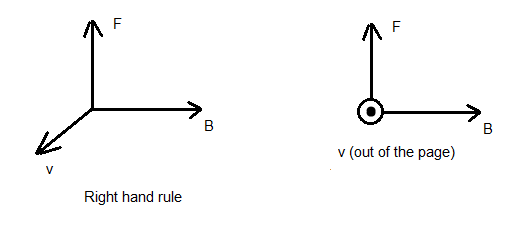
Example 6: A force acting on a positive charge is directed out of the page and the magnetic field is directed to the West. Find the direction of motion of the charge if it is moving perpendicular to the magnetic field. 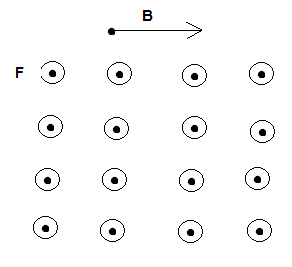
Solution: In this example we are given the force F. Draw vectors F (out of the page as shown in the given figure) and B. v can either be up or down since it is perpendicular to both F and B. Since F is given, use the right hand rule twice for each of the possible directions of v (up and down), and the right answer is the the one that agrees with the right hand rule as shown below. 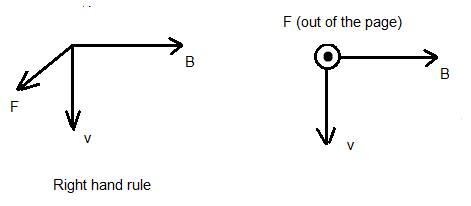
|