|
Consider a projectile being launched at an initial velocity v0 in a direction making an angle θ with the horizontal. We assume that air resistance is negligible and the only force acting on the object is the force of gravity with acceleration g = 9.8 m/s2. Also an interactive html 5 applet may be used to better understand the projectile equations. projectile problems with solutions are also included in this site.
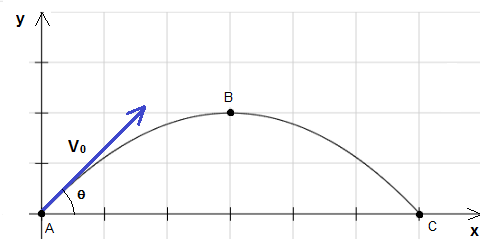
The initial velocity V0 being a vector quantity, has two components:
V0x and V0y given by
V0x = V0 cos(θ)
V0y = V0 sin(θ)
The acceleration A is a also a vector with two components Ax and Ay given by
Ax = 0 and Ay = - g = - 9.8 m/s2
Along the x axis the acceleration is equal to 0 and therefore the velocity Vxis constant and is given by
Vx = V0 cos(θ)
Along the y axis, the acceleration is uniform and equal to -g and the velocity at time t is given by
Vy = V0 sin(θ) - g t
Along the x axis the velocity Vxis constant and therefore the component x of the displacement is given by
x = V0 cos(θ) t
Along the y axis, the motion is that of a uniform acceleration type and the y component of the displacement is given by
y = V0 sin(θ) t - (1/2) g t2
The shape of the trajectory followed by the projectile is found as follows
Solve the formula x = V0 cos(θ) t for t to obtain
Substitute t by x / V0 cos(θ) in the expression of y obtained above
Simplify
The above equation is that of a parabola of the form
y = A x2 + B x
Path of Projectile: y = A x2 + B x
Time of flight of the projectile
The time of flight is the time taken for the projectile to go from point
A to point C (see figure above). It is calculated by setting y = 0 (y = 0 at point C) and solve for t
y = V0 sin(θ) t - (1/2) g t2 = 0
t(V0 sin(θ) t - (1/2) g) = 0
Two solutions: t = 0 (correspond to point A) and t = 2 V0 sin(θ) / g (correspond to point C)
Hence the time of flight = 2 V0 sin(θ) / g
Time of Flight = 2 V0 sin(θ) / g
Maximum height of the projectile (corresponding to point B in figure above)
At point B in the figure above, the projectile is momentarily horizontal and therefore the vertical component of its velocity is equal to zero. Hence
Vy = V0 sin(θ) - g t = 0
Solve for t to obtain
t = V0 sin(θ) / g (Note: this is half the time of flight because of the symmetry of the parabola)
Substitute t by V0 sin(θ) / g in the expression of y, we obtain the maximum height
H = V0 sin(θ) V0 sin(θ) / g - (1/2) g [ V0 sin(θ) / g ]2
|
Maximum Height (at point B) =
|
|
|
Horizontal range of a projectile (distance AC in the figure above)
Distance AC which is the horizontal range is equal to x when t is equal to the time of flight 2 V0 sin(θ) / g obtained above. Hence
range = AC = x(2 V0 sin(θ) / g)
= V0 cos(θ) 2 V0 sin(θ) / g
= V02 sin(2θ) / g
Horizontal Range = V02 sin(2θ) / g
|
