Graphing Linear Functions
Graph a linear function: a step by step tutorial with examples and detailed solutions. Free graph paper is available.
Linear Functions
Any function of the form
\[ f (x) = m x + b, \]
is called a linear function. The
domain of this function is the set of all real numbers. The range of \( f \) is the
set of all real numbers. The graph of \( f \) is a line with slope \( m \) and \( y \) intercept \( b \).
Note: A function \( f (x) = b \), where \( b \) is a constant real number is called a constant function. Its graph is a horizontal line at \( y = b \) and its slope is undefined.
Example 1
Graph the linear function \( f \) given by
\[
f (x) = 2 x + 4
\]
Solution to Example 1
-
You need only two points to graph a linear
function. These points may be chosen as the x and y intercepts of the graph for example.
- Determine the x intercept, set \( f(x) = 0 \) and
solve for \( x \)
\[ 2x + 4 = 0 \]
to find
\[ x = -2 \]
- Determine the y intercept, set \( x = 0 \) to find
\( f(0) \)
\( f(0) = 4 \)
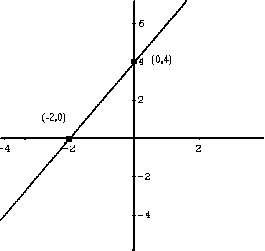
- The graph of the above function is a line passing through
the points (- 2 , 0) and (0 , 4) as shown below.
Matched Problem
Graph the linear function f given by
\[
f (x) = x + 3 \]
Example 2
Graph the linear function f given by
\[
f (x) = - (1 / 3) x - 1 / 2
\]
Solution to Example 2
- Determine the x intercept, set \( f(x) = 0 \) and solve for x.
\[ -(1 / 3) x - 1 / 2 = 0 \]
to find
\[ x = - 3 / 2 \]
- Determine the y intercept, set \( x = 0 \) to find
\[ f(0) = - \dfrac{1}{2} \].
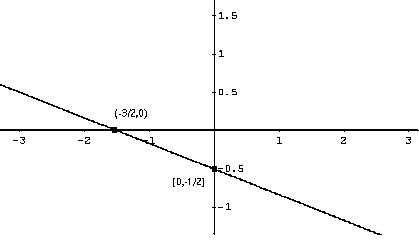
-
The graph of the above function is a line passing through the points \( (-3 / 2 , 0) \) and \( (0 , -1 / 2) \) as shown below.
Matched Problem 2
Graph the linear function f given by
\[
f (x) = - x / 5 + 1 / 3
\]
More References and Links to Graphing and Graphs of Functions