A collection of challenging AP Calculus AB questions similar to those on the actual exam. Detailed solutions and explanations are available. Answers are provided at the bottom of the page.
-
\[ \lim_{h \to 0} \frac{e^{4} e^{h} - e^{4}}{h} = \]
A) \(e\)
B) \(1\)
C) \(e^h\)
D) \(e^4\)
E) \(4^e\) -
The function \(g\) defined by \[ g(x) = \frac{x^{3} + 2x^{2} - 3x}{x^{2} + 2x - 3} \] has vertical asymptotes at:
A) \(x = 1, -3\)
B) \(x = 0\)
C) \(x = 1\)
D) \(x = -3\)
E) Function \(g\) has no vertical asymptotes -
Given \[ \lim_{x \to 0} \frac{\sin x}{x} = 1 \] find \[ \lim_{x \to 0} \frac{x + 4x^{2} + \sin x}{3x} \]
A) \(\frac{2}{3}\)
B) \(\frac{4}{3}\)
C) \(\frac{1}{3}\)
D) \(2\)
E) Does not exist -
Function \(f\) is defined by \[ f(x) = 2x^{3}\sin(x) + \frac{1}{x}\tan(x) + x\sec(x) + 2 \] find \(f'(x)\).
A) \(6x^2 \sin(x) - \frac{1}{x^2}\tan(x) + \sec(x)\)
B) \(6x^2 \sin(x) + 2x^3 \cos(x) - \frac{1}{x^2}\tan(x) + \frac{1}{x} \sec^2(x) + \sec(x) + x \sin(x) \sec^2(x)\)
C) \(2x^3 \cos(x) + \frac{1}{x} \sec^2(x) + x \sin(x) \sec^2(x)\)
D) \(6x^2 \cos(x) - \frac{1}{x^2} \sec^2(x) + \sec^2(x)\)
E) \(6x^2 \sin(x) + 2x^3 \cos(x) - \frac{1}{x^2}\tan(x) + \frac{1}{x} \sec^2(x) + \sec(x) + x \sin(x) \sec^2(x) + 2\) -
Curve \(C\) is described by \(0.25x^2 + y^2 = 9\). Determine the \(y\)-coordinates where the tangent line has slope \(1\).
A) \(-\frac{3\sqrt{5}}{5}, \frac{3\sqrt{5}}{5}\)
B) \(-\frac{\sqrt{35}}{2}, \frac{\sqrt{35}}{2}\)
C) \(-3, 3\)
D) \(-\frac{\sqrt{2}}{2}, \frac{\sqrt{2}}{2}\)
E) \(-3\sqrt{2}, 3\sqrt{2}\) -
Solve the differential equation \(\frac{dy}{dx} = \frac{\cos x}{y^2}\) with \(y(\pi/2) = 0\).
A) \(y = 3 \sin x - 3\)
B) \(y = \sin x - 1\)
C) \(y = \sqrt[3]{3 \sin x - 3}\)
D) \(y = (3 \sin x - 3)^3\)
E) \(y = \frac{1}{\sqrt[3]{3 \sin x - 3}}\) -
\[ \int \sin^4 x \cos x \, dx = \]
A) \(\cos^5 x + C\)
B) \(-\frac{1}{5}\sin^5 x + C\)
C) \(\sin^5 x + C\)
D) \(-\frac{1}{5}\cos^5 x + C\)
E) \(-5\cos^5 x + C\) -
\[ \frac{d}{dx} \int_{3}^{2x} \sin(t^2 + 1) \, dt = \]
A) \(2 \sin(4x^2 + 1)\)
B) \(2 \sin(x^2 + 1)\)
C) \(\sin(x^2 + 1)\)
D) \(2 \sin(4x^2 + 1) - 2 \sin(3^2 + 1)\)
E) \(2 \sin(4x^2)\) -
\[ \int_{0}^{10} \left(|4 - x| + |2 - 2x|\right)dx = \]
A) \(100\)
B) \(108\)
C) \(110\)
D) \(112\)
E) \(114\) -
\[ \int \frac{(5 + x^{3/4})^{9}}{x^{1/4}}dx = \]
A) \((5 + x^{3/4})^{10}\)
B) \((x^{3/4})^{10}\)
C) \(\frac{1}{10}(5 + x^{3/4})^{10}\)
D) \(\frac{1}{10} \frac{(5 + x^{3/4})^{10}}{x^{1/4}}\)
E) \(\frac{2}{15}(5 + x^{3/4})^{10}\) -
Given \[ h(x) = (\arctan(x^3 + 1) + 2x)^4\], find \(h'(x)\).
A) \(\frac{3x^2}{x^6 + 2x^3 + 2} + 2\)
B) \(4(\arctan(x^3 + 1) + 2x)^3 \cdot \left( \frac{3x^2}{x^6 + 2x^3 + 2} \right)\)
C) \(4(\arctan(x^3 + 1) + 2x)^3\)
D) \(4(\arctan(x^3 + 1) + 2x)^3 \cdot \left( \frac{3x^2}{x^6 + 2x^3 + 2} + 2 \right)\)
E) \(\frac{1}{4}(\arctan(x^3 + 1) + 2x)^3\) -
The graph of function \(h\) is shown below. How many zeros does \(h'\) have?
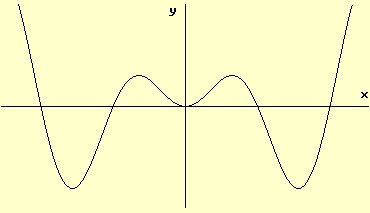
A) \(1\)
B) \(2\)
C) \(3\)
D) \(4\)
E) \(5\) -
The graph of a polynomial \(f\) is shown. If we divide \(f'(x)\) by \(x - b\), the remainder is most likely:

A) \(f(b)\)
B) \(1\)
C) \(0\)
D) \(2\)
E) \(-1\) -
The parametric curve \((\ln(t - 2), 3t)\) for \(t > 2\) represents:
A) \(y = \ln\left(\frac{x}{3} - 2\right)\)
B) \(y = 3x\)
C) \(x = \ln(y - 2)\)
D) \(y = 3(e^x + 2)\)
E) \(y = \ln(x)\) -
Let \(P(x) = 2x^3 + Kx + 1\). Find \(K\) if the remainder when dividing \(P(x)\) by \(x - 2\) is \(10\).
A) \(-\frac{7}{2}\)
B) \(\frac{2}{7}\)
C) \(\frac{7}{2}\)
D) \(-\frac{2}{7}\)
E) \(K\) cannot be determined -
Function \(f\) is defined by: \[ f(x) = \begin{cases} f(x) = \dfrac{\sqrt{4x + 4} - \sqrt{2x + 4}}{2x}, \\\\ f(0) = C \end{cases} \] What value of \(C\) makes \(f\) continuous at \(x = 0\)?
A) \(0\)
B) \(\frac{1}{4}\)
C) \(\frac{1}{8}\)
D) \(1\)
E) Any real number -
Given \(f'(x) = g(x)\) and \(g'(x) = f(x)\), the second derivative of \((f \cdot g)(x)\) is:
A) \(f''(x)g''(x)\)
B) \(g'(x)g(x) + f(x)f'(x)\)
C) \(4g(x)f(x)\)
D) \(2g(x)f(x)\)
E) \(g(x)f(x)\) -
The average rate of change of \(f(x) = \sin x + x\) on \([0, \pi]\) is:
A) \(0\)
B) \(2\pi\)
C) \(\pi\)
D) \(2\)
E) \(1\) -
Find the area of the shaded region between \(y = \sin x\) and \(y = \frac{1}{2}\):

A) \(1\)
B) \(0.5\)
C) \(2 + \frac{\pi}{3}\)
D) \(2 + \frac{\pi}{3} - \sqrt{3}\)
E) \(2 + \frac{\pi}{3} + \sqrt{3}\) -
Given \(g(x) = f(x^2)\), \(f(x) = h(x^3 + 1)\), and \(h'(x) = 2x + 1\), find \(g'(x)\).
A) \(2x^3\)
B) \(12x^9 + 18x^3\)
C) \(2x^{11} + 3x^5\)
D) \(2x^9 + 3x^3\)
E) \(12x^{11} + 18x^5\)
Answer Key
- D
- E
- A
- B
- A
- C
- D
- A
- B
- E
- B
- E
- C
- D
- A
- B
- C
- E
- D
- E
For detailed step-by-step solutions, visit the solutions page.