
Numerical and graphical approaches are used to introduce to the concept of limits using examples.

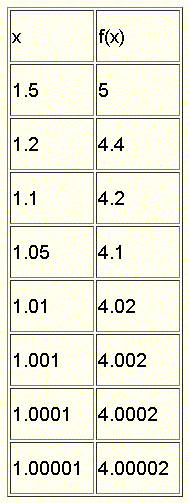
Let \( g(x) = \dfrac{\sin x}{x} \) and compute \( g(x) \) as \( x \) takes values closer to 0. We consider values of \( x \) approaching 0 from the left (\( x \lt 0 \)) and values of \( x \) approaching 0 from the right (\( x > 0 \)).

Here we say that \( \lim_{{x \to 0}} g(x) = 1 \). Note that \( g(0) = \dfrac{\sin 0}{0} = \dfrac{0}{0} \) is undefined at \( x = 0 \).
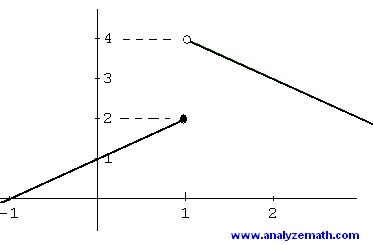
The graph below shows that as \( x \) approaches 1 from the left, \( y = f(x) \) approaches 2 and this can be written as \[ \lim_{{x \to 1^-}} f(x) = 2 \] As \( x \) approaches 1 from the right, \( y = f(x) \) approaches 4 and this can be written as \[ \lim_{{x \to 1^+}} f(x) = 4 \] Note that the left and right hand limits and \( f(1) = 3 \) are all different.
This graph shows that
\[ \lim_{{x \to 1^-}} f(x) = 2 \]
As \( x \) approaches 1 from the right, \( y = f(x) \) approaches 4 and this can be written as
\[ \lim_{{x \to 1^+}} f(x) = 4 \]
Note that the left hand limit \( \lim_{{x \to 1^-}} f(x) = 2 \) and \( f(1) = 2 \) are equal.
This graph shows that \[ \lim_{{x \to 0^-}} f(x) = 1 \] and \[ \lim_{{x \to 0^+}} f(x) = 1 \] Note that the left and right hand limits are equal and we can write \[ \lim_{{x \to 0}} f(x) = 1 \] In this example, the limit when \( x \) approaches 0 is equal to \( f(0) = 1 \).

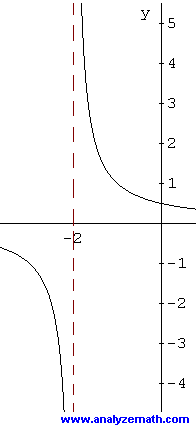
This graph shows that as \( x \) approaches -2 from the left, \( f(x) \) gets smaller and smaller without bound and there is no limit. We write
\[ \lim_{{x \to -2^-}} f(x) = -\infty \]
As \( x \) approaches \( -2 \) from the right, \( f(x) \) gets larger and larger without bound and there is no limit. We write
\[ \lim_{{x \to -2^+}} f(x) = +\infty \]
Note that \( -\infty \) and \( +\infty \) are symbols and not numbers. These are symbols used to indicate that the limit does not exist.

If \( x \) is allowed to increase without bound, \( f(x) \) in the graph below approaches 2. This can be written \[ \lim_{{x \to +\infty}} f(x) = 2 \] If \( x \) is allowed to decrease without bound, \( f(x) \) approaches 2. This can be written \[ \lim_{{x \to -\infty}} f(x) = 2 \]
