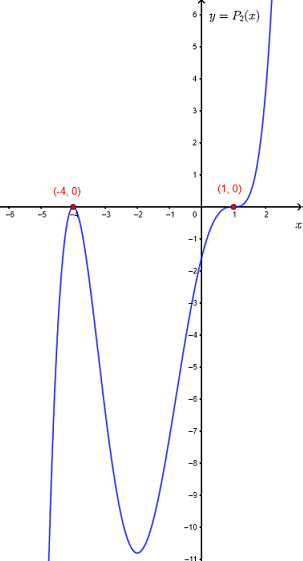
Let \(P(x)\) be a polynomial. The zeros are all values of \(x\) for which \(P(x) = 0\). The real zeros correspond to the \(x\)-intercepts of the graph, where the polynomial either crosses or touches the \(x\)-axis.
Example 1
Find the zeros of \(P(x) = 5 (x - 1)(x - 2)\).
Solution:
Solve \(5(x-1)(x-2) = 0\).
The factors give:
\[
x - 1 = 0 \quad \text{or} \quad x - 2 = 0
\]
Hence, the zeros are:
\[
x = 1, \quad x = 2
\]
2. Multiplicity of Zeros
If a polynomial is factored as
\[
P(x) = (x - x_1)^{m_1} (x - x_2)^{m_2} \dots (x - x_n)^{m_n},
\]
then the zero \(x=x_i\) has multiplicity \(m_i\). Multiplicity indicates how many times a zero occurs in the factorization. The total number of zeros (including complex) equals the degree of the polynomial, so the number of real zeros is at most equal to the degree.
Example 2
Find the zeros and their multiplicities of
\[
P(x) = -2 (x+1)^3 (x-3) (2x+7)^2.
\]