Algebra 2 Problems with Detailed Solutions
Review and gain a deep understanding of Algebra 2 topics. This set of problems serves as a self-test to diagnose your background in pre-university mathematics.
1. Complex Numbers
Problem 1-1
Let \(z = 2 - 3 i \) where \( i \) is the imaginary unit. Evaluate \( z z^* \) where \( z^* \) is the conjugate of \( z \), and write the answer in standard form.
View Solution
The conjugate of z is given by \[ z^* = 2 + 3 i \]
Hence \[ z z^* = (2 - 3i)(2 + 3i) = 4 + 9 = 13 \]
Problem 1-2
Evaluate and write in standard form \( \dfrac{1-i}{2-i} \) , where \( i \) is the imaginary unit.
View Solution
Multiply numerator and denominator by the conjugate of the denominator \(2 + i\)
\[ \dfrac{1-i}{2-i} = \dfrac{(1-i)(2 + i)}{(2-i)(2 + i)}\]
Simplify: \[ = 3 / 5 - (1 / 5) i \]
2. Quadratic Equations
Problem 2-1
Find all solutions of the equation \( x(x + 3) = - 5 \).
View Solution
Expand and write the equation in standard form: \[ x^2 + 3x + 5 = 0\]
Find the discriminant \( \Delta \) \[ \Delta = b^2 - 4 a c = (3)^2 - 4(1)(5) = -11\]
The discriminat is negative and therefore the equation has two complex solutions given by the quadratic formulas.
\[ x_1 = \dfrac{-b+\sqrt\Delta}{2 a} = \dfrac{-3+i\sqrt{11}}{2} = -\dfrac{3}{2} + \dfrac{\sqrt{11}}{2} i \]
\[ x_2 = \dfrac{-b-\sqrt\Delta}{2 a} = \dfrac{-3-i\sqrt{11}}{2} = -\dfrac{3}{2} - \dfrac{\sqrt{11}}{2} i \]
Problem 2-2
Find all values of the parameter \( m \) for which the equation \( -2 x^2 + m x = 2 m \) has complex solutions.
View Solution
Write the given quadratic equation in standard form and find the discriminant.
\[ -2 x^2 + m x - 2 m =0\]
\[ \Delta = b^2 - 4 a c = m^2 - 4(-2)(-2m) = m^2 - 16 m \]
For a qudratic equation to have two complex solutions, its discriminat must be negative. We therefore need top solve the inequatlity \( \Delta \lt 0\)
\[ m^2 - 16 m \lt 0 \]
The above inequality has the solution set given by the interval \[ (0 , 16) \]
3. Functions
Problem 3-1
Let \( f(x) = - x^2 + 3(x - 1) \). Evaluate and simplify \( f(a-1)\).
View Solution
To evaluate \( f(a-1)\) we substitute \( x \) by \( a - 1 \) in \( f(x) \). Hence
\[ f(a-1) = - (a-1)^2 + 3((a-1) - 1) \]
Expand and simplify \[ f(a-1) = -a^2+5a-7 \].
Problem 3-2
Write, in interval notation, the domain of function \(f\) given by \(f(x) = \sqrt{x^2-16} \).
View Solution
The domain of function f is the set of all real numbers so that f(x) has real values. For a square root to be real, the radicand must be non negative. Hence the need to solve the inequality
\[ x^2-16 \ge 0 \]
The solution set to the above inequality which is the domain of f is given by \[ (-\infty , -4] \cup [4 , +\infty) \]
Problem 3-3
Find and write, in interval notation, the range of function \(f\) given by \(f(x) = - x^2 - 2x + 6 \).
View Solution
One way to find the range of the given quadratic function is to rewrite it in vertex form by completing the square.
\[ f(x) = - x^2 - 2x + 6 = - (x^2 + 2x) + 6 = -((x + 1)^2 - 1) + 6 = - (x + 1)^2 + 7\]
The graph of the given quadratic function is a parabola opening downward and with vertex at the point (-1,7). Hence the range is given by the interval \[ (-\infty , 7] \]
Problem 3-4
Let \(f(x) = \sqrt{x - 2} \) and \(g(x) = x^2 + 2 \); evaluate \( (f_o g)(a - 1) \) for \( a \lt 1 \).
View Solution
\( (f_o g)(x) \) is the composition of two functions and is given by \[ (f_o g)(x) = f(g(x)) \]
Hence \[ (f_o g)(a - 1) = f(g(a-1)) = f((a-1)^2 + 2) = \sqrt{(a-1)^2 + 2 - 2} = \sqrt{(a-1)^2}= |a-1|\]
Since \( a \lt 1 \) is equivalent to \( a - 1 \lt 0 \) , the final answer can be simplified to \[ (f_o g)(a - 1) = |a-1| = - (a - 1) = - a + 1 \]
Problem 3-5
Which of the following is a one-to-one function?(There may be more than one answer).
a) \(f(x) = - 2 \quad \) b) \(g(x) = \ln(x^2 - 1) \quad \) c) \(h(x) = |x| + 2 \quad \) d) \(j(x) = 1/x + 2 \quad \) e) \(k(x) = \sin(x) + 2 \quad \) f) \(l(x) = ln(x - 1) + 1 \)
View Solution
Functions in parts a), b), c) are even functions and therefore are not one to one functions.
Function in part e) is not a one to one because it is a periodic.
Let us show algebraically that the functions in part d) and f) are one to one functions using the contrapositive to the definition of one-to-one functions which is: Function f is a one to one if: \[ f(a) = f(b) \implies a = b \]
For function j in part d); write the equation \( j(a) = j(b) \) \[ 1/a + 2 = 1/b + 2 \]
Solve for a \[ a = b \]. Hence j(x) in part d) is a one to one.
For function l in part f); write the equation \( l(a) = l(b) \) \[ ln(a-1) + 1 = ln(b-1)+1 \]
Solve for a \[ ln(a-1) = ln(b-1) \]. ln(x) is a one to one function, hence \[ a - 1 = b - 1 \] \[ a = b \]. Hence l(x) in part f) is a one to one.
Problem 3-6
What is the inverse of function f given by \(f(x) = \dfrac{-x+2}{x-1}\)?
View Solution
Write the given function as an equation with y = f(x) \[ y = \dfrac{-x+2}{x-1} \]
We now need to solve the above equation for x. Cross multiply to obtain \[ y (x - 1) = (-x + 2) \]
Expand \[ yx - y = - x + 2 \]
Add x and y to both sides and simplify \[ y x + x = 2 + y \]
Factor x out on the left side \[ x(y + 1) = 2 + y \]
Solve for x \[ x = \dfrac{2 + y}{y + 1} \]
Interchange x and y. \[ y = \dfrac{2 + x}{x + 1} \]
The inverse of f is given by. \[ f^{-1}(x) = \dfrac{2 + x}{x + 1} \]
Problem 3-7
Classify the following functions as even, odd or neither.
a) \(f(x) = - x^3 \quad \) b) \(g(x) = |x|+ 2 \quad \) c) h(x) = \( \ln(x - 1) \)
View Solution
Function \( f \) is even if \( f(x) = f(-x) \) and odd if \( f(x) = - f(-x) \).
Let us calculate f(-x), g(-x) and h(-x) and compare them to f(x), g(x) and h(x) respectively
\[ f(-x) = - (-x)^3 = x^3 = - f(x) \] hence f is odd
\[ g(-x) = |- x|+ 2 = |x| + 2 = g(x) \] hence g is even
\[ h(-x) = \ln( - x - 1) \]
h(-x) is neither equal to h(x) nor to - h(x) and therfore function is neither even nor odd.
Problem 3-8
Function \(f \) has one zero only at \(x = -2\). What is the zero of the function \(2f(2x - 5) \)?
View Solution
Function f has a zero at \( x = -2 \), therefore \[ f(-2) = 0 \]
Hence, the function \( 2f(2x - 5) \) has a zero when its argument equals \(-2\). We set the argument to \(-2\): \[ 2x - 5 = -2 \]
Solving for \( x \), \[ 2x = 3 \] \[ x = \frac{3}{2} \]
Problem 3-9
Which of the following piecewise functions has the graph shown below?
a) \( f(x) = \begin{cases} x^2 & \text{if} \; x \ge 0 \\ 2 & \text{if} \; -2 \lt x \lt 0\\ - x + 1& \text{if} \; x \le -2 \end{cases} \)
b) \( g(x) = \begin{cases} x^2 & \text{if} \; x \gt 0 \\ 2 & \text{if} \; -2 \lt x \le 0\\ - x + 1& \text{if} \; x \le -2 \end{cases} \)
c) \( h(x) = \begin{cases} x^2 & \text{if} \; x \gt 0 \\ 2 & \text{if} \; -2 \lt x \lt 0\\ - x + 1 & \text{if} \; x \lt -2 \end{cases} \)

View Solution
Checking the interval of definition of the different parts of each function, function g in part b) have intervals and formulas that correspond to the givern graph.
Problem 3-10
Calculate the average rate of change of function \( f(x) = \dfrac{1}{x} \) as x changes from \( x = a\) to \( x = a + h \).
View Solution
The definition of the average rate of change (ARC) of a function \( f \) as \( x \) changes from \( x = a \) to \( x = a + h \) is given by
\[ \text{ARC} = \dfrac{f(a+h) - f(a)}{(a+h) - a} \]
Simplify:
\[ = \dfrac{\dfrac{1}{a+h} - \dfrac{1}{a}}{h} = \dfrac{1}{h}\!\left(\dfrac{1}{a+h} - \dfrac{1}{a}\right) = \dfrac{-1}{a(a+h)} \]
4. Polynomials
Problem 4-1
Find the quotient and the remainder of the division \( \dfrac{-x^4+2x^3-x^2+5}{x^2-2} \).
View Solution
Use long division to rewrite the division as \[ \dfrac{-x^4 + 2x^3 - x^2 + 5}{x^2 - 2} = -x^2 + 2x - 3 + \frac{4x - 1}{x^2 - 2} \]
Then identify the quotient \(Q\) and remainder \(R\) as \[ Q = -x^2 + 2x - 3, \qquad R = 4x - 1 \]
Problem 4-2
Find \( k \) so that the remainder of the division \( \dfrac{4 x^2+2x-3}{2 x + k} \) is equal to \( -1 \)?
View Solution
Use long division to rewrite the division as \[ \dfrac{4x^2 + 2x - 3}{2x + k} = Q(x) + \dfrac{R}{2x + k} \]
which may also be written as \[ 4x^2 + 2x - 3 = (2x + k)Q(x) + R \]
Substitute \(x = -\dfrac{k}{2}\) in the above to get \[ 4\left(-\dfrac{k}{2}\right)^2 + 2\left(-\dfrac{k}{2}\right) - 3 = \left(2\left(-\dfrac{k}{2}\right) + k\right) Q\!\left(-\dfrac{k}{2}\right) + R \]
Expand and simplify, taking into account that the term \( \left(2\left(-\dfrac{k}{2}\right) + k\right) Q\!\left(-\dfrac{k}{2}\right) \) is equal to zero. \[ k^2 - k - 3 = R \]
Substitute \(R = -1\) (given) and solve for \(k\). \[ k^2 - k - 2 = 0 \]
The above equation has two solutions: \[ k = 2 \quad \text{and} \quad k = -1 \]
Problem 4-3
\( (x - 2) \) is one of the factors of \( p(x) = -2x^4-8x^3+2x^2+32x+24 \). Factor \(p\) completely.
View Solution
Since \( (x - 2) \) is a factor of \( p(x) \), then \[ p(x) = (x - 2) Q(x) \]
\( Q(x) \) is obtained by division. \[ Q(x) = \dfrac{p(x)}{x - 2} = -2x^3 - 12x^2 - 22x - 12 = -2(x^3 + 6x^2 + 11x + 6) \]
We now need to factor \( x^3 + 6x^2 + 11x + 6 \) using the Rational Root Theorem. The factors of the constant term 6 are \( 1, 2, 3, 6 \), and the factor of the leading coefficient 1 is 1.
Possible solutions are given by \( \pm \) the ratios of the factors of 6 and the factors of the leading coefficient 1. \[ \pm \dfrac{1, 2, 3, 6}{1} \]
We can easily check that \( x = -1 \) is a zero of \( x^3 + 6x^2 + 11x + 6 \); hence \[ x^3 + 6x^2 + 11x + 6 = (x + 1)Q'(x) \]
Using division we get \[ Q'(x) = \dfrac{x^3 + 6x^2 + 11x + 6}{x + 1} = x^2 + 5x + 6 \]
The quadratic \( x^2 + 5x + 6 \) may now be easily factored as \[ Q'(x) = x^2 + 5x + 6 = (x + 2)(x + 3) \]
We now factor \( p(x) \) starting from the beginning. \[ \begin{aligned} p(x) &= (x - 2)Q(x) \\ &= -2(x - 2)(x^3 + 6x^2 + 11x + 6) \\ &= -2(x - 2)(x + 1)Q'(x) \\ &= -2(x - 2)(x + 1)(x + 2)(x + 3) \end{aligned} \]
Problem 4-4
Factor \( 16 x^4 - 81 \) completely.
View Solution
Use the difference of two squares to factor. \[ 16x^4 - 81 = (4x^2 - 9)(4x^2 + 9) \]
The term \( 4x^2 - 9 \) is a difference of two squares, but we need to write \( 4x^2 + 9 \) as a difference of two squares using the imaginary unit \( i \). \[ (4x^2 - 9)(4x^2 + 9) = (4x^2 - 9)\bigl(4x^2 - (3i)^2\bigr) \]
Factor again using the difference of two squares. \[ 16x^4 - 81 = (2x - 3)(2x + 3)(2x - 3i)(2x + 3i) \]
Problem 4-5
Find all solutions to the equation \( (x - 3)(x^2 - 4) = (- x + 3)(x^2 + 2x) \)
View Solution
Rewrite the equation with the right-hand side equal to zero. \[ (x - 3)(x^2 - 4) - (-x + 3)(x^2 + 2x) = 0 \]
Factor \( (x - 3) \) out. \[ (x - 3)(x^2 - 4 + x^2 + 2x) = 0 \]
Group. \[ (x - 3)(2x^2 + 2x - 4) = 0 \]
Solve the two equations. \[ x - 3 = 0 \quad \Rightarrow \quad x = 3 \]
\[ 2x^2 + 2x - 4 = 0 \quad \Rightarrow \quad x = 1 \text{ or } x = -2 \]
The solution set of the given equation is \[ \{-2,\, 1,\, 3\} \]
Problem 4-6
Solve the inequality \( (x + 2)(x^2-4x-5) \ge (-x - 2)(x+1)(x-3)\)
View Solution
Rewrite the inequality with the right-hand side equal to zero. \[ (x + 2)(x^2 - 4x - 5) - (-x - 2)(x + 1)(x - 3) \ge 0 \]
Factor \( (x + 2) \) out. \[ (x + 2)\bigl((x^2 - 4x - 5) + (x + 1)(x - 3)\bigr) \ge 0 \]
Factor \( x^2 - 4x - 5 \). \[ x^2 - 4x - 5 = (x + 1)(x - 5) \]
Substitute back. \[ (x + 2)\bigl((x + 1)(x - 5) + (x + 1)(x - 3)\bigr) \ge 0 \]
Factor completely. \[ (x + 2)(x + 1)(2x - 8) \ge 0 \]
The expression has three zeros: \( -2, -1, 4 \). These split the number line into four intervals. \[ (-\infty, -2],\; [-2, -1],\; [-1, 4],\; [4, \infty) \]
Using test values or a sign chart, the solution set of the inequality is \[ [-2, -1] \cup [4, \infty) \]
Problem 4-7
The graph of a polynomial function is shown below. Which of the following functions can possibly have this graph?
a) \( y = -(x+2)^5(x-1)^2 \quad \) b) \( y = 0.5(x+2)^3(x-1)^2 \quad \) c) \( y = -0.5(x+2)^3 (x-1)^2 \quad \) d) \( y = -(x+2)^3(x-1)^2 \)

View Solution
The graph is that of a polynomial of odd degree with leading coefficient negative and therefore the function in part b) cannot be the correct answer.
The functions in parts a), c), and d) have the same zero at \( x = 1 \) of multiplicity 2.
The equation in part a) has a second zero at \( x = -2 \) of multiplicity 5 but its y-intercept is equal to \(-32\), which is different from the y-intercept \(-4\) of the graph shown, and therefore cannot be the correct answer.
The equations in parts c) and d) each have a second zero at \( x = -2 \) of multiplicity 3, but the y-intercept in part d) is equal to \(-8\) and therefore cannot be the correct answer.
The equation in part c) has a y-intercept equal to \(-4\) and therefore is the correct answer.
Problem 4-8
Which of the following graphs could possibly be that of the function f given by \( f(x) = k (x - 1)(x^2 + 4) \) where k is a negative constant? Find k if possible.

View Solution
The given function has one real zero at \( x = 1 \) and therefore its graph has one x-intercept only at \( x = 1 \). Hence graphs a) (green) and b) (blue) cannot be the correct answer.
Since \( k \) is negative, graph d) (black) cannot be the answer, and the only possible answer is graph c) (red).
If graph c) is a possible solution with y-intercept equal to 4, then \[ f(0) = 4 \]
Simplify and solve the equation \( f(0) = 4 \) for \( k \). \[ k(0 - 1)(0^2 + 4) = 4 \] \[ k = -1 \]
5. Rational Expressions, Equations, Inequalities and Functions
Problem 5-1
Write as a single rational expression: \( \dfrac{x^2+3x-5}{(x-1)(x+2)} - \dfrac{2}{x+2} - 1 \).
View Solution
Set all terms to the same denominator. \[ \dfrac{x^2 + 3x - 5}{(x - 1)(x + 2)} - \dfrac{2(x - 1)}{(x - 1)(x + 2)} - \dfrac{(x - 1)(x + 2)}{(x - 1)(x + 2)} \]
Add and simplify. \[ = \dfrac{x^2 + 3x - 5 - 2(x - 1) - (x - 1)(x + 2)}{(x - 1)(x + 2)} = \dfrac{-1}{(x - 1)(x + 2)} \]
Problem 5-2
Solve the equation: \( \dfrac{- x^2+5}{x-1} = \dfrac{x-2}{x+2} - 4 \).
View Solution
We start by stating that \( x = 1 \) and \( x = -2 \) cannot be solutions because these values make the denominator zero.
Multiply all terms of the equation by \( (x - 1)(x + 2) \) in order to eliminate the denominator. \[ \dfrac{-x^2 + 5}{x - 1}(x - 1)(x + 2) = \dfrac{x - 2}{x + 2}(x - 1)(x + 2) - 4(x - 1)(x + 2) \]
Simplify. \[ (-x^2 + 5)(x + 2) = (x - 2)(x - 1) - 4(x - 1)(x + 2) \]
Write the equation with zero on the right-hand side. \[ (-x^2 + 5)(x + 2) - (x - 2)(x - 1) + 4(x - 1)(x + 2) = 0 \]
Expand and group the left side. \[ -x^3 + x^2 + 12x = 0 \]
Factor the left side. \[ -x(x + 3)(x - 4) = 0 \]
Solution set: \( \{-3, 0, 4\} \)
Problem 5-3
Solve the inequality: \( \dfrac{1}{x-1}+\dfrac{1}{x+1} \ge \dfrac{3}{x^2-1} \).
View Solution
We start by stating that \( x = 1 \) and \( x = -1 \) cannot be included in the solution set because these values make the denominator zero.
Rewrite the inequality with the right-hand side equal to zero. \[ \dfrac{1}{x - 1} + \dfrac{1}{x + 1} - \dfrac{3}{x^2 - 1} \ge 0 \]
Set all terms to the same denominator. \[ \dfrac{x + 1}{(x - 1)(x + 1)} + \dfrac{x - 1}{(x - 1)(x + 1)} - \dfrac{3}{(x - 1)(x + 1)} \ge 0 \]
Group the terms on the left side. \[ \dfrac{2x - 3}{(x - 1)(x + 1)} \ge 0 \]
The zeros of the numerator and denominator are \( -1,\; 1,\; \dfrac{3}{2} \)
They split the number line into four intervals: \( (-\infty, -1),\; (-1, 1),\; (1, \tfrac{3}{2}],\; [\tfrac{3}{2}, +\infty) \)
Using test values or a sign chart, the solution set is \[ (-1, 1) \cup \left[\tfrac{3}{2}, +\infty\right) \]
Problem 5-4
Find the horizontal and vertical asymptotes of the function: \( y = \dfrac{3x^2}{5 x^2 - 2 x - 7} + 2 \).
View Solution
Group the terms on the right-hand side to rewrite the given function as a ratio of two polynomials. \[ y = \dfrac{3x^2 + 2(5x^2 - 2x - 7)}{5x^2 - 2x - 7} = \dfrac{13x^2 - 4x - 14}{5x^2 - 2x - 7} \]
The degree of the numerator and denominator are equal; therefore, the horizontal asymptote is the ratio of the leading coefficients: \[ y = \dfrac{13}{5} \]
The vertical asymptotes are given by the zeros of the denominator. \[ 5x^2 - 2x - 7 = 0 \]
Solving gives the vertical asymptotes: \[ x = -1 \quad \text{and} \quad x = \dfrac{7}{5} \]
Problem 5-5
Which of the following rational functions has an oblique asymptote? Find the point of intersection of the oblique asymptote with the function.
a) \( y = -\dfrac{x-1}{x^2+2} \quad \) b) \( y = -\dfrac{x^4-1}{x^2+2} \quad \) c) \( y = -\dfrac{x^3 + 2x ^ 2 -1}{x^2- 2} \quad \) d) \( y = -\dfrac{x^2-1}{x^2+2} \)
View Solution
The rational function in part c) has the degree of the numerator 3 and that of the denominator 2 and therefore has an oblique asymptote. The oblique asymptote is the quotient of the division of the numerator by the denominator of the given rational function.
\[ y = -\dfrac{x^3 + 2x^2 - 1}{x^2 - 2} = -(x + 2) - \dfrac{2x + 3}{x^2 - 2} \]
The oblique asymptote has the equation \[ y = -(x + 2) \]
The point of intersection is found by solving \[ -\dfrac{x^3 + 2x^2 - 1}{x^2 - 2} = -(x + 2) \]
The above equation has one solution given by \[ x = -\dfrac{3}{2} \]
We now calculate \(y\) by substituting \(x = -\dfrac{3}{2}\) into the equation of the function or the oblique asymptote: \[ y = -\left(-\dfrac{3}{2} + 2\right) = -\dfrac{1}{2} \]
The point of intersection is \[ \left(-\dfrac{3}{2}, -\dfrac{1}{2}\right) \]
Problem 5-6
Which of the following graphs could be that of function \( f(x) = \dfrac{2x-2}{x-1} \)?

View Solution
The given function can be rewritten as \[ f(x) = \dfrac{2x - 2}{x - 1} = \dfrac{2(x - 1)}{x - 1} = 2, \quad x \ne 1 \]
Assuming the graph has a hole at \(x = 1\), the correct graph is d) (red).
6. Trigonometry and Trigonometric Functions
Problem 6-1
A rotating wheel completes 1000 rotations per minute. Determine the angular speed of the wheel in radians per second.
View Solution
Each rotation corresponds to an angle of \(2\pi\) radians. For 1000 rotations, \[ 1000 \times 2\pi = 2000\pi \] radians are rotated in one minute.
Since there are 60 seconds in one minute, the wheel rotates \[ \dfrac{2000\pi}{60} \approx 104.7 \] radians per second.
Problem 6-2
Determine the exact value of \( \sec(-11\pi/3) \).
View Solution
The absolute value of the angle is greater than \(2\pi\); therefore we rewrite it as a sum of a special angle and a multiple of \(2\pi\):
\[ \sec\!\left(-\dfrac{11\pi}{3}\right) = \sec\!\left(-\dfrac{12\pi}{3} + \dfrac{\pi}{3}\right) = \sec(-4\pi + \dfrac{\pi}{3}) \]
Simplifying, \[ = \sec\!\left(\dfrac{\pi}{3}\right) = \dfrac{1}{\cos(\pi/3)} = \dfrac{1}{1/2} = 2 \]
Problem 6-3
Convert 1200° in radians giving the exact value.
View Solution
Since \(180^\circ = \pi\) radians, \[ 1200^\circ = \dfrac{1200\pi}{180} = \dfrac{20\pi}{3} \]
Problem 6-4
Convert \( \dfrac{-7\pi}{9} \) in degrees giving the exact value.
View Solution
Since \(180^\circ = \pi\) radians, \[ -\dfrac{7\pi}{9} = \dfrac{-7\pi}{9} \times \dfrac{180}{\pi} = -140^\circ \]
Problem 6-5
What is the range and the period of the the function \( f(x) = -2\sin(-0.5(x - \pi/5)) - 6 \)?
View Solution
We begin with the range of the sine function \(-2\sin(-0.5(x - \pi/5))\), which has amplitude 2: \[ -2 \le -2\sin(-0.5(x - \pi/5)) \le 2 \]
Adding \(-6\) to all parts gives \[ -8 \le -2\sin(-0.5(x - \pi/5)) - 6 \le -4 \]
Hence, the range is \[ [-8, -4] \]
For a function of the form \(y = a\sin(bx + c) + d\), the period is \[ P = \dfrac{2\pi}{|b|} = \dfrac{2\pi}{0.5} = 4\pi \]
Problem 6-6
Which of the following graphs could be that of function given by: \( y = - \cos(2x - \pi/4) + 2 \)?

View Solution
One way to graph the given function is through successive transformations. We start with \(y = \cos(2x)\).

Next, graph \(y = \cos(2x - \pi/4)\) by shifting right by \(\pi/8\).

Reflect across the x-axis to obtain \(y = -\cos(2x - \pi/4)\).
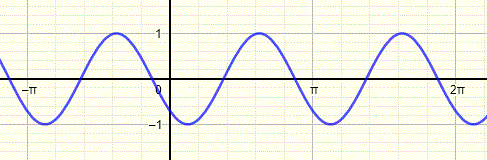
Finally, shift up 2 units to get \(y = -\cos(2x - \pi/4) + 2\).

This graph matches option b).
Problem 6-7
Find a possible equation of the form \( y = a \sin(b x + c) + d \) for the graph shown below.(there are many possible solutions)

View Solution
One period is the distance of one cycle which is from \( x = 0 \) to \( x = 4\pi \); hence the period is \[ 4\pi \]
We also know the formula of the period \( P = \dfrac{2\pi}{|b|} \); hence \[ 4\pi = \dfrac{2\pi}{|b|} \]
Solve for \( b \) to obtain \[ b = 0.5 \quad \text{or} \quad b = -0.5 \]
Let us use \( b = 0.5 \); hence we start by writing the function to be found as \[ y = a \sin(0.5x + c) + d \]
Let \( y_{\max} \) be the maximum value of \( y \) and \( y_{\min} \) be the minimum value of \( y \). The amplitude \( |a| \) is given by \[ |a| = \frac{y_{\max} - y_{\min}}{2} = \frac{-1 - (-3)}{2} = 1 \]
Two possible values for \( a \) are \( 1 \) and \( -1 \). Use \( a = 1 \); the function becomes \[ y = \sin(0.5x + c) + d \]
The value of \( d \) is given by \[ d = \frac{y_{\max} + y_{\min}}{2} = \frac{-1 + (-3)}{2} = -2 \]
The function to be found is \[ y = \sin(0.5x + c) - 2 \]
The graph given has no horizontal shifting; hence \( c = 0 \) and the equation is \[ y = \sin(0.5x) - 2 \]
Problem 6-8
Find the smallest positive value of x, in radians, such that \( - 4 \cos (2x - \pi/4) + 1 = 3 \)
View Solution
We solve the given trigonometric equation and select the smallest positive solution. Rewrite the equation as \[ \cos(2x - \pi/4) = -\frac{1}{2} \]
Let \( t = 2x - \pi/4 \). Then \[ \cos(t) = -\frac{1}{2} \]
Solving for \( t \) gives the infinite solutions \[ t_1 = \frac{2\pi}{3} + k(2\pi), \qquad t_2 = \frac{4\pi}{3} + k(2\pi) \]
Substitute back \( t = 2x - \pi/4 \): \[ 2x_1 - \frac{\pi}{4} = \frac{2\pi}{3} + k(2\pi), \qquad 2x_2 - \frac{\pi}{4} = \frac{4\pi}{3} + k(2\pi) \]
Solving for \( x \) gives \[ x_1 = \frac{11\pi}{24} + k\pi, \qquad x_2 = \frac{19\pi}{24} + k\pi \]
The smallest positive solution occurs when \( k = 0 \): \[ x = \frac{11\pi}{24} \]
Problem 6-9
Simplify the expression: \( \dfrac{\cot(x)\sin(x) + \cos(x) \sin^2(x)+\cos^3(x)}{\cos(x)} \)
View Solution
Using the identity \( \cot(x) = \dfrac{\cos(x)}{\sin(x)} \), rewrite the expression as \[ \frac{\cot(x)\sin(x) + \cos(x)\sin^2(x) + \cos^3(x)}{\cos(x)} = \frac{\cos(x) + \cos(x)(\sin^2(x)+\cos^2(x))}{\cos(x)} \]
Using the identity \( \sin^2(x) + \cos^2(x) = 1 \), we obtain \[ \frac{\cos(x) + \cos(x)}{\cos(x)} = 2 \]
7. Logarithmic and Exponential Functions
Problem 7-1
Simplify the expression \( \dfrac{4x^2 y^8}{8 x^3 y^5} \) using positive exponents in the final answer.
View Solution
Rewrite the expression in ratios of like terms: \[ \frac{4x^2 y^8}{8x^3 y^5} = \left(\frac{4}{8}\right) \left(\frac{x^2}{x^3}\right) \left(\frac{y^8}{y^5}\right) \]
Using exponent rules: \[ = \frac{1}{2} x^{2-3} y^{8-5} = \frac{1}{2}\frac{y^3}{x} \]
Problem 7-2
Evaluate the expression \( \dfrac{3^{1/3} 9^{1/3}}{4^{1/2}} \).
View Solution
Rewrite \( 9 \) as \( 3^2 \): \[ \frac{3^{1/3} 9^{1/3}}{4^{1/2}} = \frac{3^{1/3}(3^2)^{1/3}}{4^{1/2}} \]
Using exponent rules: \[ = \frac{3^{1/3+2/3}}{2} = \frac{3}{2} \]
Problem 7-3
Rewrite the expression \( \log_b(2x - 4) = c \) in exponential form.
View Solution
Logarithmic and exponential functions of the same base are inverses; hence \[ 2x - 4 = b^c \]
Problem 7-4
Simplify the expressiomn: \( \log_a(9) \cdot \log_3(a^2) \)
View Solution
Using the change of base formula: \[ \log_a(9)\log_3(a^2) = \log_a(9)\frac{\log_a(a^2)}{\log_a(3)} \]
Rewrite \( 9 = 3^2 \) and simplify: \[ = 2\log_a(3)\frac{2}{\log_a(3)} = 4 \]
Problem 7-5
Solve the equation \( \log(x + 1) - log(x - 1) = 2 \log(x + 1) \).
View Solution
Rewrite the equation: \[ \log\!\left(\frac{x+1}{x-1}\right) = \log(x+1)^2 \]
Since logarithms are one-to-one: \[ \frac{x+1}{x-1} = (x+1)^2 \]
Cross-multiply: \[ x+1 = (x-1)(x+1)^2 \]
Solving gives: \[ (x-1)(2-x^2) = 0 \]
The solutions are: \[ x = 1, \quad x = \sqrt{2}, \quad x = -\sqrt{2} \]
Only positive arguments are allowed in logarithms, so the valid solution is \[ x = \sqrt{2} \]
Problem 7-6
Solve the equation \( e^{2x} + e^x = 6 \).
View Solution
Let \( z = e^x \) and rewrite the equation in terms of \( z \). \[ z^2 + z - 6 = 0 \]
Solve for \( z \) to obtain \[ z = 2 \quad \text{and} \quad z = -3 \]
Substitute \( z \) by \( e^x \) and solve for \( x \). \[ e^x = 2 \quad \Rightarrow \quad x = \ln(2) \] \[ e^x = -3 \quad \text{has no solution} \]
The given equation has one solution \[ x = \ln(2) \]
Problem 7-7
What is the horizontal asymptote of the graph of \( f(x) = 2 ( - 2 - e^{x-1}) \)?
View Solution
As \( x \) becomes very large, the term \( e^{x-1} \) approaches zero and the only term left is \[ y = 2(-2) = -4 \]
which is the equation of the horizontal asymptote of the given function.
Problem 7-8
What is the vertical asymptote of the graph of \( f(x) = log(2x - 6) + 3 \)?
View Solution
As the argument of the logarithmic function \( 2x - 6 \) approaches zero from the right, \( f(x) \) approaches very small (negative infinity) values. Hence, the vertical asymptote is found by solving \[ 2x - 6 = 0 \]
Solution: \[ x = 3 \]
which is the equation of the vertical asymptote of the given function.
Problem 7-9
Match the given functions with the graph shown below?
A) \( y = 2 - 0.5^{2x-1} \quad \) B) \( y = 0.5^{2x-1} \quad \) C) \( y = 2 - 0.5^{-2x+1} \quad \) D) \( y = 0.5^{-2x+1} \)

View Solution
Functions in part A) and part C) are given by \[ y = 2 - 0.5^{\,2x-1} \quad \text{and} \quad y = 2 - 0.5^{-2x+1} \]
They both have the same horizontal asymptote \( y = 2 \).
A function of the form \( 0.5^{2x} \) is an exponential function with base \( 0.5 \) and therefore is decreasing. However, \( -0.5^{2x} \) is increasing because of the negative sign. The graph in part d) is increasing and has a horizontal asymptote \( y = 2 \).
Hence, function A) corresponds to graph d), and function C) corresponds to graph a).
Functions in part B) and part D) are given by \[ y = 0.5^{\,2x-1} \quad \text{and} \quad y = 0.5^{-2x+1} \]
They both have the same horizontal asymptote \( y = 0 \).
The function \( 0.5^{2x-1} \) is decreasing, whereas \( 0.5^{-2x} \) is increasing because of the negative sign in the exponent. The graph in part c) is decreasing and has a horizontal asymptote \( y = 0 \).
Hence, function B) corresponds to graph c), and function D) corresponds to graph b).
Problem 7-10
Match the given functions with the graph shown below?
A) \( y = 2+ln(x-2) \quad \) B) \( y=-log_2(x+1)-1 \quad \) C) \( y = -ln(-x) \quad \) D) \( y = y=-log_3(x+1)-1 \)

View Solution
The function in part A) is \[ y = 2 + \ln(x - 2) \]
It has a vertical asymptote given by \( x - 2 = 0 \), which yields \( x = 2 \). The graph in part d) has a vertical asymptote at \( x = 2 \) and therefore corresponds to function A).
The function in part C) is \[ y = -\ln(-x) \]
It has a vertical asymptote given by \( -x = 0 \), which yields \( x = 0 \). The graph in part a) has a vertical asymptote at \( x = 0 \) and therefore corresponds to function C).
The functions in parts B) and D) are \[ y = -\log_2(x+1) - 1 \quad \text{and} \quad y = -\log_3(x+1) - 1 \]
They both have a vertical asymptote at \( x = -1 \) and the same y-intercept \( (0,-1) \).
Evaluating at \( x = 1 \), the function in part B) gives \( y = -2 \). The point \( (1,-2) \) lies on graph c). Hence, function B) corresponds to graph c), and function D) corresponds to graph b).
More References and Links