This comprehensive guide covers definitions, properties, and classifications of angles in geometry, along with practice problems and detailed solutions.
Angle Definition
An angle is formed by two rays (sides) that share a common endpoint called the vertex. The angle measures the amount of rotation between the two rays.

Units of Angle Measures
Angles can be measured in two main units:
- Degrees (\(^\circ\)): Example: \( \alpha = 60^\circ \)
- Radians (dimensionless): Example: \( \beta = 2.3 \) rad, \( \gamma = \dfrac{2\pi}{5} \) rad
Note: When no unit is specified for angles like \( \beta = 2.3 \), radians are assumed.
Angle Notation
Angles can be denoted using Greek letters (\( \alpha, \beta, \gamma, \ldots \)), Latin letters (\( A, a, B, b, \ldots \)), or by naming the vertex and points: \( \angle AOB \). The measure is written as \( m\angle AOB = 23^\circ \).

Types of Angles
Adjacent Angles
Two angles are adjacent if they share a common vertex and side, but have no common interior points.
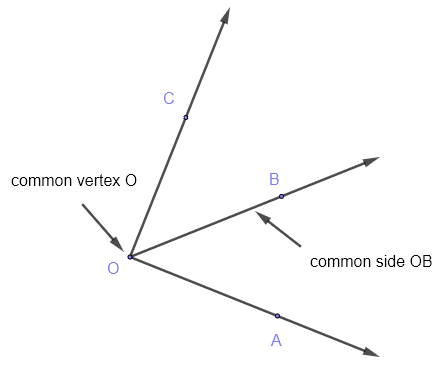
Note: \( m\angle AOC = m\angle AOB + m\angle BOC \)
Complete Angle
A complete angle measures \( 360^\circ \) or \( 2\pi \) radians, representing one full rotation.

Right Angle
A right angle measures exactly \( 90^\circ \) or \( \dfrac{\pi}{2} \) radians.

Notes:
1. The small square symbol indicates a right angle.
2. Lines intersecting at \( 90^\circ \) are perpendicular.
Straight Angle
A straight angle measures \( 180^\circ \) or \( \pi \) radians, forming a straight line.

Acute Angle
An acute angle measures between \( 0^\circ \) and \( 90^\circ \) (or \( 0 \) and \( \dfrac{\pi}{2} \) radians).

Obtuse Angle
An obtuse angle measures between \( 90^\circ \) and \( 180^\circ \) (or \( \dfrac{\pi}{2} \) and \( \pi \) radians).

Angle Pairs
Complementary Angles
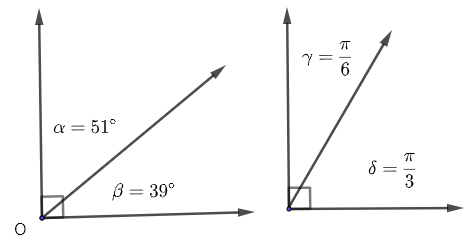
Two angles are complementary if their measures sum to \( 90^\circ \) or \( \dfrac{\pi}{2} \) radians.
Examples:
1. \( \alpha = 51^\circ \) and \( \beta = 39^\circ \) are complementary since \( \alpha + \beta = 90^\circ \)
2. \( \gamma = \dfrac{\pi}{6} \) and \( \delta = \dfrac{\pi}{3} \) are complementary since \( \gamma + \delta = \dfrac{\pi}{2} \)
Supplementary Angles
Two angles are supplementary if their measures sum to \( 180^\circ \) or \( \pi \) radians.

Examples:
1. \( \gamma = \dfrac{\pi}{6} \) and \( \delta = \dfrac{5\pi}{6} \) are supplementary since \( \gamma + \delta = \pi \)
2. \( \alpha = 127^\circ \) and \( \beta = 53^\circ \) are supplementary since \( \alpha + \beta = 180^\circ \)
Vertical Angles
Vertical angles are formed by two intersecting lines. They are always congruent (equal in measure).

In the figure: \( \angle COA \cong \angle DOB \) and \( \angle AOD \cong \angle BOC \)
Angle Conversion
Degrees to Radians
To convert angle \( \theta \) from degrees to radians:
\[ \theta_{\text{radians}} = \dfrac{\theta_{\text{degrees}} \times \pi}{180} \]Example: Convert \( \theta = 120^\circ \) to radians:
\[ \dfrac{120 \times \pi}{180} = \dfrac{2\pi}{3} \approx 2.09439 \text{ radians} \]Radians to Degrees
To convert angle \( \alpha \) from radians to degrees:
\[ \alpha_{\text{degrees}} = \dfrac{\alpha_{\text{radians}} \times 180}{\pi} \]Example 1: Convert \( \theta = 2.1 \) radians to degrees:
\[ \dfrac{2.1 \times 180}{\pi} = \dfrac{378}{\pi} \approx 120.32^\circ \]Example 2: Convert \( \theta = \dfrac{3\pi}{4} \) radians to degrees:
\[ \dfrac{\dfrac{3\pi}{4} \times 180}{\pi} = 135^\circ \]Special Angles
| Degrees | Radians |
|---|---|
| \( 0^\circ \) | \( 0 \) |
| \( 30^\circ \) | \( \dfrac{\pi}{6} \) |
| \( 45^\circ \) | \( \dfrac{\pi}{4} \) |
| \( 60^\circ \) | \( \dfrac{\pi}{3} \) |
| \( 90^\circ \) | \( \dfrac{\pi}{2} \) |
| \( 120^\circ \) | \( \dfrac{2\pi}{3} \) |
| \( 135^\circ \) | \( \dfrac{3\pi}{4} \) |
| \( 150^\circ \) | \( \dfrac{5\pi}{6} \) |
| \( 180^\circ \) | \( \pi \) |
| \( 210^\circ \) | \( \dfrac{7\pi}{6} \) |
| \( 225^\circ \) | \( \dfrac{5\pi}{4} \) |
| \( 240^\circ \) | \( \dfrac{4\pi}{3} \) |
| \( 270^\circ \) | \( \dfrac{3\pi}{2} \) |
| \( 300^\circ \) | \( \dfrac{5\pi}{3} \) |
| \( 315^\circ \) | \( \dfrac{7\pi}{4} \) |
| \( 330^\circ \) | \( \dfrac{11\pi}{6} \) |
| \( 360^\circ \) | \( 2\pi \) |
Practice Problems & Solutions
Part A: Angle Classification
Given angles with measures:
\( a = 21^\circ \), \( b = 90.1^\circ \), \( c = 90^\circ \), \( d = 134.2^\circ \), \( e = 69^\circ \), \( f = 45.8^\circ \)
- Which angles are acute?
- Which angles are obtuse?
- Which pairs are complementary?
- Which pairs are supplementary?
Solutions:
- Acute angles: \( a, e, f \) (each between \( 0^\circ \) and \( 90^\circ \))
- Obtuse angles: \( b, d \) (each between \( 90^\circ \) and \( 180^\circ \))
- Complementary pair: \( a \) and \( e \) (\( 21^\circ + 69^\circ = 90^\circ \))
- Supplementary pair: \( d \) and \( f \) (\( 134.2^\circ + 45.8^\circ = 180^\circ \))
Part B: Angle Relationships
- \( A \) and \( B \) are complementary with \( A = 22^\circ \). Find \( B \).
Solution: \( A + B = 90^\circ \) \(\Rightarrow\) \( 22^\circ + B = 90^\circ \) \(\Rightarrow\) \( B = 68^\circ \) - \( \alpha \) and \( \beta \) are supplementary with \( \alpha = 0.5\pi \). Find \( \beta \).
Solution: \( \alpha + \beta = \pi \) \(\Rightarrow\) \( 0.5\pi + \beta = \pi \) \(\Rightarrow\) \( \beta = 0.5\pi \) - \( a \) and \( b \) are supplementary with \( b = 2a \). Find \( a \) and \( b \) in degrees.
Solution: \( a + b = 180^\circ \), \( b = 2a \) \(\Rightarrow\) \( a + 2a = 180^\circ \) \(\Rightarrow\) \( 3a = 180^\circ \) \(\Rightarrow\) \( a = 60^\circ \), \( b = 120^\circ \) - \( C \) and \( D \) are complementary with \( D - C = 23^\circ \). Find \( C \) and \( D \).
Solution: \( C + D = 90^\circ \), \( D - C = 23^\circ \) \(\Rightarrow\) \( D = 23^\circ + C \)
Substitute: \( C + (23^\circ + C) = 90^\circ \) \(\Rightarrow\) \( 2C = 67^\circ \) \(\Rightarrow\) \( C = 33.5^\circ \), \( D = 56.5^\circ \) - Given \( m\angle QOS = 52^\circ \), find \( m\angle ROT \) and \( m\angle SOR \).
Solution: \( \angle QOS \) and \( \angle ROT \) are vertical \(\Rightarrow\) \( m\angle ROT = 52^\circ \)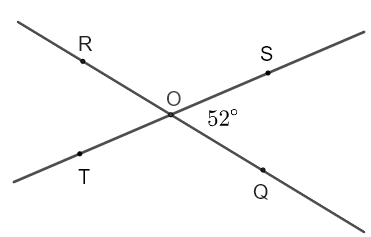
\( \angle SOR \) and \( \angle ROT \) are supplementary \(\Rightarrow\) \( m\angle SOR = 180^\circ - 52^\circ = 128^\circ \) - Given \( m\angle AOC = 90^\circ \), \( m\angle AOB = 67^\circ \), \( m\angle GOH = 27^\circ \), find \( m\angle DOF \).
Solution: \( \angle GOH \) and \( \angle COD \) are vertical \(\Rightarrow\) \( m\angle COD = 27^\circ \)
\( \angle COD \) and \( \angle DOE \) are complementary \(\Rightarrow\) \( m\angle DOE = 90^\circ - 27^\circ = 63^\circ \)
\( \angle EOF \) and \( \angle AOB \) are vertical \(\Rightarrow\) \( m\angle EOF = 67^\circ \)
\( \angle DOF = \angle DOE + \angle EOF = 63^\circ + 67^\circ = 130^\circ \)
Part C: Angle Conversion
- Convert \( A = 22^\circ \), \( B = 145^\circ \), \( C = 90^\circ \) to radians.
Solution:
\( A = 22^\circ = \dfrac{22\pi}{180} = \dfrac{11\pi}{90} \approx 0.384 \) rad
\( B = 145^\circ = \dfrac{145\pi}{180} = \dfrac{29\pi}{36} \approx 2.531 \) rad
\( C = 90^\circ = \dfrac{90\pi}{180} = \dfrac{\pi}{2} \approx 1.571 \) rad - Convert \( a = 0.2 \), \( b = 2.5 \), \( c = \dfrac{\pi}{3} \) to degrees.
Solution:
\( a = 0.2 \text{ rad} = \dfrac{0.2 \times 180}{\pi} = \dfrac{36}{\pi} \approx 11.46^\circ \)
\( b = 2.5 \text{ rad} = \dfrac{2.5 \times 180}{\pi} = \dfrac{450}{\pi} \approx 143.24^\circ \)
\( c = \dfrac{\pi}{3} \text{ rad} = \dfrac{\pi}{3} \times \dfrac{180}{\pi} = 60^\circ \)
Additional Resources
- More Angle Problems with Solutions
- Geometry Tutorials and Problems
- Angles in Parallel Lines and Transversals
- Recommended Textbook: The Four Pillars of Geometry by John Stillwell (Springer, 2005)
- Comprehensive Reference: Geometry: A Comprehensive Course by Daniel Pedoe (Dover Publications, 2013)