Overlapping circles area problems with detailed solutions and clear diagrams.
Problem Statement
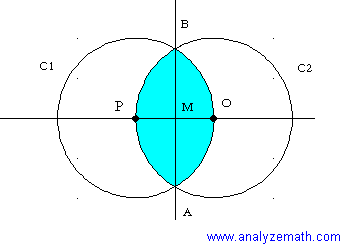
The distance between the centers of two circles \( C_1 \) and \( C_2 \) is equal to \(10\) cm. The circles have equal radii of \(10\) cm. \( O \) is the center of \( C_2 \) and \( P \) is the center of \( C_1 \). Find the overlapping area of the two circles. Approximate your answer to one decimal place.
Solution
The overlapping area consists of two equal parts. We find one part (shown in blue below) and then multiply it by 2. Since the two circles have equal radii, \( M \) is the midpoint of segment \( OP \). Given \( OP = 10 \) cm, we find:

Step 1: Finding the Central Angle
Using the cosine rule:
\[ \cos(\angle BOM) = \frac{d(O, M)}{OB} = \frac{5}{10} = \frac{1}{2} \]Taking the arccos function:
\[ \angle BOM = 60^\circ \]Since \( \angle AOB = 2 \times \angle BOM \):
\[ \angle AOB = 120^\circ \]Step 2: Calculating Sector and Triangle Areas
The area of the blue region is the difference between the area of sector \( OBPA \) and the area of triangle \( AOB \).
The area of sector \( OBPA \) is:
\[ \text{sector area} = \frac{1}{2} r^2 \theta = \frac{1}{2} (10)^2 \times \frac{120 \pi}{180} = \frac{100\pi}{3} \]The area of triangle \( OBA \) is:
\[ \text{triangle area} = \frac{1}{2} r^2 \sin(120^\circ) = \frac{1}{2} (10)^2 \times \frac{\sqrt{3}}{2} = \frac{50\sqrt{3}}{2} \]Step 3: Calculating Total Overlapping Area
The blue region (Area 1) is:
\[ \text{Area 1} = \frac{100\pi}{3} - \frac{50\sqrt{3}}{2} \]The total overlapping area (Area 2) is:
\[ \text{Area 2} = 2 \times \left( \frac{100\pi}{3} - \frac{50\sqrt{3}}{2} \right) \] \[ \approx 122.8 \text{ cm}^2 \]