Explore postulates and theorems on congruent triangles using examples and practice problems with detailed step-by-step solutions.
Triangle Congruence Postulates & Theorems
- Side-Angle-Side (SAS): If two sides and the included angle of a triangle are congruent to two sides and the included angle of another triangle, the triangles are congruent.
- Side-Side-Side (SSS): If the three sides of a triangle are congruent to the three sides of another triangle, the triangles are congruent.
- Angle-Side-Angle (ASA): If two angles and the included side of a triangle are congruent to two angles and the included side of another triangle, the triangles are congruent.
- Angle-Angle-Side (AAS): If two angles and a non-included side of a triangle are congruent to two angles and a non-included side of another triangle, the triangles are congruent.
- Hypotenuse-Leg (HL): If the hypotenuse and a leg of a right triangle are congruent to the hypotenuse and a leg of another right triangle, the triangles are congruent.
Worked Examples
Example 1: Parallelogram Diagonal (SAS Postulate)
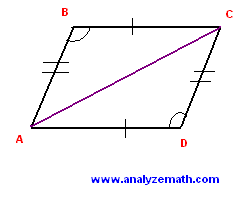
Let \(ABCD\) be a parallelogram and \(AC\) be one of its diagonals. What can you say about \(\triangle ABC\) and \(\triangle CDA\)? Explain.
Solution:
In parallelogram \(ABCD\):
- Opposite sides are congruent: \(BC \cong AD\) and \(AB \cong CD\)
- Opposite angles are congruent: \(\angle ABC \cong \angle CDA\)
- Triangles \(ABC\) and \(CDA\) have two congruent sides and the included angle: \(BC \cong AD\), \(AB \cong CD\), and \(\angle ABC \cong \angle CDA\)
Example 2: Square Diagonal (SSS Postulate)
Let \(ABCD\) be a square and \(AC\) be one of its diagonals. What can you say about \(\triangle ABC\) and \(\triangle CDA\)? Explain.

Solution:
In square \(ABCD\):
- All sides are congruent: \(AB \cong BC \cong CD \cong DA\)
- Diagonal \(AC\) is common to both triangles
- Triangles \(ABC\) and \(CDA\) have three congruent sides: \(AB \cong CD\), \(BC \cong DA\), and \(AC \cong CA\)
Example 3: Isosceles Triangle Angle Bisector
\(\triangle ABC\) is isosceles with \(AB \cong BC\). \(BB'\) is the angle bisector of \(\angle B\). Show that \(\triangle ABB' \cong \triangle CBB'\).

Solution:
Since \(\triangle ABC\) is isosceles with \(AB \cong BC\), we have \(\angle A \cong \angle C\).
\(BB'\) bisects \(\angle B\), so \(\angle ABB' \cong \angle CBB'\).
Side \(BB'\) is common to both triangles.
By ASA postulate, \(\triangle ABB' \cong \triangle CBB'\).
Example 4: Triangle Congruence via AAS Theorem

Solution:
In \(\triangle ABC\): \(\angle ABC = 180^\circ - (25^\circ + 125^\circ) = 30^\circ\).
Triangles \(ABC\) and \(PQR\) have:
- \(\angle ABC \cong \angle QPR = 30^\circ\)
- \(\angle BAC \cong \angle PQR = 25^\circ\)
- Side \(BC \cong PR\)
Example 5: Right Triangles (HL Theorem)
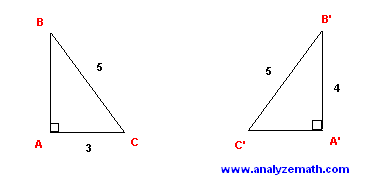
Show that the two right triangles below are congruent.
Solution:
In \(\triangle ABC\), using Pythagorean theorem: \(AB = \sqrt{5^2 - 3^2} = \sqrt{25 - 9} = \sqrt{16} = 4\).
Both triangles are right triangles with:
- Hypotenuse \(BC \cong B'C' = 5\)
- Leg \(AB \cong A'B' = 4\)
Practice Problems with Solutions
Problem 1: Isosceles Triangle Sub-triangles
In isosceles \(\triangle ABC\), \(BA \cong BC\). Points \(M\) and \(N\) are on \(AC\) such that \(MA \cong MB\) and \(NB \cong NC\). Show that \(\triangle AMB \cong \triangle CNB\).

Solution:
Since \(MA \cong MB\), \(\triangle AMB\) is isosceles \(\implies \angle BAM \cong \angle ABM\).
Since \(NB \cong NC\), \(\triangle CNB\) is isosceles \(\implies \angle BCN \cong \angle CBN\).
\(\triangle ABC\) is isosceles \(\implies \angle BAM \cong \angle BCN\).
Thus all four angles \(\angle BAM\), \(\angle ABM\), \(\angle CBN\), \(\angle BCN\) are congruent.
Triangles \(AMB\) and \(CNB\) have:
- \(AB \cong CB\) (isosceles triangle legs)
- \(\angle BAM \cong \angle BCN\)
- \(\angle ABM \cong \angle CBN\)
Problem 2: Parallelogram and Square Combination
\(ABCD\) is a parallelogram and \(BEFC\) is a square. Show that \(\triangle ABE \cong \triangle DCF\).

Solution:
In parallelogram \(ABCD\): \(BA \cong CD\).
In square \(BEFC\): \(EB \cong FC\).
Angles \(\angle EBA\) and \(\angle FCD\) are congruent (corresponding angles between parallel lines).
Triangles \(ABE\) and \(DCF\) have:
- \(EB \cong FC\)
- \(BA \cong CD\)
- \(\angle EBA \cong \angle FCD\)
Problem 3: Square Perpendicular Segments
\(ABCD\) is a square. \(C'\) is on \(BA\) and \(B'\) is on \(AD\) such that \(BB' \perp CC'\). Show that \(\triangle AB'B \cong \triangle BC'C\).

Solution:
Since \(ABCD\) is a square: \(\angle BAB' \cong \angle CBC' = 90^\circ\).
\(BC \parallel AD\) with transversal \(BB'\) \(\implies \angle OBC \cong \angle BB'A\) (alternate interior).
In right \(\triangle CBO\): \(\angle OBC + \angle BCO = 90^\circ\).
In right \(\triangle ABB'\): \(\angle ABB' + \angle BB'A = 90^\circ\).
Since \(\angle OBC \cong \angle BB'A\), then \(\angle ABB' \cong \angle BCC'\).
Triangles \(AB'B\) and \(BC'C\) have:
- \(BC \cong BA\) (square sides)
- \(\angle BCC' \cong \angle ABB'\)
- \(\angle CBC' \cong \angle BAB' = 90^\circ\)
Problem 4: Midpoint and Perpendiculars
\(ABC\) is a triangle with midpoint \(M\) of \(AC\). Points \(I\) and \(J\) are on \(BM\) such that \(AI \perp BM\) and \(CJ \perp BM\). Show that \(\triangle AIM \cong \triangle CJM\).

Solution:
\(M\) is midpoint of \(AC\) \(\implies AM \cong MC\).
\(AI \parallel CJ\) (both perpendicular to \(BM\)).
\(\angle MAI \cong \angle MCJ\) (alternate interior angles).
\(\angle AMI \cong \angle JMC\) (vertical angles).
Triangles \(AIM\) and \(CJM\) have:
- \(AM \cong MC\)
- \(\angle MAI \cong \angle MCJ\)
- \(\angle AMI \cong \angle JMC\)
Problem 5: Isosceles Triangle Perpendiculars
\(\triangle ABC\) is isosceles with \(BA \cong BC\). Points \(K\) on \(AB\) and \(L\) on \(BC\) have perpendiculars \(KK' \perp AC\) and \(LL' \perp AC\) with \(KK' \cong LL'\). Show that \(\triangle KK'M \cong \triangle LL'M\).

Solution:
\(KK' \parallel LL'\) (both perpendicular to \(AC\)).
\(\angle K'KM \cong \angle L'LM\) (alternate interior angles).
\(\angle KK'M \cong \angle LL'M = 90^\circ\).
Given \(KK' \cong LL'\).
Triangles \(KK'M\) and \(LL'M\) have:
- \(KK' \cong LL'\)
- \(\angle K'KM \cong \angle L'LM\)
- \(\angle KK'M \cong \angle LL'M\)