Learn about similar triangles through definitions, theorems, worked examples, and practice problems with detailed step-by-step solutions.
Review of Similar Triangles
Definition
Two triangles \(\triangle ABC\) and \(\triangle A'B'C'\) are similar if their corresponding angles are congruent and corresponding sides are proportional:
\[ \dfrac{AB}{A'B'} = \dfrac{BC}{B'C'} = \dfrac{CA}{C'A'} \]
Similarity Theorems & Worked Examples
1. Angle-Angle (AA) Similarity Theorem
If two angles of one triangle are congruent to two angles of another triangle, the triangles are similar.
Example 1:
Let \(\triangle ABC\) be a triangle and \(\overline{A'C'}\) parallel to \(\overline{AC}\). What can you say about \(\triangle ABC\) and \(\triangle A'BC'\)?

Solution:
Since \(\overline{A'C'} \parallel \overline{AC}\):
\(\angle BA'C' \cong \angle BAC\) (corresponding angles)
\(\angle BC'A' \cong \angle BCA\) (corresponding angles)
By AA similarity, \(\triangle ABC \sim \triangle A'BC'\).
2. Side-Side-Side (SSS) Similarity Theorem
If corresponding sides of two triangles are proportional, the triangles are similar.
Example 2:
Given vertices \(A(-2, 0)\), \(B(0, 4)\), \(C(2, 0)\) and \(P(-1, 1)\), \(Q(0, 3)\), \(R(1, 1)\), show that \(\triangle ABC \sim \triangle PQR\).

Solution:
Calculate side lengths:
\(AB = \sqrt{(0 + 2)^2 + (4 - 0)^2} = \sqrt{4 + 16} = 2\sqrt{5}\)
\(BC = \sqrt{(2 - 0)^2 + (0 - 4)^2} = \sqrt{4 + 16} = 2\sqrt{5}\)
\(CA = \sqrt{(-2 - 2)^2 + (0 - 0)^2} = 4\)
\(PQ = \sqrt{(0 + 1)^2 + (3 - 1)^2} = \sqrt{1 + 4} = \sqrt{5}\)
\(QR = \sqrt{(1 - 0)^2 + (1 - 3)^2} = \sqrt{1 + 4} = \sqrt{5}\)
\(RP = \sqrt{(-1 - 1)^2 + (1 - 1)^2} = 2\)
Ratios: \(\dfrac{AB}{PQ} = \dfrac{2\sqrt{5}}{\sqrt{5}} = 2\), \(\dfrac{BC}{QR} = 2\), \(\dfrac{CA}{RP} = 2\)
Since \(\dfrac{AB}{PQ} = \dfrac{BC}{QR} = \dfrac{CA}{RP}\), by SSS similarity \(\triangle ABC \sim \triangle PQR\).
3. Side-Angle-Side (SAS) Similarity Theorem
If an angle of one triangle is congruent to an angle of another triangle, and the including sides are proportional, the triangles are similar.
Example 3:
Show that \(\triangle ABC \sim \triangle A'BC'\).

Solution:
\(\angle ABC \cong \angle A'BC'\) (given)
Check including sides: \(\dfrac{BA}{BA'} = \dfrac{10}{4} = 2.5\), \(\dfrac{BC}{BC'} = \dfrac{5}{2} = 2.5\)
Since the ratios are equal and the included angles congruent, by SAS similarity \(\triangle ABC \sim \triangle A'BC'\).
Similar Triangles Practice Problems & Solutions
Problem 1: Parallel Segments and Proportions
Problem Statement: In the diagram, \(\overline{A'C'} \parallel \overline{AC}\). Find length \(y = BC'\) and \(x = A'A\).

Solution:
Separate triangles: \(\triangle ABC\) and \(\triangle A'BC'\).
Since \(\overline{A'C'} \parallel \overline{AC}\), triangles are similar (AA).
Set up proportions: \(\dfrac{30 + x}{30} = \dfrac{22}{14} = \dfrac{y + 15}{y}\)
Solve for \(x\): \(\dfrac{30 + x}{30} = \dfrac{22}{14} \implies 14(30 + x) = 660\)
\(420 + 14x = 660 \implies 14x = 240 \implies x \approx 17.1\)
Solve for \(y\): \(\dfrac{22}{14} = \dfrac{y + 15}{y} \implies 22y = 14y + 210\)
\(8y = 210 \implies y = 26.25\)
Problem 2: Mountain Height Calculation via Similar Triangles
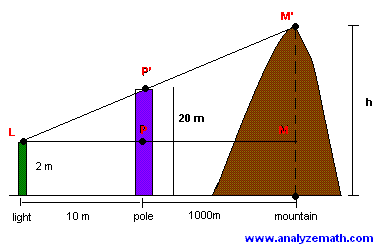
Problem Statement: A light source at \(L\) (height 2 m) shines through pole top \(P'\) to mountain top \(M'\). Pole height = 20 m. Distance mountain-pole = 1000 m, pole-laser = 10 m. Find mountain height \(h\).
Solution:
Triangles \(\triangle LPP'\) and \(\triangle LMM'\) are similar (AA).
Proportions: \(\dfrac{LM}{LP} = \dfrac{MM'}{PP'} \implies \dfrac{1000 + 10}{10} = \dfrac{h - 2}{20 - 2}\)
\(\dfrac{1010}{10} = \dfrac{h - 2}{18} \implies 101 = \dfrac{h - 2}{18}\)
\(h - 2 = 1818 \implies h = 1820 \, \text{meters}\).
Problem 3: Ratio of Altitudes in Similar Triangles
Problem Statement: Given \(\triangle ABC \sim \triangle A'B'C'\) with ratio \(k\), find ratio \(\dfrac{BH}{B'H'}\) of their altitudes.

Solution:
Since triangles are similar, \(\angle B \cong \angle B'\) and \(\angle BAH \cong \angle B'A'H'\).
Right triangles \(\triangle BHA\) and \(\triangle B'H'A'\) are similar (AA).
Therefore: \(\dfrac{BH}{B'H'} = \dfrac{AB}{A'B'} = k\).
Problem 4: Intersecting Chords Relationship
Problem Statement: Chords \(\overline{BA'}\) and \(\overline{AB'}\) intersect at \(C\). Find a relationship between segments \(AC, BC, B'C, A'C\).

Solution:
Join \(\overline{BA}\) and \(\overline{B'A'}\).
\(\angle ABA' \cong \angle AB'A'\) (subtend same arc)
\(\angle BAB' \cong \angle BA'B'\) (subtend same arc)
So \(\triangle ABC \sim \triangle A'B'C\) (AA).
Proportions: \(\dfrac{BC}{B'C} = \dfrac{CA}{CA'}\)
Cross multiply: \(BC \cdot CA' = B'C \cdot CA\).
Problem 5: Right Triangle Altitude and Similar Triangles
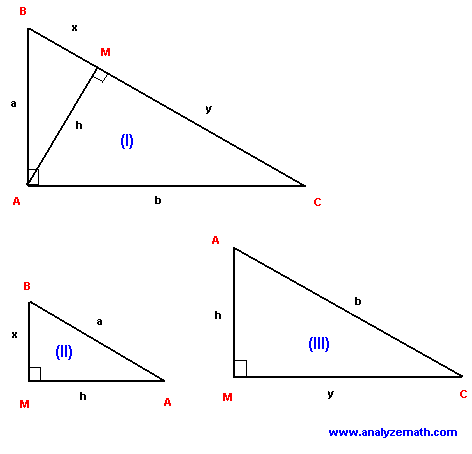
Problem Statement: In right \(\triangle ABC\), \(\overline{AM} \perp \overline{BC}\). How many similar triangles are there?
Solution:
Three similar triangles:
1. \(\triangle ABC \sim \triangle MBA\) (AA: right angle and \(\angle B\))
2. \(\triangle ABC \sim \triangle MAC\) (AA: right angle and \(\angle C\))
3. Consequently, \(\triangle MBA \sim \triangle MAC\).