Graphing Cube Root Functions

A tutorial on graphing and sketching cube root functions is presented. The graph, domain, range of these functions and other properties are discussed.

Graph, Domain, and Range of the Basic Cube Root Function

The basic cube root function is defined by: \[ f(x) = \sqrt[3]{x} \]

Examples & Step-by-Step Solutions

Example 1: Basic Cube Root Function \( f(x) = \sqrt[3]{x} \)

Problem: Graph \( f(x) = \sqrt[3]{x} \) and find the range of \( f \).


Solution:

Because the domain of \( f \) is the set of all real numbers, we construct a table of values using convenient inputs whose cube roots are integers:

\( x \) \(-8\) \(-1\) \(0\) \(1\) \(8\)
\( f(x) = \sqrt[3]{x} \) \(-2\) \(-1\) \(0\) \(1\) \(2\)

The values of \( x \) were selected so that their cube roots are whole numbers, making it easy to plot the points.

Points and graph of cube root(x)

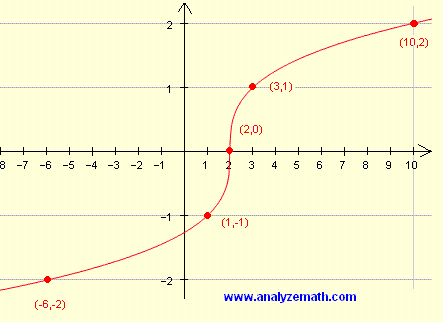
Example 2: Horizontal Shift \( f(x) = \sqrt[3]{x - 2} \)

Problem: Graph \( f(x) = \sqrt[3]{x - 2} \) and find the range of \( f \).


Solution:

The domain of the cube root function is the set of all real numbers. It is easy to calculate \( \sqrt[3]{x - 2} \) if you select values of the argument \( x - 2 \) equal to \(-8, -1, 0, 1, 8\), and then solve for \( x \):

\( x - 2 \) \(-8\) \(-1\) \(0\) \(1\) \(8\)
\( f(x) = \sqrt[3]{x - 2} \) \(-2\) \(-1\) \(0\) \(1\) \(2\)
\( x \) \(-6\) \(1\) \(2\) \(3\) \(10\)

The last two rows in the table of data are used to graph \( f \).

Points and graph of cube root(x - 2)

Note: The graph of \( f(x) = \sqrt[3]{x - 2} \) is that of \( f(x) = \sqrt[3]{x} \) shifted \( 2 \) units to the right.

Example 3: Reflection & Horizontal Shift \( f(x) = -\sqrt[3]{x + 1} \)

Problem: Graph \( f(x) = -\sqrt[3]{x + 1} \) and find the range of \( f \).


Solution:

The domain of the function is the set of all real numbers. We select values of \( x + 1 \) equal to \(-8, -1, 0, 1, 8\) to construct the table of values and solve for \( x \):

\( x + 1 \) \(-8\) \(-1\) \(0\) \(1\) \(8\)
\( f(x) = -\sqrt[3]{x + 1} \) \(2\) \(1\) \(0\) \(-1\) \(-2\)
\( x \) \(-9\) \(-2\) \(-1\) \(0\) \(7\)

Points and graph of -cube root(x + 1)

Example 4: Combined Transformation \( f(x) = -2\sqrt[3]{x - 2} + 2 \)

Problem: Graph \( f(x) = -2\sqrt[3]{x - 2} + 2 \) and find the range of \( f \).


Solution:

The domain of function \( f \) is the set of all real numbers. We select values of \( x - 2 \) equal to \(-8, -1, 0, 1, 8\) to construct the table:

\( x - 2 \) \(-8\) \(-1\) \(0\) \(1\) \(8\)
\( f(x) = -2\sqrt[3]{x - 2} + 2 \) \(6\) \(4\) \(2\) \(0\) \(-2\)
\( x \) \(-6\) \(1\) \(2\) \(3\) \(10\)

Points and graph of -2 cube root (x - 2) + 2

More References and Links to Graphing

Explore additional graphing tutorials and resources:

Graphing Functions | Cube Root Functions Tutorial | Home Page