Problems with detailed solutions on the graphing of the hyperbola equation are presented in this tutorial.
A hyperbola with center at the origin \( (0,0) \), is the graph of
\[ \Large{\dfrac{x^2}{a^2} - \dfrac{y^2}{b^2} = 1 \quad (I) \quad \text{or} \quad \dfrac{y^2}{a^2} - \dfrac{x^2}{b^2} = 1 \quad (II) } \]The graph the equation (I) has the following properties: x-intercepts at \( \pm a \), no y-intercepts, foci at \( (-c, 0) \) and \( (c, 0) \), asymptotes with equations \( y = \pm \dfrac{b}{a}x \).
The graph of equation (II) has the following properties: y-intercepts at \( \pm a \), no x-intercepts, foci at \( (0, -c) \) and \( (0, c) \), asymptotes with equations \( y = \pm \dfrac{a}{b}x \).
\( a \), \( b \) and \( c \) are related by \[ c^2 = a^2 + b^2 \].
The length of the transverse axis is \( 2a \), and the length of the conjugate axis is \( 2b \).
Applying the symmetry tests for graphs of equations in two variables, the hyperbolas given by the above equations are symmetric with respect to the x-axis, the y-axis, and the origin.
A tutorial on the definition and properties of hyperbolas can be found on this site.
Given the following equation:
\[ 9x^2 - 16y^2 = 144 \]a) Find the x and y intercepts, if possible, of the graph of the equation.
b) Find the coordinates of the foci.
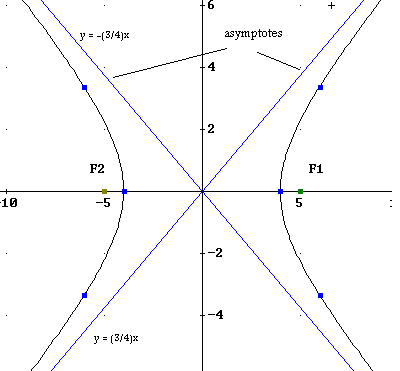
c) Sketch the graph of the equation.
a) We first write the given equation in standard form by dividing both sides of the equation by 144
\[ \frac{9x^2}{144} - \frac{16y^2}{144} = 1 \] \[ \frac{x^2}{16} - \frac{y^2}{9} = 1 \] \[ \frac{x^2}{4^2} - \frac{y^2}{3^2} = 1 \]We now compare the equation obtained with the standard equation (I) in the review above and we can say that the given equation is that of a hyperbola with \( a = 4 \) and \( b = 3 \).
Set \( y = 0 \) in the equation obtained and find the x-intercepts.
\[ \frac{x^2}{4^2} = 1 \]Solve for x.
\[ x^2 = 4^2 \] \[ x = \pm 4 \]Set \( x = 0 \) in the equation obtained and find the y-intercepts.
\[ \frac{y^2}{3^2} = -1 \]NO y-intercepts since the above equation does not have real solutions.
b) We need to find \( c \) first (see formula above).
\[ c^2 = a^2 + b^2 \]\( a \) and \( b \) were found in part a), hence: \[ c^2 = 4^2 + 3^2 \] \[ c^2 = 25 \]
Solve for \( c \).
\[ c = \pm 5 \]The foci are \( F_1 = (5, 0) \) and \( F_2 = (-5, 0) \).
c)
1 - Find the asymptotes \( y = -\frac{b}{a}x \) and \( y = \frac{b}{a}x \) and plot them.
\[ y = -\frac{3}{4}x \quad \text{and} \quad y = \frac{3}{4}x \]2 - Plot the x-intercepts
3 - Find extra points (if necessary)
Set \( x = 6 \) and find y
\[ 9(6)^2 - 16y^2 = 144 \] \[ -16y^2 = 144 - 324 \] \[ y^2 = \frac{45}{4} \]Solve for y
\[ y = \pm \frac{3\sqrt{5}}{2} \]So the points \( (6, \frac{3\sqrt{5}}{2}) \) and \( (6, -\frac{3\sqrt{5}}{2}) \) are on the graph of the hyperbola.
Also, because of the symmetry of the graph of the hyperbola, the points \( (-6, \frac{3\sqrt{5}}{2}) \) and \( (-6, -\frac{3\sqrt{5}}{2}) \) are also on the graph of the hyperbola.
\[ x^2 - y^2 = 9 \]
a) Find the x and y intercepts, if possible, of the graph of the equation.
b) Find the coordinates of the foci.
c) Sketch the graph of the equation.