First and Second Derivatives Questions with Answers (Part 2)
Master Graphical Analysis of Functions and Derivatives
Calculus questions with detailed solutions are presented below. The graphical behavior of a function $f$, its first derivative $f'(x)$, and its second derivative $f''(x)$ is analyzed to determine intervals of increase/decrease, extrema, concavity, and inflection points.
Question 1
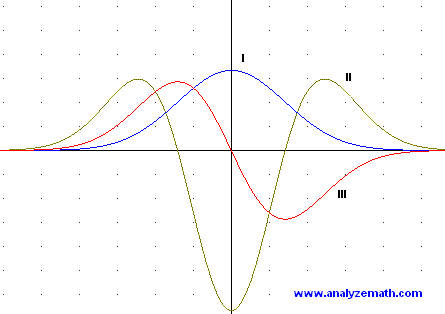
The graphs of a function $f$, its first derivative $f'(x)$, and its second derivative $f''(x)$ are shown below. Identify which graph represents $f$, $f'(x)$, and $f''(x)$.
Show Solution
- Graph (I) is entirely above the x-axis ($y>0$). Therefore, it cannot represent a derivative of graphs (II) or (III), since both show intervals of increase and decrease, which require sign changes in the derivative. Hence, graph (I) represents the function $f$.
- Graph (I) has a maximum at $x=0$. Thus, $f'(0)=0$. Among the remaining graphs, only graph (III) crosses the x-axis at $x=0$. Therefore, graph (III) represents $f'(x)$.
- Graph (II) must represent $f''(x)$. It is negative near $x=0$, indicating that $f$ is concave down at that point, which matches the shape of graph (I) around $x=0$.
Question 2
The graph of the first derivative $f'(x)$ of a function $f$ is shown below.

a) For what values of $x$ is $f$ increasing?
b) For what values of $x$ is $f$ decreasing?
c) At which values of $x$ does $f$ have a local maximum or minimum?
d) Where is the graph of $f$ concave up? Concave down?
e) Where are the points of inflection of $f$?
Show Solution
- a) Function $f$ is increasing where $f'(x)>0$: $$(-\infty,-6.6)\cup(0,3.6)$$
- b) Function $f$ is decreasing where $f'(x)<0$: $$(-6.6,0)\cup(3.6,+\infty)$$
- c) Local maxima occur where $f'(x)=0$ and changes from positive to negative: $$x=-6.6\quad\text{and}\quad x=3.6$$ Local minima occur where $f'(x)=0$ and changes from negative to positive: $$x=0$$
-
d) Concavity is determined by the sign of $f''(x)$ (the slope of $f'(x)$).
- $f'(x)$ is increasing on $(-4,2)$, so $f''(x)>0$ and $f$ is concave up on: $$(-4,2)$$
- $f'(x)$ is decreasing on $(-\infty,-4)\cup(2,+\infty)$, so $f''(x)<0$ and $f$ is concave down on these intervals.
- e) Points of inflection occur where $f''(x)=0$ and changes sign (where $f'(x)$ has local extrema). From the graph, these occur at: $$x=-4\quad\text{and}\quad x=2$$
Question 3
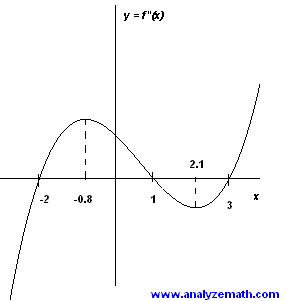
The graph of the second derivative $f''(x)$ of a function $f$ is shown below.
a) Where does $f'(x)$ have a local maximum or minimum?
b) Where is $f$ concave up?
c) Where is $f$ concave down?
d) Where are the points of inflection of $f$?
Show Solution
- a) $f'(x)$ has a local maximum where $f''(x)=0$ and changes from positive to negative: $$x=1$$ $f'(x)$ has local minima where $f''(x)=0$ and changes from negative to positive: $$x=-2\quad\text{and}\quad x=3$$
- b) $f$ is concave up where $f''(x)>0$: $$(-2,1)\cup(3,+\infty)$$
- c) $f$ is concave down where $f''(x)<0$: $$(-\infty,-2)\cup(1,3)$$
- d) Points of inflection occur where $f''(x)$ changes sign (crosses the x-axis): $$x=-2,\;1,\;3$$