Digital SAT Math Practice Test 14: Advanced Module

This advanced practice module contains 19 questions and detailed solutions strictly validated for the current Digital SAT format. Legacy topics such as complex numbers and abstract number theory have been removed. The questions are categorized into the four official testing domains: Algebra, Advanced Math, Problem-Solving and Data Analysis, and Geometry and Trigonometry, designed specifically to simulate the difficulty of the second, harder testing module.

Domain 1: Algebra

Focus: Linear equations, systems, linear modeling, and inequalities.

Question 1

The graph of the cost $C(x) = mx + b$ in US dollars as a function of the number of units produced $x$ by a company, is shown below. $m$ is the cost per unit and $b$ is the fixed cost.

sat question - cost graph

Use the graph to approximate $m$, the cost per unit, and the fixed cost $b$.

View Solution

Identify two distinct points from the line to calculate the slope $m$. Let's use the $y$-intercept $(0, 2000)$ and another clear point $(12000, 8000)$.

$$m = \frac{8000 - 2000}{12000 - 0} = \frac{6000}{12000} = 0.5$$

The slope $m$ is $0.5$ dollars per unit.

The fixed cost $b$ is the $y$-intercept of the graph, which is where $x = 0$. From the graph, this value is $2000$.

Answer: $m = 0.5$ USD/unit, $b = 2000$ USD

Question 2

The graph of the revenue $R(x) = ax$ in US dollars as a function of the number of units $x$ produced by a company, is shown below. $a$ is the revenue per unit sold.

sat question - revenue graph

Use the graph to approximate $a$.

View Solution

Identify two points to find the slope $a$. Using the origin $(0, 0)$ and a clear point on the grid like $(8000, 6000)$:

$$a = \frac{6000 - 0}{8000 - 0} = \frac{6}{8} = 0.75$$

Answer: $a = 0.75$ USD/unit

Question 3

The graphs of the revenue $R(x) = ax$ and the cost $C(x) = mx + b$ are shown below. $R$ and $C$ are in US dollars and $x$ is the number of units produced. The break even point is the point at which $R(x) = C(x)$.

sat question - break even graph

Find the revenue at the break even point in terms of $m$, $a$ and $b$.

View Solution

Set the two equations equal to each other to find the break even quantity $x$:

$$ax = mx + b \implies ax - mx = b \implies x(a - m) = b \implies x = \frac{b}{a - m}$$

Now substitute this quantity $x$ back into the revenue equation $R(x) = ax$ to find the revenue at that point:

$$R = a \cdot \left(\frac{b}{a - m}\right) = \frac{ab}{a - m}$$

Answer: $R = \frac{ab}{a - m}$

Domain 2: Advanced Math

Focus: Quadratics, higher-order polynomials, rational equations, and function notation.

Question 4

To which expression is $\frac{\frac{x^2+1}{x+2}}{\frac{1}{x+2}+4}$ equivalent to for $x > 6$?

  1. $\frac{x^2+1}{4}$
  2. $\frac{x^2+1}{4x + 9}$
  3. $\frac{x^2+1}{x + 2}$
  4. $\frac{1}{x + 2}$
View Solution

First, write the main denominator as a single rational expression by finding a common denominator:

$$\frac{1}{x+2} + 4 = \frac{1}{x+2} + \frac{4(x + 2)}{x + 2} = \frac{1 + 4x + 8}{x+2} = \frac{4x + 9}{x+2}$$

Now substitute this back into the original complex fraction:

$$\frac{\frac{x^2+1}{x+2}}{\frac{4x + 9}{x+2}}$$

To divide fractions, multiply by the reciprocal of the denominator:

$$= \frac{x^2+1}{x+2} \cdot \frac{x+2}{4x+9}$$

Cancel out the common $(x+2)$ terms:

$$= \frac{x^2+1}{4x+9}$$

Answer: B

Question 5

$t$ seconds after a ball is thrown vertically from ground, at a velocity of 30 meters per second, its height $h$ changes with time as follows: $h(t) = -5t^2 + 30t$ where $h$ is in meters. For how long will the height of the ball be more than 25 meters?

View Solution

Set the height equation equal to 25 to find the exact times the ball crosses the 25-meter mark:

$$-5t^2 + 30t = 25$$

Move all terms to one side to form a quadratic equation:

$$-5t^2 + 30t - 25 = 0$$

Divide the entire equation by $-5$ to simplify:

$$t^2 - 6t + 5 = 0$$

Factor the quadratic:

$$(t - 1)(t - 5) = 0$$

The solutions are $t = 1$ and $t = 5$. Since the parabola opens downward (negative $t^2$ coefficient), the ball is above 25 meters between $t = 1$ and $t = 5$.

Duration = $5 - 1 = 4$ seconds.

Answer: 4 seconds

Question 6

$t$ seconds after a ball is thrown vertically from ground, at a velocity of 30 meters per second, its height $h$ changes with time as follows: $h(t) = -5t^2 + 30t$ where $h$ is in meters. What is the change in the height of the ball between $t = 1$ and $t = 2$ seconds?

View Solution

Calculate the height at $t = 1$:

$$h(1) = -5(1)^2 + 30(1) = -5 + 30 = 25 \text{ meters}$$

Calculate the height at $t = 2$:

$$h(2) = -5(2)^2 + 30(2) = -20 + 60 = 40 \text{ meters}$$

Find the difference:

$$\text{Change} = 40 - 25 = 15 \text{ meters}$$

Answer: The height increases by 15 meters.

Question 7

Functions $g$ and $f$ are given by $g(u) = 3u + 3$ and $f(t+2) = g(2t - 3)$. What is $f(x)$?

View Solution

We want to find $f(x)$, but we are given $f(t+2)$. Let's do a substitution: let $x = t + 2$.

This means $t = x - 2$. Substitute this $t$ into the right side of the equation:

$$f(x) = g(2(x - 2) - 3) = g(2x - 4 - 3) = g(2x - 7)$$

Now, apply the definition of the function $g(u) = 3u + 3$ using $u = 2x - 7$:

$$f(x) = 3(2x - 7) + 3 = 6x - 21 + 3 = 6x - 18$$

Answer: $f(x) = 6x - 18$

Question 8

$m$ is a real number in the equation $2x^2 + 3mx = 4 - 2x$. For what value(s) of $m$ is the sum of the solutions greater than 5?

View Solution

First, write the quadratic equation in standard form ($Ax^2 + Bx + C = 0$):

$$2x^2 + 3mx + 2x - 4 = 0 \implies 2x^2 + (3m + 2)x - 4 = 0$$

According to Vieta's formulas, the sum of the roots of a quadratic equation is $-\frac{B}{A}$.

$$\text{Sum} = -\frac{3m + 2}{2}$$

Set up the inequality as stated in the problem (Sum $> 5$):

$$-\frac{3m + 2}{2} > 5$$

Multiply by 2:

$$-(3m + 2) > 10 \implies -3m - 2 > 10 \implies -3m > 12$$

Divide by $-3$ (remember to flip the inequality sign!):

$$m < -4$$

Answer: $m < -4$

Domain 3: Problem-Solving and Data Analysis

Focus: Rates, proportions, unit conversions, and probability.

Question 9

The magnitude of the universal gravitational force $F$ between two bodies of masses $m_1$ and $m_2$ is given by $F = \frac{G m_1 m_2}{d^2}$. If the force at distance $d$ is 2000 N, what is the force at distance $4d$?

View Solution

This is a proportional reasoning question. Notice that distance is squared in the denominator. Substitute $4d$ into the formula:

$$F_2 = \frac{G m_1 m_2}{(4d)^2} = \frac{G m_1 m_2}{16d^2} = \frac{1}{16} \cdot \left(\frac{G m_1 m_2}{d^2}\right)$$

The force is $\frac{1}{16}$ of the original force.

$$F_2 = \frac{1}{16} \cdot 2000 = 125 \text{ N}$$

Answer: 125 Newtons

Question 10

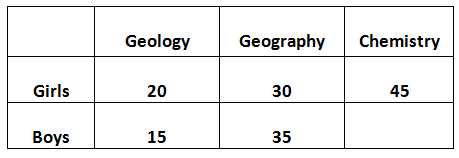
A total of 200 students are registered. A student can register in several courses but must register in only one course of geology, geography or chemistry. The table below shows registration. How many boys are registered in chemistry?

sat question - student registration table
View Solution

Since the total number of students is 200, we can subtract all the known entries from the total to find the missing value.

Sum of known entries: $20 + 30 + 45 + 15 + 35 = 145$

Boys in chemistry = $Total - 145 = 200 - 145 = 55$

Answer: 55

Question 11

Use the table in the previous problem to find the probability $p$ that a student selected at random is registered in geology or geography.

View Solution

First, calculate the total number of students in both Geology and Geography (combining boys and girls):

$$\text{Geology} = 20 + 30 = 50$$

$$\text{Geography} = 15 + 35 = 50$$

Total students in these two subjects = $50 + 50 = 100$.

The probability $p$ is the target group divided by the total population (200):

$$p = \frac{100}{200} = 0.5$$

Answer: $0.5$

Question 12

According to relativity, mass $m$ of a particle at speed $v$ is given by $m = \frac{m_0}{\sqrt{1 - v^2/c^2}}$. What is $m$ if $v = 0.9c$ and $m_0 = 1$ gram?

View Solution

Substitute the given values into the formula:

$$m = \frac{1}{\sqrt{1 - \frac{(0.9c)^2}{c^2}}} = \frac{1}{\sqrt{1 - \frac{0.81c^2}{c^2}}}$$

The $c^2$ terms cancel out:

$$m = \frac{1}{\sqrt{1 - 0.81}} = \frac{1}{\sqrt{0.19}}$$

Using a calculator: $m \approx 2.294$ grams.

Answer: $\approx 2.3$ grams

Question 13

John can read 15 pages every 20 minutes. Linda can read 20 pages every 16 minutes. How many minutes are needed for them to read a total of 100 pages together?

View Solution

First, find the unit rate of reading for each person (pages per minute).

John's rate = $\frac{15}{20} = \frac{3}{4}$ pages/min.

Linda's rate = $\frac{20}{16} = \frac{5}{4}$ pages/min.

When working together, their rates add up:

Combined rate = $\frac{3}{4} + \frac{5}{4} = \frac{8}{4} = 2$ pages/min.

To find the time for 100 pages, divide the total pages by the combined rate:

$$\text{Time} = \frac{100 \text{ pages}}{2 \text{ pages/min}} = 50 \text{ minutes}$$

Answer: 50 minutes

Domain 4: Geometry and Trigonometry

Focus: Coordinate geometry, circles, volume, and angles.

Question 14

The graphs of a semi circle of diameter $OB$ and two lines are shown below. Point $O$ is the origin. Line $L$ has equation $y = \frac{1}{3}x$ and intersects line $M$ and the semi circle at $C$. Line $M$ intersects the semi circle and the x-axis at $(4, 0)$. Find an equation for line $M$.

sat question - semi circle and lines
View Solution

According to Thales's Theorem, an angle inscribed across a circle's diameter is always a right angle ($90^\circ$). Since $OB$ is a diameter, $\angle OCB = 90^\circ$.

This means Line $L$ and Line $M$ are perpendicular. Perpendicular lines have negative reciprocal slopes.

Slope of $L = \frac{1}{3}$, so the slope of $M = -3$.

We know Line $M$ passes through point $B(4, 0)$. Use point-slope form:

$$y - y_1 = m(x - x_1) \implies y - 0 = -3(x - 4) \implies y = -3x + 12$$

Answer: $y = -3x + 12$

Question 15

Triangle $ABC$ is equilateral. What are the coordinates of point $C$?

sat question - equilateral triangle
View Solution

Let $C = (a, b)$. The base $AB$ lies on the horizontal line $y=1$. The length of $AB$ is the distance between $(1,1)$ and $(5,1)$, which is $4$.

Since the triangle is equilateral, sides $AC$ and $BC$ must also equal $4$. Use the distance formula for $AC$ and $BC$ squared:

1) $AC^2: (a-1)^2 + (b-1)^2 = 16$

2) $BC^2: (a-5)^2 + (b-1)^2 = 16$

Subtracting the two equations gives: $(a-1)^2 = (a-5)^2 \implies a = 3$. (This makes sense, as the peak of an equilateral triangle lies halfway between the base's $x$-coordinates).

Substitute $a=3$ into the first equation to find $b$:

$$(3-1)^2 + (b-1)^2 = 16 \implies 4 + (b-1)^2 = 16 \implies (b-1)^2 = 12$$

$$b - 1 = \pm \sqrt{12} = \pm 2\sqrt{3} \implies b = 1 \pm 2\sqrt{3}$$

Since the triangle points upwards into the first quadrant, we take the positive value: $b = 1 + 2\sqrt{3}$.

Answer: $(3, 1 + 2\sqrt{3})$

Question 16

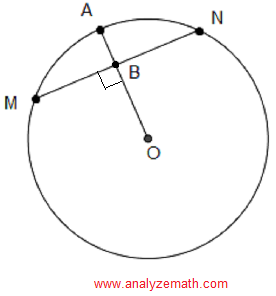
If $AB$ is $1/3$ of $BO$, what is the length of chord $MN$ of the circle with center $O$ and radius $5 \text{ cm}$?

sat question - right similar triangle
View Solution

The radius of the circle is $AO = 5$. Since $AB + BO = 5$, and $AB = \frac{1}{3}BO$, we can set up an equation:

Let $BO = x$. Then $\frac{1}{3}x + x = 5 \implies \frac{4}{3}x = 5 \implies x = \frac{15}{4}$.

Draw a radius from $O$ to $M$. This creates a right triangle $\triangle MBO$ with hypotenuse $OM = 5$ (radius) and leg $OB = \frac{15}{4}$.

Use the Pythagorean theorem to find the other leg $MB$ (which is half the chord):

$$MB^2 + \left(\frac{15}{4}\right)^2 = 5^2 \implies MB^2 + \frac{225}{16} = 25$$

$$MB^2 = \frac{400}{16} - \frac{225}{16} = \frac{175}{16}$$

$$MB = \frac{\sqrt{175}}{4} = \frac{5\sqrt{7}}{4}$$

The full chord $MN$ is twice $MB$:

$$MN = 2 \cdot \frac{5\sqrt{7}}{4} = \frac{5\sqrt{7}}{2}$$

Answer: $\frac{5\sqrt{7}}{2}$ cm

Question 17

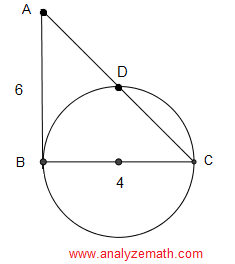
In the figure below, $AB$ is tangent to a circle with diameter $BC$. Find the length of segment $AD$.

sat question - chord of circles
View Solution

Since $AB$ is tangent to the circle at $B$, and $BC$ is the diameter, $\angle ABC$ is $90^\circ$. By Thales's Theorem, angle $BDC$ is inscribed on the diameter $BC$, so $\angle BDC$ is also $90^\circ$.

Because $\angle BDA$ and $\angle BDC$ are supplementary, $\triangle BDA$ is also a right triangle.

We have similar triangles: $\triangle ABC \sim \triangle BDA$ (they share angle $A$ and a $90^\circ$ angle).

First, find the hypotenuse $AC$ of the large triangle:

$$AC = \sqrt{6^2 + 4^2} = \sqrt{52} = 2\sqrt{13}$$

Using the similarity ratio to find altitude $BD$:

$$\frac{AC}{AB} = \frac{BC}{BD} \implies \frac{2\sqrt{13}}{6} = \frac{4}{BD} \implies BD = \frac{24}{2\sqrt{13}} = \frac{12}{\sqrt{13}}$$

Now, use the Pythagorean theorem on the small $\triangle BDA$ to find $AD$:

$$AD = \sqrt{AB^2 - BD^2} = \sqrt{36 - \frac{144}{13}} = \sqrt{\frac{468 - 144}{13}} = \sqrt{\frac{324}{13}} = \frac{18}{\sqrt{13}}$$

Answer: $\frac{18}{\sqrt{13}}$

Question 18

Lines $m$ and $n$ are parallel and lines $k, n$ and $J$ all intersect at point $O$. Find angle $x$.

sat question - parallel lines and intersects
View Solution

Look at the top intersection on line $m$. The angle adjacent to the $116^\circ$ angle forms a straight line ($180^\circ$). Let's call it $\alpha$:

$$\alpha = 180^\circ - 116^\circ = 64^\circ$$

Because lines $m$ and $n$ are parallel, alternate interior angles are equal. This means the angle inside the triangle at the bottom intersection is also $64^\circ$ ($\beta = 64^\circ$).

Now, look at the triangle formed at intersection $O$. The angles in a triangle must add up to $180^\circ$:

$$x + 64^\circ + 48^\circ = 180^\circ \implies x + 112^\circ = 180^\circ \implies x = 68^\circ$$

Answer: $68^\circ$

Question 19

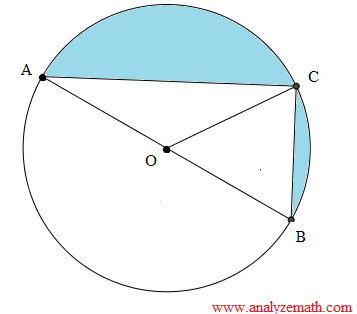
Points $A, B,$ and $C$ lie on a circle with radius $5 \text{ cm}$. $O$ is the center, and $\angle CAB = 30^\circ$. Find the shaded area to one decimal place.

sat question - circle and right triangle
View Solution

The inscribed angle $\angle CAB$ is $30^\circ$. The central angle subtending the same arc $CB$ is exactly double: $\angle COB = 2 \times 30^\circ = 60^\circ$.

Since $AB$ passes through the center $O$, it is a diameter, meaning it's a straight line ($180^\circ$). The adjacent central angle is $\angle AOC = 180^\circ - 60^\circ = 120^\circ$.

The shaded area is equal to the area of the top semi-circle minus the area of the two triangles ($\triangle AOC$ and $\triangle COB$).

We use the triangle area formula $A = \frac{1}{2}ab\sin(\theta)$, where $a$ and $b$ are the radius ($R=5$):

$$\text{Area } \triangle AOC = \frac{1}{2}(5)(5)\sin(120^\circ) = \frac{25}{2}\left(\frac{\sqrt{3}}{2}\right) = \frac{25\sqrt{3}}{4}$$

$$\text{Area } \triangle COB = \frac{1}{2}(5)(5)\sin(60^\circ) = \frac{25}{2}\left(\frac{\sqrt{3}}{2}\right) = \frac{25\sqrt{3}}{4}$$

Now, calculate the final shaded area:

$$\text{Shaded Area} = \frac{1}{2} \pi R^2 - (\text{Area } \triangle AOC + \text{Area } \triangle COB)$$

$$= \frac{25\pi}{2} - \left(\frac{25\sqrt{3}}{4} + \frac{25\sqrt{3}}{4}\right) = \frac{25\pi}{2} - \frac{25\sqrt{3}}{2} \approx 39.27 - 21.65 \approx 17.6 \text{ cm}^2$$

(Note: Calculations yield approximately $17.6 \text{ cm}^2$)

Answer: $\approx 17.6 \text{ cm}^2$