This page presents carefully selected practice questions on exponential functions, accompanied by detailed, step-by-step solutions and explanations. Topics cover algebraic simplification, parameter fitting, real-world population growth models, radioactive decay half-life problems, and advanced exponential equations.
Properties of Exponential Functions
For all real numbers \(x\) and \(y\), and for any base \(a > 0\) with \(a \neq 1\):
- \(a^x a^y = a^{x+y}\) (Example: \(2^3 \cdot 2^5 = 2^8\))
- \((a^x)^y = a^{xy}\) (Example: \((4^2)^5 = 4^{10}\))
- \((ab)^x = a^x b^x\) (Example: \((3 \times 7)^3 = 3^3 \cdot 7^3\))
- \(\left(\frac{a}{b}\right)^x = \frac{a^x}{b^x}\) (Example: \(\left(\frac{3}{5}\right)^3 = \frac{3^3}{5^3}\))
- \(\frac{a^x}{a^y} = a^{x-y}\) (Example: \(\frac{5^7}{5^4} = 5^3\))
Questions with Detailed Solutions
Question 1: Simplifying Expressions
Simplify the expression:
\[ 2^x - 2^{x+1} \]Solution Steps:
- Use the property \(a^{x+y} = a^x a^y\) to rewrite \(2^{x+1} = 2^x \cdot 2\).
- Substitute into the expression: \(2^x - 2^x \cdot 2\).
- Factor out \(2^x\): \(2^x(1 - 2)\).
- Simplify: \(-2^x\).
Question 2: Finding Function Parameters
Find constants \(A\) and \(k\) such that \(f(1)=1\) and \(f(2)=2\), where \(f(x) = A e^{kx}\).
Solution Steps:
- From \(f(1)=1\): \(A e^k = 1\)
- From \(f(2)=2\): \(A e^{2k} = 2\)
- Rewrite the second equation: \(A e^k e^k = 2\)
- Substitute \(A e^k = 1\) into the expression to get \(e^k = 2\).
- Take the natural logarithm: \(k = \ln(2)\).
- Substitute back into \(A e^k = 1\) to find \(A = \frac{1}{2}\).
- Final form: \(f(x) = \frac{1}{2} e^{x\ln(2)} = 2^{x-1}\).
Check: \(f(1) = 2^{0} = 1\), and \(f(2) = 2^{1} = 2\).
Question 3: Population Growth Modeling
Two cities have populations (in thousands) given by:
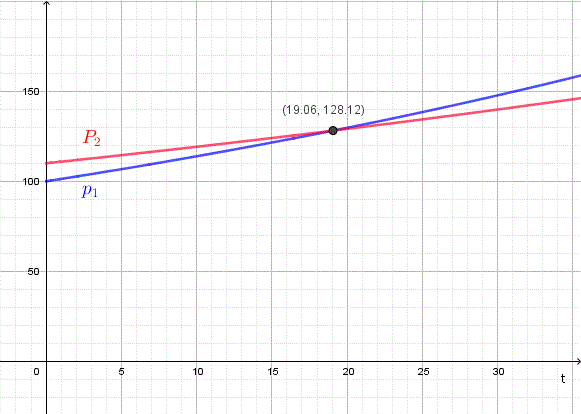
\[ P_1(t) = 100 e^{0.013t}, \qquad P_2(t) = 110 e^{0.008t} \]Here, \(t\) is time in years since 2004. When will the populations be equal, and what will that population be?
Solution Steps:
- Set \(P_1(t) = P_2(t)\): \(100 e^{0.013t} = 110 e^{0.008t}\)
- Divide by \(100 e^{0.008t}\): \(e^{0.005t} = 1.1\)
- Take the natural logarithm: \(0.005t = \ln(1.1)\)
- Solve for \(t\): \(t = \frac{\ln(1.1)}{0.005} \approx 19\) years.
- Target Year: \(2004 + 19 = 2023\).
- Population: \(P_1(19) = 100 e^{0.013 \cdot 19} \approx 128\) thousand.
Graphical check:
Question 4: Radioactive Decay Half-Life
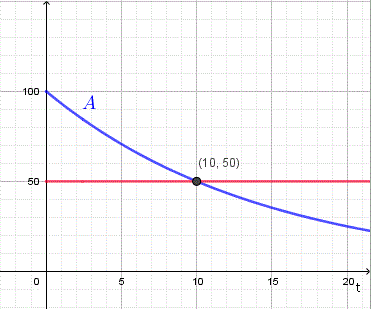
A radioactive substance decays according to \(A(t) = A_0 e^{rt}\). If the half-life is 10 days, find \(r\) to three decimal places.
Solution Steps:
- At half-life time \(t = 10\), the amount is \(\frac{A_0}{2}\): \(A_0 e^{10r} = \frac{A_0}{2}\)
- Simplify by dividing out \(A_0\): \(e^{10r} = \frac{1}{2}\)
- Take natural logarithms on both sides: \(10r = \ln\left(\frac{1}{2}\right)\)
- Solve for \(r\): \(r = 0.1 \ln\left(\frac{1}{2}\right) \approx -0.069\)
Question 5: Solving a Nonlinear Exponential Equation (Challenging)
Solve the following exponential equation for real values of \(x\):
\[ 4^x - 2^{x+1} - 8 = 0 \]Solution Steps:
- Rewrite \(4^x\) as \((2^2)^x = (2^x)^2\) and use exponent rules on \(2^{x+1}\) to write it as \(2 \cdot 2^x\).
- Substitute these into the equation: \[ (2^x)^2 - 2 \cdot 2^x - 8 = 0 \]
- Let \(u = 2^x\) to transform the equation into a standard quadratic form: \[ u^2 - 2u - 8 = 0 \]
- Factor the quadratic equation: \[ (u - 4)(u + 2) = 0 \]
- Find the roots for \(u\): \[ u = 4 \quad \text{or} \quad u = -2 \]
- Substitute back \(u = 2^x\):
- \(2^x = 4 \implies 2^x = 2^2 \implies x = 2\)
- \(2^x = -2\) has no real solution since the range of an exponential function is strictly positive (\(2^x > 0\)).
- Final Answer: \(x = 2\).