Définition des transformées de Fourier
Si \( f(t) \) est une fonction de la variable réelle \( t \), alors la transformée de Fourier \( F(\omega) \) de \( f \) est donnée par l'intégrale :
Intégrale de la transformée de Fourier :
\[ F(\omega) = \int_{-\infty}^{+\infty} e^{-j \omega t} f(t) \, dt \]
où \( j = \sqrt{-1} \) est l'unité imaginaire.
Dans ce qui suit, \( u(t) \) est la fonction échelon unité définie par :
\( u(t) = 1 \) pour \( t \ge 0 \) et \( u(t) = 0 \) pour \( t < 0 \).
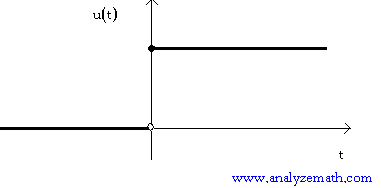
Table des transformées de Fourier
| Fonction \( f(t) \) | Transformée de Fourier \( F(\omega) \) |
|---|---|
| \( u(t) e^{-a t} \), \( a > 0 \) | \( \dfrac{1}{a + j \omega} \) |
| \( f(t) = 1 \) pour \( -a \le t \le a \) et \( 0 \) sinon |
\( \dfrac{2 \sin(\omega a)}{\omega} \) |
| \( f(t) = A \) (constante) | \( 2 \pi A \delta(\omega) \) |
| \( \delta(t) \) | \( 1 \) |
| \( \delta(t - a) \) | \( e^{-j \omega a} \) |
| \( \cos(a t) \) | \( \pi [\delta(\omega + a) + \delta(\omega - a)] \) |
| \( \sin(a t) \) | \( -j \pi [\delta(\omega - a) - \delta(\omega + a)] \) |
| \( e^{j a t} \) | \( 2 \pi \delta(\omega - a) \) |
| \( f'(t) \) | \( j \omega F(\omega) \) |
| \( f''(t) \) | \( (j \omega)^2 F(\omega) \) |
| \( t f(t) \) | \( j \dfrac{d F(\omega)}{d \omega} \) |
| \( t^2 f(t) \) | \( j^2 \dfrac{d^2 F(\omega)}{d \omega^2} \) |