La dérivation est utilisée pour analyser les propriétés clés des fonctions quadratiques telles que les intervalles de croissance et de décroissance, les maxima locaux et les minima locaux.
A - Fonction quadratique sous forme générale
Les fonctions quadratiques sous leur forme générale s'écrivent :
où \(a\), \(b\) et \(c\) sont des nombres réels avec \(a \neq 0\).
La première dérivée de \(f\) est :
\[ f'(x) = 2 a x + b \]Pour déterminer les points de maximum ou de minimum ainsi que les intervalles de croissance ou de décroissance, analysez le signe de \(f'(x)\). La dérivée est positive si :
\[ 2 a x + b > 0 \quad \Rightarrow \quad 2 a x > -b \]Nous considérons deux cas selon le signe de \(a\) :
Cas 1 : \(a > 0\)
En divisant les deux côtés de l'inégalité par \(2a > 0\), nous obtenons :
\[ x > -\dfrac{b}{2a} \]Le tableau ci-dessous résume le signe de \(f'(x)\) et indique si \(f\) est croissante ou décroissante :

Par conséquent, la fonction quadratique possède un minimum en \(\left(-\dfrac{b}{2a}, f\left(-\dfrac{b}{2a}\right)\right)\), est décroissante sur \((-\infty, -\dfrac{b}{2a})\) et croissante sur \(\left(-\dfrac{b}{2a}, +\infty\right)\).
Cas 2 : \(a < 0\)
En divisant les deux côtés par \(2a < 0\), l'inégalité est inversée :
\[ x < -\dfrac{b}{2a} \]Le signe de \(f'(x)\) est analysé à l'aide du tableau suivant :

Dans ce cas, la fonction quadratique possède un maximum en \(\left(-\dfrac{b}{2a}, f\left(-\dfrac{b}{2a}\right)\right)\), est croissante sur \((-\infty, -\dfrac{b}{2a})\) et décroissante sur \(\left(-\dfrac{b}{2a}, +\infty\right)\).
B - Fonction quadratique sous forme canonique (sommet)
Les fonctions quadratiques sous forme canonique s'écrivent :
où \(a \neq 0\) et \(h, k\) sont des nombres réels.
La dérivée est :
\[ f'(x) = 2 a (x - h) \]Nous analysons le signe de \(f'(x)\) en étudiant :
\[ a (x - h) > 0 \]Cas 1 : \(a > 0\)
En divisant les deux côtés par \(a > 0\) :
\[ x > h \]Utilisez le tableau suivant pour analyser le signe :
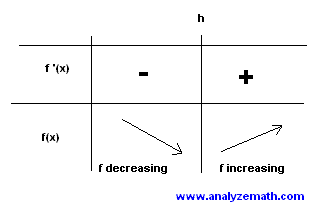
Par conséquent, la fonction quadratique possède un minimum en \((h, k)\), est décroissante sur \((-\infty, h)\) et croissante sur \((h, +\infty)\).
Cas 2 : \(a < 0\)
En divisant les deux côtés par \(a < 0\), l'inégalité est inversée :
\[ x < h \]Le signe de \(f'(x)\) est analysé à l'aide de :

Ici, la fonction quadratique possède un maximum en \((h, k)\), est croissante sur \((-\infty, h)\) et décroissante sur \((h, +\infty)\).
Exemples traités
Exemple 1 : Trouver l'extremum de \( f(x) = 2x^2 - 8x + 1 \)
Tout d'abord, trouvez la dérivée :
\[ f'(x) = 4x - 8 \]La dérivée change de signe en \(x = \dfrac{8}{4} = 2\). Puisque \(a = 2 > 0\), \(f\) possède un minimum en \((2, f(2)) = (2, -7)\).
Comportement de la fonction :
- Décroissante sur \((-\infty, 2)\)
- Croissante sur \((2, +\infty)\)

Exemple 2 : Trouver l'extremum de \( f(x) = - (x + 3)^2 + 1 \)
La dérivée est :
\[ f'(x) = -2(x + 3) \]La dérivée change de signe en \(x = -3\). Puisque \(a = -1 < 0\), \(f\) possède un maximum en \((-3, 1)\).
Comportement de la fonction :
- Croissante sur \((-\infty, -3)\)
- Décroissante sur \((-3, +\infty)\)

Exercices sur les propriétés des fonctions quadratiques
Pour chaque fonction quadratique ci-dessous, trouvez l'extremum (minimum ou maximum), l'intervalle de croissance et l'intervalle de décroissance :
- \( f(x) = x^2 + 6x \)
- \( f(x) = -x^2 - 2x + 3 \)
- \( f(x) = x^2 - 5 \)
- \( f(x) = -(x - 4)^2 + 2 \)
- \( f(x) = -x^2 \)
Réponses aux exercices
- a) Minimum en \((-3, -9)\). Décroissante sur \((-\infty, -3)\), croissante sur \((-3, +\infty)\).
- b) Maximum en \((-1, 4)\). Croissante sur \((-\infty, -1)\), décroissante sur \((-1, +\infty)\).
- c) Minimum en \((0, -5)\). Décroissante sur \((-\infty, 0)\), croissante sur \((0, +\infty)\).
- d) Maximum en \((4, 2)\). Croissante sur \((-\infty, 4)\), décroissante sur \((4, +\infty)\).
- e) Maximum en \((0, 0)\). Croissante sur \((-\infty, 0)\), décroissante sur \((0, +\infty)\).