Comment trouver les limites de fonctions avec valeurs absolues ; plusieurs exemples et solutions détaillées sont présentés ainsi que des interprétations graphiques. Une série d'exercices avec réponses est présentée au bas de la page.
Dans ce qui suit, \( C \) représente la constante d'intégration le cas échéant.
Questions avec solutions détaillées
Cliquez sur chaque question pour afficher sa solution détaillée étape par étape.
Question 1
Trouvez la limite : \( \displaystyle \lim_{x \to -1} \dfrac{x}{|x|} \)
Afficher la solution
Les étapes pour trouver la limite sont :
\[ \lim_{x \to -1} \dfrac{x}{|x|} = \dfrac{-1}{|-1|} = \dfrac{-1}{1} = -1 \]Question 2
Évaluez la limite : \( \displaystyle \lim_{x \to 1} \dfrac{x}{|x|} \)
Afficher la solution
Les étapes pour trouver la limite sont :
\[ \lim_{x \to 1} \dfrac{x}{|x|} = \dfrac{1}{|1|} = 1 \]Question 3
Trouvez la limite : \( \displaystyle \lim_{x \to 0} \dfrac{x}{|x|} \)
Afficher la solution
Rappelez-vous que :
\( |x| = x \) pour \( x \ge 0 \) et \( |x| = -x \) pour \( x < 0 \)
Calculons la limite à gauche de \( x = 0 \) où \( x < 0 \) et par conséquent \( |x| = -x \) :
\[ \lim_{x \to 0^-} \dfrac{x}{|x|} = \lim_{x \to 0^-} \dfrac{x}{-x} = \lim_{x \to 0^-} (-1) = -1 \]Calculons la limite à droite de \( x = 0 \) où \( x > 0 \) et par conséquent \( |x| = x \) :
\[ \lim_{x \to 0^+} \dfrac{x}{|x|} = \lim_{x \to 0^+} \dfrac{x}{x} = \lim_{x \to 0^+} 1 = 1 \]Les limites à gauche et à droite de \( x = 0 \) ne sont pas égales, par conséquent :
\[ \lim_{x \to 0} \dfrac{x}{|x|} \quad \text{n'existe pas} \]Le graphique de \( f(x) = \dfrac{x}{|x|} \) est présenté ci-dessous, illustrant que les limites à gauche et à droite de 0 ne sont pas égales.

Question 4
Évaluez la limite : \( \displaystyle \lim_{x \to \infty} \dfrac{x}{|x|} \)
Afficher la solution
Lorsque \( x \) augmente indéfiniment, \( x > 0 \) et par conséquent \( |x| = x \). D'où :
\[ \lim_{x \to \infty} \dfrac{x}{|x|} = \lim_{x \to \infty} \dfrac{x}{x} = \lim_{x \to \infty} 1 = 1 \]Question 5
Trouvez la limite : \( \displaystyle \lim_{x \to -\infty} \dfrac{x}{|x|} \)
Afficher la solution
Lorsque \( x \) diminue indéfiniment, \( x < 0 \) et par conséquent \( |x| = -x \). D'où :
\[ \lim_{x \to -\infty} \dfrac{x}{|x|} = \lim_{x \to -\infty} \dfrac{x}{-x} = \lim_{x \to -\infty} (-1) = -1 \]Question 6
La limite \( \displaystyle \lim_{x \to -2} \dfrac{|x + 2|}{x + 2} \) existe-t-elle ?
Afficher la solution
Calculons séparément la limite à gauche de \( -2 \) (où \( x \le -2 \)) et à droite de \( -2 \) (où \( x \ge -2 \)).
Rappelez-vous que :
Si \( x + 2 \ge 0 \) ou \( x \ge -2 \), alors \( |x + 2| = x + 2 \).
Si \( x + 2 \le 0 \) ou \( x \le -2 \), alors \( |x + 2| = -(x + 2) \).
Calculons la limite à gauche de \( x = -2 \) :
\[ \lim_{x \to -2^-} \dfrac{|x + 2|}{x + 2} = \lim_{x \to -2^-} \dfrac{-(x + 2)}{x + 2} = \lim_{x \to -2^-} (-1) = -1 \]Calculons la limite à droite de \( x = -2 \) :
\[ \lim_{x \to -2^+} \dfrac{|x + 2|}{x + 2} = \lim_{x \to -2^+} \dfrac{x + 2}{x + 2} = \lim_{x \to -2^+} 1 = 1 \]Les limites à gauche et à droite de \( x = -2 \) ne sont pas égales, par conséquent :
\[ \lim_{x \to -2} \dfrac{|x + 2|}{x + 2} \quad \text{n'existe pas} \]Question 7
Trouvez la limite : \( \displaystyle \lim_{x \to 1} \dfrac{x^2 + 2x - 3}{|x - 1|} \)
Afficher la solution
En \( x = 1 \), le numérateur et le dénominateur sont tous deux égaux à zéro, ils partagent donc un facteur commun \( x - 1 \). En factorisant le numérateur :
\[ \lim_{x \to 1} \dfrac{x^2 + 2x - 3}{|x - 1|} = \lim_{x \to 1} \dfrac{(x - 1)(x + 3)}{|x - 1|} \]Rappelez-vous que \( |x - 1| = x - 1 \) pour \( x \ge 1 \) et \( |x - 1| = -(x - 1) \) pour \( x \le 1 \).
Limite à gauche de \( x = 1 \) :
\[ \lim_{x \to 1^-} \dfrac{x^2 + 2x - 3}{|x - 1|} = \lim_{x \to 1^-} \dfrac{(x - 1)(x + 3)}{-(x - 1)} = \lim_{x \to 1^-} -(x + 3) = -4 \]Limite à droite de \( x = 1 \) :
\[ \lim_{x \to 1^+} \dfrac{x^2 + 2x - 3}{|x - 1|} = \lim_{x \to 1^+} \dfrac{(x - 1)(x + 3)}{x - 1} = \lim_{x \to 1^+} (x + 3) = 4 \]Les limites à gauche et à droite ne sont pas égales, par conséquent :
\[ \lim_{x \to 1} \dfrac{x^2 + 2x - 3}{|x - 1|} \quad \text{n'existe pas} \]Le graphique de \( f(x) = \dfrac{x^2 + 2x - 3}{|x - 1|} \) est présenté ci-dessous, montrant clairement que les limites à gauche et à droite en 1 ne sont pas égales.
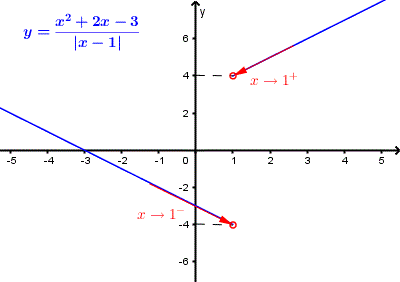
Question 8
Évaluez la limite : \( \displaystyle \lim_{x \to \infty} \dfrac{x^2 + 5x + 7}{|x + 2|} \)
Afficher la solution
Lorsque \( x \) augmente indéfiniment, \( x + 2 \) augmente également indéfiniment et par conséquent \( x + 2 \ge 0 \), d'où :
\[ \lim_{x \to \infty} \dfrac{x^2 + 5x + 7}{|x + 2|} = \lim_{x \to \infty} \dfrac{x^2 + 5x + 7}{x + 2} = +\infty \]Question 9
Trouvez la limite : \( \displaystyle \lim_{x \to -\infty} \dfrac{x^2 + 5x + 7}{|x + 2|} \)
Afficher la solution
Lorsque \( x \) diminue indéfiniment, \( x + 2 \) diminue également indéfiniment et par conséquent \( x + 2 \le 0 \), d'où :
\[ \lim_{x \to -\infty} \dfrac{x^2 + 5x + 7}{|x + 2|} = \lim_{x \to -\infty} \dfrac{x^2 + 5x + 7}{-(x + 2)} = +\infty \]Le graphique de \( f(x) = \dfrac{x^2 + 5x + 7}{|x + 2|} \) est présenté ci-dessous, illustrant que \( y = f(x) \) augmente indéfiniment lorsque \( x \) augmente ou diminue indéfiniment.
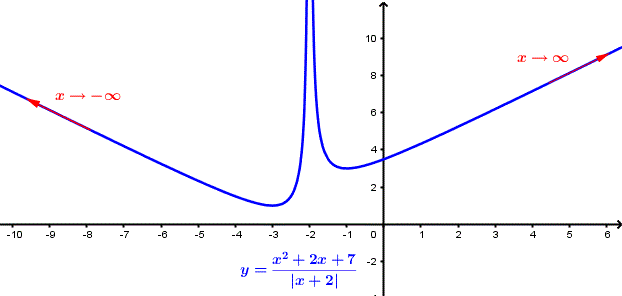
Exercices
Calculez les limites suivantes. Cliquez sur chaque exercice pour vérifier vos réponses.
Exercice 1
\( \displaystyle \lim_{x \to 0} \dfrac{x^2}{|x|} \)
Afficher la réponse
Exercice 2
\( \displaystyle \lim_{x \to -6^-} \dfrac{-(x + 6)}{|x + 6|} \)
Afficher la réponse
Exercice 3
\( \displaystyle \lim_{x \to -6^+} \dfrac{-(x + 6)}{|x + 6|} \)
Afficher la réponse
Exercice 4
\( \displaystyle \lim_{x \to 3} \dfrac{x^2 - x - 6}{|x - 3|} \)