Paper presented by Dr. A. Dendane at the 11th Annual Research Conference - UAE University, April 2010
Task: Students use Autograph to graph the functions \( y = \tan(x) \) and \( y = \cot(x) \) and use graph transformations to find a relationship of the form \( \tan(x) = a \cot(x + b) \) between the two graphs. They then use Autograph to check their answers graphically.
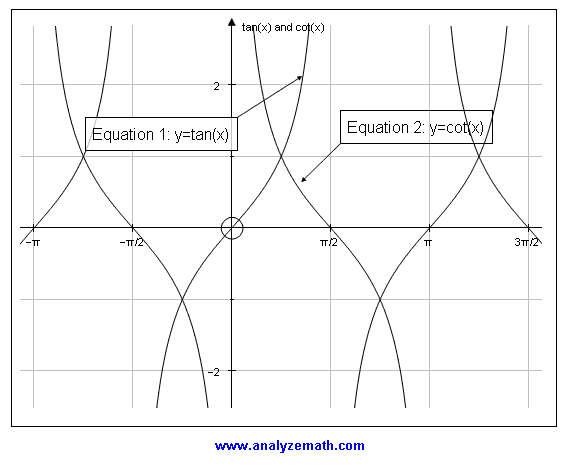
Fig. 3: Explore relationship between \( \tan(x) \) and \( \cot(x) \).
Students worked in pairs during this activity and were highly motivated. The entire activity was student-centered, with students working independently of the teacher to define their own strategies for finding a solution. Two important points should be noted about this activity: first, the question associated with it had multiple valid solution paths; second, students were able to easily verify their answers graphically. These features greatly increased student enthusiasm for using Autograph.
Problem: Find the length \( a \) and width \( b \) of a rectangle with a constant perimeter of 60 meters so that its area has a maximum value.
Task: Students explore two possible representations of the problem and the connections between them: a rectangle with a constant perimeter and varying dimensions \( a \) and \( b \), and a rectangular coordinate graph representing the area of the rectangle as a function of \( a \). Students then approximate the values of \( a \) and \( b \) that maximize the area.

Fig. 4: Rectangle with maximum area problem.
This activity can be broadcast to the entire class, facilitating a whole-class interactive session. Students actively participate by responding to open-ended questions posed by the instructor. They are first asked to find a graphical solution to the problem, followed by an exploration of the analytical solution. This activity helps students develop intuition in optimization and bridges the gap to analytical problem-solving.