Master Grade 12 Math: Circle & Trigonometry Problems
Advanced Practice with Sectors, Arcs, and Circular Coordinates
Welcome to this comprehensive collection of sectors and circles trigonometry problems designed for Grade 12 math students. Each problem focuses on critical pre-calculus concepts such as arc length, central angles, deriving coordinates of points on a circle, and the practical application of trigonometric functions. Detailed, step-by-step solutions are provided to ensure you thoroughly grasp the methodology behind each answer.
Coordinates and Angles in Standard Position
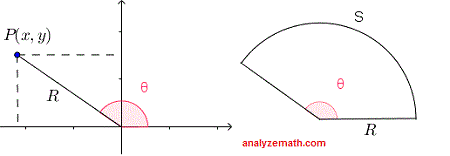
When solving the problems below, we will heavily rely on the definitions of the trigonometric functions of an angle \( \theta \). These are defined in terms of the coordinates of a point \( P(x , y) \) that lies on the terminal side of an angle \( \theta \) on a circle of radius \( R \).
We will also use the fundamental relationship between the arc length \( S \), the radius \( R \), and the central angle \( \theta \). Important: The angle \( \theta \) must be in radians to use this formula directly!
Core Practice Problems
Problem 1 - Arc Length and Coordinates on a Circle
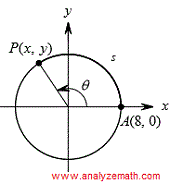
Given that the coordinates of point \( A \), located on the circle below, are \( (8, 0) \), and the arc \( s \) has a length of 20 units, determine the coordinates of point \( P \) as shown in the diagram below.
Show Detailed Solution
Step 1: Determine the Radius.
Point A is on the x-axis at \( (8,0) \). Because the center of the circle is at the origin \( (0,0) \), the distance from the origin to point A is exactly the radius. Therefore, \( R = 8 \).
Step 2: Find the central angle \( \theta \).
We use the arc length formula \( s = R \theta \). We are given \( s = 20 \) and we know \( R = 8 \). Substitute these values to solve for \( \theta \) in radians:
Step 3: Calculate the coordinates of P.
Use the standard circular coordinate formulas \( x = R \cos(\theta) \) and \( y = R \sin(\theta) \). Make sure your calculator is set to Radian mode!
Conclusion:
The coordinates of point \( P \) are approximately \( (-6.40, 4.79) \). (This makes logical sense as the point is in the second quadrant, where x is negative and y is positive).
Problem 2 - Arc Length Using Tangent and Radius
In a rectangular coordinate system, a circle with its center at the origin passes through the point \( P(4\sqrt{2},\ 5\sqrt{2}) \). What is the exact and approximate length of the arc \( S \) starting from the positive x-axis to point P?

Show Detailed Solution
Step 1: Find the radius \( R \).
The radius is the distance from the origin \( (0,0) \) to point P. We use the distance formula (or Pythagorean theorem):
Step 2: Find the central angle \( \theta \).
We use the tangent definition to find the angle. Since both x and y are positive, the point is in Quadrant I, so we don't need to adjust the angle.
Step 3: Calculate the arc length \( S \).
Using the formula \( S = R\theta \):
Problem 3 - Clock Minute Hand and Arc Length
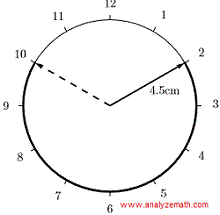
The length of the minute hand of a clock is \( 4.5 \, \text{cm} \). Find the exact length of the arc traced by the tip of the minute hand between 11:10 PM and 11:50 PM.
Show Detailed Solution
Step 1: Determine the elapsed time.
From 11:10 PM to 11:50 PM, the elapsed time is exactly 40 minutes.
Step 2: Find the angular displacement.
A clock is a full circle (\( 360^\circ \) or \( 2\pi \) radians), representing 60 minutes of time. We need to find the fraction of the circle the minute hand covered.
Now, convert this fraction directly into radians. A full rotation is \( 2\pi \):
\[ \theta = \dfrac{2}{3} \times 2\pi = \dfrac{4\pi}{3} \text{ radians} \]Step 3: Calculate the arc length.
The radius \( R \) is the length of the minute hand, which is 4.5 cm. Apply the arc length formula \( S = R \theta \):
Problem 4 - Circle Geometry with Multiple Points
The points \( P(a, b) \), \( Q(5, 0) \), and \( M(c, -1) \) lie on a circle centered at \( O(0, 0) \) with a radius \( R = 5 \) units. The angle for point P is given as \( 35^\circ \).

Find the following:
- The coordinates \( (a,b) \) of point \( P \).
- The arc length between \( Q \) and \( P \) in the counterclockwise direction.
- The x-coordinate \( c \) of point \( M \).
- The full central Angle \( \theta \) originating from the positive x-axis to point M.
Show Detailed Solution
a) Find the coordinates of P:
Using the radius \( R = 5 \) and angle \( 35^\circ \), we use the standard formulas (ensure calculator is in Degree mode for this step):
b) Find the arc length PQ:
First, we must convert the angle from degrees to radians because the formula \( S=R\theta \) requires radians.
c) Find the x-coordinate of M:
Point M is \( (c, -1) \). Since M is on the circle, its distance to the origin must equal the radius (5).
Look at the diagram. Point M is located in Quadrant III, where x-coordinates must be negative. Therefore, we reject the positive root:
\[ c = -2\sqrt{6} \approx -4.899 \]d) Find angle \( \theta \):
Let the total angle from the positive x-axis to M be \( \alpha \). According to the diagram, \( \alpha = \theta + 35^\circ \).
We find \( \alpha \) using the tangent of point M \( (-2\sqrt{6}, -1) \):
\[ \tan(\alpha) = \dfrac{y}{x} = \dfrac{-1}{-2\sqrt{6}} = \dfrac{1}{2\sqrt{6}} \]Since the point is in the third quadrant, the calculator's \( \arctan \) function (which returns a Quadrant I angle) will be off by \( 180^\circ \). We must add \( 180^\circ \):
\[ \alpha = 180^\circ + \arctan\left(\dfrac{1}{2\sqrt{6}}\right) \approx 180^\circ + 11.54^\circ = 191.54^\circ \]Now, subtract the \( 35^\circ \) offset to solve for \( \theta \):
\[ \theta = \alpha - 35^\circ = 191.54^\circ - 35^\circ = \mathbf{156.54^\circ} \]Problem 5 - Arc Length and Distance in a Circle
A circle with radius \( R = 4 \) units and center \( O \) is shown below. The angle to point P is \( 130^\circ \).

Find the following:
- The length of the arc between points \( D \) and \( P \) in the counterclockwise direction.
- The coordinates \( (a , b) \) of point \( P \).
- The length of the straight line segment \( PD \).
Show Detailed Solution
a) Calculate arc length DP:
Convert the angle to radians: \( \theta = 130^\circ \times (\dfrac{\pi}{180^\circ}) = \dfrac{130\pi}{180} = \dfrac{13\pi}{18} \).
b) Find coordinates of P:
Using standard trig definitions with \( R = 4 \) and \( \theta = 130^\circ \):
c) Find the length of line segment PD:
Point D lies on the positive x-axis at distance R, so its coordinates are \( D(4, 0) \). Use the 2D distance formula \( d = \sqrt{(x_2-x_1)^2 + (y_2-y_1)^2} \):
(Alternatively, you could use the Law of Cosines on triangle OPD: \( c^2 = a^2 + b^2 - 2ab\cos(\theta) \implies PD^2 = 4^2 + 4^2 - 2(4)(4)\cos(130^\circ) \). This yields the exact same result!)
Problem 6 - Arc Length and Coordinates on a Circle
In a circle with center \( O \) and radius \( R = 3 \), the arc length \( S \) between points \( A \) and \( B \) is given as \( S = 12.5 \, \text{ units} \). Find the coordinates \( (a, b) \) of point \( B \).

Show Detailed Solution
Step 1: Find the angle \( \theta \) in radians.
Rearrange the arc length formula \( S = R\theta \) to solve for \( \theta \):
(Note: Since \( \pi \approx 3.14 \) and \( \dfrac{3\pi}{2} \approx 4.71 \), an angle of 4.167 radians falls squarely in the third quadrant. This matches our diagram).
Step 2: Find the coordinates.
Apply the coordinate formulas directly using the radian measure. Ensure your calculator is in Radian mode.
Coordinates of B are \( (-1.57, -2.56) \).
Problem 7 - Arc Length from Coordinates
Point \( P \) has coordinates \( (4.1 , b) \) and is located on the circle, of center \( O \) and radius \( R = 5 \), in Quadrant I. Find the length of arc \( S \).

Show Detailed Solution
Step 1: Find the angle \( \theta \).
We are given the x-coordinate (\( 4.1 \)) and the radius (\( 5 \)). We use the cosine relation:
Because point P is explicitly stated to be in Quadrant I, the angle \( \theta \) is acute (between 0 and \( \pi/2 \)). We can directly use the inverse cosine function to find the angle in radians:
\[ \theta = \arccos(0.82) \approx 0.6094 \text{ radians} \]Step 2: Calculate the arc length.
Substitute the radian angle into the arc length formula:
Challenge Problems
Ready to test your synthesis of these concepts? These problems combine algebra, geometry, and trigonometry to push your problem-solving skills.
Challenge Problem 1 - Maximizing Sector Area
A sector of a circle is created with a flexible piece of wire that is exactly \( P = 100 \text{ cm} \) long. This wire forms the two radii and the outer arc length. Find the radius \( R \) and the central angle \( \theta \) (in radians) that will maximize the internal area of this sector.
Show Detailed Solution
Step 1: Set up the equations.
The perimeter of a sector is made of two radii and the arc length \( S \). Therefore, \( P = 2R + S \). Since \( S = R\theta \), we can write the perimeter equation as:
The area of a sector is given by \( A = \dfrac{1}{2}R^2\theta \).
Step 2: Express Area in terms of one variable.
From the perimeter equation, solve for \( \theta \):
Substitute this \( \theta \) into the Area equation to create a function solely in terms of \( R \):
\[ A(R) = \dfrac{1}{2}R^2 \left( \dfrac{100 - 2R}{R} \right) = \dfrac{1}{2}R(100 - 2R) = 50R - R^2 \]Step 3: Maximize the Area function.
The area equation \( A(R) = -R^2 + 50R \) is a downward-facing parabola. The maximum occurs at the vertex. Using the vertex formula \( R = \dfrac{-b}{2a} \):
(Alternatively, take the derivative: \( A'(R) = 50 - 2R = 0 \implies R = 25 \)).
Step 4: Find the corresponding angle \( \theta \).
Substitute \( R = 25 \) back into our equation for \( \theta \):
Remarkably, for any fixed perimeter, a sector's area is always maximized when the central angle is exactly 2 radians!
Challenge Problem 2 - Belt Around Two Pulleys
A tight belt is wrapped around two circular pulleys. The smaller pulley has a radius of \( r_1 = 3 \text{ cm} \), and the larger pulley has a radius of \( r_2 = 8 \text{ cm} \). The distance between the centers of the two pulleys is \( d = 13 \text{ cm} \). Calculate the total length of the belt.
Show Detailed Solution
Step 1: Find the length of the straight segments.
Draw a line parallel to the straight belt segment through the center of the smaller circle. This creates a right triangle with a hypotenuse equal to the distance between centers (\( d = 13 \)) and a leg equal to the difference in radii (\( r_2 - r_1 = 8 - 3 = 5 \)).
Let \( L \) be the length of one straight segment of the belt. Using the Pythagorean theorem:
Since there are two straight segments (top and bottom), their combined length is \( 2 \times 12 = 24 \text{ cm} \).
Step 2: Find the central angle of the contact points.
Let \( \alpha \) be the angle in the right triangle adjacent to the centers.
\( \cos(\alpha) = \dfrac{\text{adjacent}}{\text{hypotenuse}} = \dfrac{5}{13} \). Thus, \( \alpha = \arccos(\dfrac{5}{13}) \approx 1.176 \text{ radians} \).
Step 3: Calculate the arc lengths around the pulleys.
Through geometric deduction, the angle where the belt touches the smaller pulley is \( 2\alpha \).
Arc on small pulley: \( S_1 = r_1(2\alpha) = 3(2 \times 1.176) = 3(2.352) = 7.056 \text{ cm} \).
The angle where the belt touches the larger pulley is the major arc, which is \( 2\pi - 2\alpha \).
Major angle: \( 2\pi - 2.352 \approx 6.283 - 2.352 = 3.931 \text{ radians} \).
Arc on large pulley: \( S_2 = r_2(3.931) = 8(3.931) = 31.448 \text{ cm} \).
Step 4: Sum the parts.
Total Length = Straight Segments + Small Arc + Large Arc
\[ \text{Total Length} \approx 24 + 7.056 + 31.448 = \mathbf{62.5 \text{ cm}} \]
Challenge Problem 3 - Intersection Arc Length
Find the exact coordinates of the points of intersection of the circle \( x^2 + y^2 = 25 \) and the line \( y = 2x + 5 \). Then, determine the exact length of the shorter arc connecting these two points on the circle.
Show Detailed Solution
Step 1: Find the points of intersection.
Substitute the linear equation into the circle equation:
Factor out \( 5x \):
\[ 5x(x + 4) = 0 \implies x = 0 \text{ or } x = -4 \]Find corresponding y-values using \( y = 2x+5 \):
If \( x = 0, y = 5 \). Point 1: \( (0, 5) \).
If \( x = -4, y = -3 \). Point 2: \( (-4, -3) \).
Step 2: Find the central angle between these points.
Let vectors \( \vec{A} = (0, 5) \) and \( \vec{B} = (-4, -3) \). We can find the angle \( \theta \) between them using the dot product formula: \( \vec{A} \cdot \vec{B} = |\vec{A}||\vec{B}|\cos(\theta) \).
Dot product: \( (0)(-4) + (5)(-3) = -15 \)
Magnitudes (both are the radius): \( |\vec{A}| = 5 \), \( |\vec{B}| = 5 \).
Step 3: Calculate the arc length.
We know the radius is \( R = 5 \). Using \( S = R\theta \):