Find a Polynomial Given its Graph: Questions with Solutions
Mastering Intercepts, Multiplicities, and Curve Behavior
Learn how to determine a polynomial function straight from its graph. This page provides guided practice questions focused on identifying key visual features like zeros, odd/even multiplicities, and symmetry. Step-by-step solutions and clear explanations are included to help you lock in the process.
Core Practice Problems
Problem 1 - Cubic Polynomial with Multiple Roots
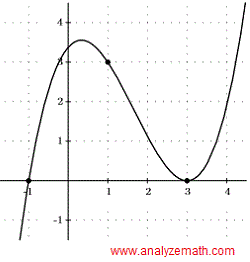
Find the exact equation of the cubic polynomial function \( g \) shown below.
Show Solution
Step 1: Identify Zeros and Multiplicities
The graph of the function crosses the x-axis cleanly at \( x = -1 \). This indicates a zero of multiplicity 1, corresponding to the factor \( (x + 1) \).
The graph touches the x-axis and turns around at \( x = 3 \). This indicates a zero of multiplicity 2 (a parabolic shape), corresponding to the factor \( (x - 3)^2 \).
Step 2: Set up the Equation
Based on the factors, the function \( g \) has the general form:
\[ g(x) = k(x + 1)(x - 3)^2 \]
where \( k \) is an unknown constant multiplier.
Step 3: Solve for \( k \)
We can find \( k \) using the marked point on the graph with coordinates \( (1, 3) \):
\[ g(1) = k(1 + 1)(1 - 3)^2 = 3 \]
\[ k(2)(-2)^2 = 3 \]
\[ 8k = 3 \implies k = \dfrac{3}{8} \]
Conclusion:
The exact equation for \( g(x) \) is:
\[ g(x) = \dfrac{3}{8}(x + 1)(x - 3)^2 \]
Problem 2 - Fourth Degree Polynomial with Multiplicities
Find the fourth-degree polynomial function \( f \) whose graph is shown in the figure below.

Show Solution
Step 1: Identify Zeros and Multiplicities
By analyzing the x-intercepts, we find three distinct points of interaction:
* A straight cross at \( x = 2 \), meaning a multiplicity of 1, giving factor \( (x - 2) \).
* A straight cross at \( x = -2 \), meaning a multiplicity of 1, giving factor \( (x + 2) \).
* A touch-and-turn at \( x = -1 \), meaning a multiplicity of 2, giving factor \( (x + 1)^2 \).
Step 2: Set up the Equation
Multiplying these factors yields our base 4th degree polynomial:
\[ f(x) = k(x - 2)(x + 2)(x + 1)^2 \]
where \( k \) is a constant.
Step 3: Solve for \( k \)
The graph reveals a clear y-intercept at \( (0, -1) \). Substitute \( x = 0 \) and \( y = -1 \):
\[ f(0) = k(0 - 2)(0 + 2)(0 + 1)^2 = -1 \]
\[ k(-2)(2)(1)^2 = -1 \]
\[ -4k = -1 \implies k = \dfrac{1}{4} \]
Conclusion:
The equation is:
\[ f(x) = \dfrac{1}{4}(x - 2)(x + 2)(x + 1)^2 \]
Problem 3 - Degree 4 Polynomial with Different Multiplicities
Find the exact equation of the degree 4 polynomial \( f \) graphed below.

Show Solution
Step 1: Identify Zeros and Multiplicities
The graph has x-intercepts at \( x = 0 \) and \( x = \dfrac{5}{2} \). Because the graph crosses the x-axis at both points, both zeros must have an odd multiplicity.
* At \( x = 0 \), the graph exhibits a flattened "S" or cubic shape. This indicates a multiplicity of 3, yielding the factor \( x^3 \).
* At \( x = \dfrac{5}{2} \), the cross is direct and relatively linear, indicating a multiplicity of 1, yielding the factor \( \left(x - \dfrac{5}{2}\right) \).
Step 2: Set up the Equation
Using these observations, we write the general form:
\[ f(x) = k(x)^3 \left(x - \dfrac{5}{2}\right) \]
Step 3: Solve for \( k \)
We use the given reference point \( (2, -4) \) to find \( k \):
\[ -4 = k(2)^3 \left(2 - \dfrac{5}{2}\right) \]
\[ -4 = k(8) \left(-\dfrac{1}{2}\right) \]
\[ -4 = -4k \implies k = 1 \]
Conclusion:
The equation of the polynomial is:
\[ f(x) = x^3 \left(x - \dfrac{5}{2}\right) \]
Problem 4 - Finding Standard Form Coefficients
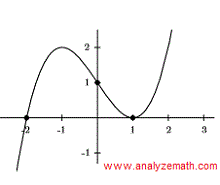
The graph of a cubic polynomial \( y = a x^3 + b x^2 +c x + d \) is shown below. Determine the specific values of coefficients \( a, b, c, \) and \( d \).
Show Solution
Step 1: Factored Form Setup
The polynomial is degree 3. The graph shows a zero of multiplicity 1 at \( x = -2 \) (factor: \( x + 2 \)), and a zero of multiplicity 2 at \( x = 1 \) (factor: \( (x - 1)^2 \)).
\[ y = k(x + 2)(x - 1)^2 \]
Step 2: Find \( k \)
Use the clear y-intercept at \( (0, 1) \):
\[ 1 = k(0 + 2)(0 - 1)^2 \]
\[ 1 = 2k \implies k = \dfrac{1}{2} = 0.5 \]
Step 3: Expand to Standard Form
Now, expand the factored polynomial to reveal the individual coefficients:
\[ y = 0.5(x + 2)(x^2 - 2x + 1) \]
\[ y = 0.5(x^3 - 2x^2 + x + 2x^2 - 4x + 2) \]
\[ y = 0.5(x^3 - 3x + 2) \]
\[ y = 0.5x^3 - 1.5x + 1 \]
Conclusion:
Comparing this to \( y = ax^3 + bx^2 + cx + d \), we deduce:
\[ a = 0.5, \quad b = 0, \quad c = -1.5, \quad d = 1 \]
Problem 5 - Even Polynomial Symmetry
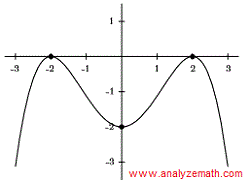
The graph of polynomial \( y=a x^4+bx^3+c x^2+d x+e \) is completely symmetric with respect to the y-axis, as shown below. Find the exact values of coefficients \( b, d, \) and \( e \).
Show Solution
Step 1: Leverage Symmetry Concepts
Since the graph is perfectly symmetric across the y-axis, the function must be an even function (where \( f(x) = f(-x) \)).
For a polynomial to be an even function, it can only contain even powers of \( x \). The terms \( bx^3 \) and \( dx \) are odd functions. For the overall polynomial to remain even, their coefficients must be zero:
\[ b = 0, \quad d = 0 \]
Step 2: Find the Constant \( e \)
The polynomial simplifies to \( y = a x^4 + c x^2 + e \).
Coefficient \( e \) represents the y-intercept. Examining the graph, the y-intercept is clearly at \( (0, -2) \):
\[ -2 = a(0)^4 + c(0)^2 + e \]
\[ e = -2 \]
Conclusion:
The required coefficients are:
\[ b = 0, \quad d = 0, \quad e = -2 \]
Challenge Problems
Push your understanding further with these descriptive graph scenarios. Draw the mental picture or sketch it out before solving!
Challenge 1 - Degree 5 Descriptive Graph
The graph of a degree 5 polynomial \( P(x) \) crosses the x-axis directly at \( x = -2 \), touches and turns tangent to the x-axis at \( x = 1 \), and touches and turns tangent to the x-axis again at \( x = 4 \). The graph has a y-intercept of \( (0, -16) \). Find the equation of the polynomial.
Show Solution
Step 1: Factor Construction
* Crosses directly at \( x = -2 \implies \) Multiplicity 1: factor \( (x + 2) \).
* Tangent at \( x = 1 \implies \) Multiplicity 2: factor \( (x - 1)^2 \).
* Tangent at \( x = 4 \implies \) Multiplicity 2: factor \( (x - 4)^2 \).
(Check the degree: 1 + 2 + 2 = 5. This aligns perfectly with the stated degree.)
Step 2: Setting up the Equation
\[ P(x) = k(x + 2)(x - 1)^2(x - 4)^2 \]
Step 3: Solving for \( k \)
Use the y-intercept \( (0, -16) \):
\[ -16 = k(0 + 2)(0 - 1)^2(0 - 4)^2 \]
\[ -16 = k(2)(-1)^2(-4)^2 \]
\[ -16 = k(2)(1)(16) \]
\[ -16 = 32k \implies k = -\dfrac{1}{2} \]
Conclusion:
\[ P(x) = -0.5(x + 2)(x - 1)^2(x - 4)^2 \]
Challenge 2 - The Odd Polynomial
A polynomial \( Q(x) \) represents an odd function. Its graph passes through the origin, is tangent to the x-axis at \( x = 2 \), and passes through the reference point \( (1, -9) \). Find the equation of the polynomial of least degree that fits this description.
Show Solution
Step 1: Understand Odd Symmetry
An odd function is symmetric about the origin (\( Q(-x) = -Q(x) \)). This means whatever graphical behavior happens on the positive x-axis must be mirrored (diagonally) on the negative x-axis.
* Tangent at \( x = 2 \implies \) Tangent at \( x = -2 \).
* Passes through the origin \( \implies \) Root at \( x = 0 \).
Step 2: Factor Construction (Least Degree)
* Root at \( 0 \) crossing through \( \implies \) Multiplicity 1: factor \( (x) \).
* Tangent at \( 2 \implies \) Multiplicity 2: factor \( (x - 2)^2 \).
* Tangent at \( -2 \implies \) Multiplicity 2: factor \( (x + 2)^2 \).
(The least degree is 1 + 2 + 2 = 5).
Step 3: Solving for \( k \)
\[ Q(x) = k(x)(x - 2)^2(x + 2)^2 \]
Use the point \( (1, -9) \):
\[ -9 = k(1)(1 - 2)^2(1 + 2)^2 \]
\[ -9 = k(1)(-1)^2(3)^2 \]
\[ -9 = k(1)(1)(9) \]
\[ 9k = -9 \implies k = -1 \]
Conclusion:
\[ Q(x) = -x(x - 2)^2(x + 2)^2 \]
Challenge 3 - Minimum Degree from Shape
The graph of a polynomial \( H(x) \) exhibits a parabolic shape touching the x-axis at \( x = -3 \), crosses cleanly in a straight line at \( x = 2 \), and crosses the x-axis while flattening out into an "S" shape at \( x = 5 \). If the graph passes through the point \( (3, -72) \), find the specific equation of the polynomial of least degree.
Show Solution
Step 1: Translating Shape to Multiplicity
* Parabolic touch at \( x = -3 \implies \) Even multiplicity. Least degree = 2. Factor: \( (x + 3)^2 \).
* Straight line cross at \( x = 2 \implies \) Multiplicity 1. Factor: \( (x - 2) \).
* Flat "S" shape cross at \( x = 5 \implies \) Odd multiplicity greater than 1. Least degree = 3. Factor: \( (x - 5)^3 \).
Step 2: Setting up the Equation
Multiplying these factors creates a 6th degree polynomial:
\[ H(x) = k(x + 3)^2(x - 2)(x - 5)^3 \]
Step 3: Solving for \( k \)
Substitute the point \( (3, -72) \):
\[ -72 = k(3 + 3)^2(3 - 2)(3 - 5)^3 \]
\[ -72 = k(6)^2(1)(-2)^3 \]
\[ -72 = k(36)(-8) \]
\[ -72 = -288k \]
\[ k = \dfrac{-72}{-288} = \dfrac{1}{4} \]
Conclusion:
\[ H(x) = 0.25(x + 3)^2(x - 2)(x - 5)^3 \]