Master Grade 12 Math Practice Test: 17 Problems with Solutions
Comprehensive Practice for Pre-Calculus and Advanced Functions
This Grade 12 math practice test features 17 problems covering a wide range of topics, from rational inequalities to trigonometric modeling. Detailed step-by-step solutions are provided for every question to help you master the concepts.
Question 1
Solve the inequality: \[ \dfrac{x+1}{x+2} - 1 \geq \dfrac{1}{x-1} \] Present the solution set using intervals, a number line, and inequality symbols.
Show Solution
1. Move all terms to one side:
\[ \dfrac{x+1}{x+2} - 1 - \dfrac{1}{x-1} \geq 0 \]2. Find a common denominator, which is $(x+2)(x-1)$:
\[ \dfrac{(x+1)(x-1) - (x+2)(x-1) - (x+2)}{(x+2)(x-1)} \geq 0 \] \[ \dfrac{(x^2-1) - (x^2+x-2) - (x+2)}{(x+2)(x-1)} \geq 0 \] \[ \dfrac{x^2 - 1 - x^2 - x + 2 - x - 2}{(x+2)(x-1)} \geq 0 \] \[ \dfrac{-2x - 1}{(x+2)(x-1)} \geq 0 \]3. Identify critical points: $x = -0.5$ (numerator zero), $x = -2$ and $x = 1$ (denominator undefined).
4. Test intervals:
- $(-\infty, -2)$: Test $x = -3 \implies \dfrac{5}{(-1)(-4)} > 0$ (True)
- $(-2, -0.5]$: Test $x = -1 \implies \dfrac{1}{(1)(-2)} < 0$ (False)
- $[-0.5, 1)$: Test $x = 0 \implies \dfrac{-1}{(2)(-1)} > 0$ (True)
- $(1, \infty)$: Test $x = 2 \implies \dfrac{-5}{(4)(1)} < 0$ (False)
Solution Set:
Inequality: $x < -2$ or $-0.5 \leq x < 1$
Interval: $(-\infty, -2) \cup [-0.5, 1)$
Question 2
Solve the equation: \[ \cos(2x) - \dfrac{2}{\sec x} = 2 \quad \text{on the interval } [0, 2\pi) \]
Show Solution
1. Rewrite $1/\sec x$ as $\cos x$:
\[ \cos(2x) - 2\cos x = 2 \]2. Use the double angle identity $\cos(2x) = 2\cos^2 x - 1$:
\[ 2\cos^2 x - 1 - 2\cos x = 2 \] \[ 2\cos^2 x - 2\cos x - 3 = 0 \]3. Apply the quadratic formula for $\cos x$:
\[ \cos x = \dfrac{2 \pm \sqrt{(-2)^2 - 4(2)(-3)}}{2(2)} = \dfrac{2 \pm \sqrt{28}}{4} = \dfrac{1 \pm \sqrt{7}}{2} \]4. Evaluate the values:
- $\dfrac{1 + \sqrt{7}}{2} \approx 1.82$ (Impossible, as $|\cos x| \leq 1$)
- $\dfrac{1 - \sqrt{7}}{2} \approx -0.823$ (Valid)
5. Find $x$: $x = \arccos\left(\dfrac{1-\sqrt{7}}{2}\right)$. This occurs in Quadrants II and III.
$x \approx 2.54 \text{ rad}$ and $x \approx 3.74 \text{ rad}$.
Question 3
Solve the equation: \[ \ln(x^2 + 2) - \ln(x - 1) = 2 \]
Show Solution
1. Combine logarithms using the quotient rule:
\[ \ln\left(\dfrac{x^2 + 2}{x - 1}\right) = 2 \]2. Convert to exponential form:
\[ \dfrac{x^2 + 2}{x - 1} = e^2 \]3. Rearrange into a quadratic equation:
\[ x^2 + 2 = e^2(x - 1) \implies x^2 - e^2x + (e^2 + 2) = 0 \]4. Solve using the quadratic formula:
\[ x = \dfrac{e^2 \pm \sqrt{(-e^2)^2 - 4(1)(e^2 + 2)}}{2} \]Note: $x$ must be greater than 1 for the original $\ln(x-1)$ to be defined. Use a calculator to find the decimal values and verify the domain.
Question 4
Solve the equation: \[ 3 \times 4^x + 2^x = 30 \]
Show Solution
1. Let $u = 2^x$. Then $4^x = (2^2)^x = (2^x)^2 = u^2$.
2. Substitute into the equation:
\[ 3u^2 + u - 30 = 0 \]3. Factor the quadratic:
\[ (3u + 10)(u - 3) = 0 \]4. Solve for $u$:
- $u = -10/3$ (Rejected, as $2^x$ must be positive)
- $u = 3$ (Valid)
5. Solve for $x$:
\[ 2^x = 3 \implies x = \dfrac{\ln 3}{\ln 2} \approx 1.58 \]Question 5
Verify the identity: \[ \dfrac{1}{2 \sin x} \tan(2x) = \dfrac{\cos x}{1 - 2 \sin^2 x} \]
Show Solution
1. Work with the Left-Hand Side (LHS). Use $\tan(2x) = \dfrac{\sin(2x)}{\cos(2x)}$:
\[ \text{LHS} = \dfrac{1}{2 \sin x} \cdot \dfrac{\sin(2x)}{\cos(2x)} \]2. Use the double angle identity $\sin(2x) = 2 \sin x \cos x$:
\[ \text{LHS} = \dfrac{1}{2 \sin x} \cdot \dfrac{2 \sin x \cos x}{\cos(2x)} = \dfrac{\cos x}{\cos(2x)} \]3. Work with the Right-Hand Side (RHS). Recall the double angle identity $\cos(2x) = 1 - 2 \sin^2 x$:
\[ \text{RHS} = \dfrac{\cos x}{1 - 2 \sin^2 x} = \dfrac{\cos x}{\cos(2x)} \]4. Conclusion: LHS = RHS. The identity is verified.
Question 6
Find the exact value of: \( \displaystyle \tan \left(\dfrac{13\pi}{12}\right) \)
Show Solution
1. Simplify the angle: $\dfrac{13\pi}{12} = \pi + \dfrac{\pi}{12}$. Since $\tan(\pi + \theta) = \tan \theta$:
\[ \tan\left(\dfrac{13\pi}{12}\right) = \tan\left(\dfrac{\pi}{12}\right) \]2. Use the difference identity $\tan(A - B) = \dfrac{\tan A - \tan B}{1 + \tan A \tan B}$ with $A = \dfrac{\pi}{4}$ and $B = \dfrac{\pi}{6}$:
\[ \tan\left(\dfrac{\pi}{12}\right) = \tan\left(\dfrac{\pi}{4} - \dfrac{\pi}{6}\right) = \dfrac{1 - 1/\sqrt{3}}{1 + (1)(1/\sqrt{3})} \]3. Rationalize and simplify:
\[ = \dfrac{\sqrt{3} - 1}{\sqrt{3} + 1} = \dfrac{(\sqrt{3} - 1)^2}{(\sqrt{3} + 1)(\sqrt{3} - 1)} = \dfrac{4 - 2\sqrt{3}}{2} = 2 - \sqrt{3} \]Question 7
When polynomial $P(x)$ is divided by $x + 1$, the remainder is 4. When divided by $x - 2$, the remainder is also 4. $P(x)$ has degree 3, leading coefficient 1, and $x - 1$ is a factor. Find $P(x)$.
Show Solution
1. From the Factor Theorem, since $x - 1$ is a factor, $P(1) = 0$.
2. From the Remainder Theorem, $P(-1) = 4$ and $P(2) = 4$.
3. Let $P(x) = (x - 1)(x^2 + bx + c)$ since the degree is 3 and leading coefficient is 1.
4. Use $P(-1) = 4$:
\[ (-1 - 1)((-1)^2 - b + c) = 4 \implies -2(1 - b + c) = 4 \implies 1 - b + c = -2 \implies c - b = -3 \]5. Use $P(2) = 4$:
\[ (2 - 1)((2)^2 + 2b + c) = 4 \implies 1(4 + 2b + c) = 4 \implies 2b + c = 0 \implies c = -2b \]6. Solve for $b, c$: Substitute $c = -2b$ into $c - b = -3$:
\[ -2b - b = -3 \implies -3b = -3 \implies b = 1, \quad c = -2 \]7. Final polynomial: $P(x) = (x-1)(x^2 + x - 2) = x^3 + x^2 - 2x - x^2 - x + 2 = x^3 - 3x + 2$.
Question 8
Function $f$ is defined by $f(x) = - x^4 - 5x^3 - 3x^2 + 9x$.
a) Factor $f(x)$ completely.
b) Use the zeros to sketch the graph of $f$.
Show Solution
1. Factor out $-x$: $f(x) = -x(x^3 + 5x^2 + 3x - 9)$.
2. Test for roots of the cubic term. $P(1) = 1 + 5 + 3 - 9 = 0$. So $(x - 1)$ is a factor.
3. Use division to find the quadratic factor: $x^3 + 5x^2 + 3x - 9 = (x - 1)(x^2 + 6x + 9)$.
4. Factor the quadratic: $(x^2 + 6x + 9) = (x + 3)^2$.
Complete Factored Form: $f(x) = -x(x - 1)(x + 3)^2$.
5. Zeros: $x = 0$ (mult 1), $x = 1$ (mult 1), $x = -3$ (mult 2).
Question 9
Find the equation of the polynomial function $g$ whose degree is 4 and whose graph is shown below, touching the x-axis at $x = -1$.

Show Solution
1. Identify zeros and multiplicities from the graph:
- At $x = -2$: Graph crosses (multiplicity 1).
- At $x = -1$: Graph touches (multiplicity 2).
- At $x = 2$: Graph crosses (multiplicity 1).
2. Write the general form: $g(x) = a(x + 2)(x + 1)^2(x - 2)$.
3. Use the y-intercept $(0, 2)$ to solve for $a$:
\[ 2 = a(0 + 2)(0 + 1)^2(0 - 2) \] \[ 2 = a(2)(1)(-2) \] \[ 2 = -4a \implies a = -0.5 \]Final Equation:
\[ g(x) = -0.5(x + 2)(x + 1)^2(x - 2) \]Question 10
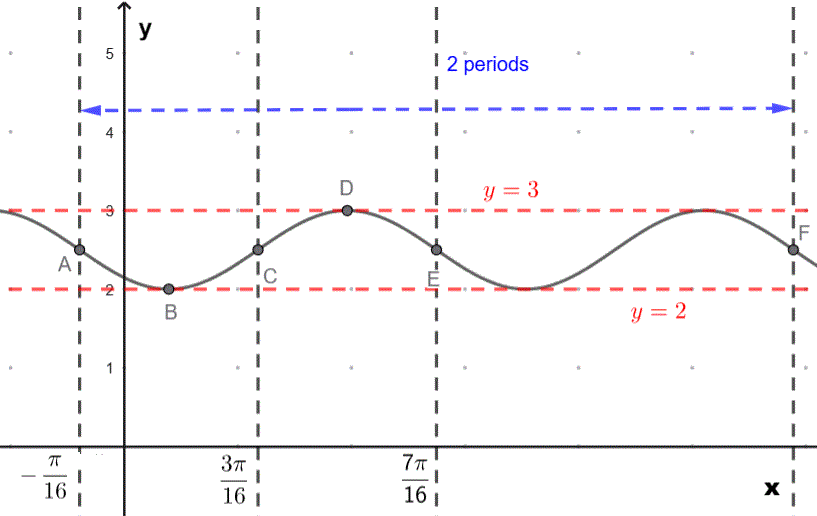
For the function $y = - 0.5 \sin \left( 4(x+\dfrac{\pi}{16}) \right) + 2.5$, make a table of values over 1 period and sketch the graph over 2 periods.
Show Solution
1. Identify key parameters:
- Amplitude: 0.5 (Reflected over the midline)
- Period: $2\pi/4 = \pi/2$
- Phase Shift: $-\pi/16$ (left)
- Vertical Shift (Midline): $y = 2.5$
2. Key points (start at phase shift, increment by Period/4 = $\pi/8$):
- $x = -\pi/16 \implies y = 2.5$
- $x = \pi/16 \implies y = 2.0$ (min due to negative sine)
- $x = 3\pi/16 \implies y = 2.5$
- $x = 5\pi/16 \implies y = 3.0$ (max)
- $x = 7\pi/16 \implies y = 2.5$
3. Graph of $y = - 0.5 \sin \left( 4(x+\dfrac{\pi}{16}) \right) + 2.5$:
Question 11
The velocity $V$ in meters of an object is given by the graph below. Write $V$ as a function of time $t$ as a cosine function.

Show Solution
1. Find the amplitude ($A$): Max = 1, Min = 0.
\[ A = \dfrac{\text{Max} - \text{Min}}{2} = \dfrac{1 - 0}{2} = 0.5 \]2. Find the vertical shift ($d$):
\[ d = \dfrac{\text{Max} + \text{Min}}{2} = \dfrac{1 + 0}{2} = 0.5 \]3. Find the period ($P$): Given as 3 seconds.
4. Calculate $b$:
\[ b = \dfrac{2\pi}{P} = \dfrac{2\pi}{3} \]5. Find the phase shift ($c$): For a cosine function, the shift corresponds to the horizontal position of the maximum. The problem states the maximum is at $t = 2.25$.
\[ c = 2.25 \]Final Equation:
\[ V(t) = 0.5 \cos\left(\dfrac{2\pi}{3}(t - 2.25)\right) + 0.5 \]Question 12
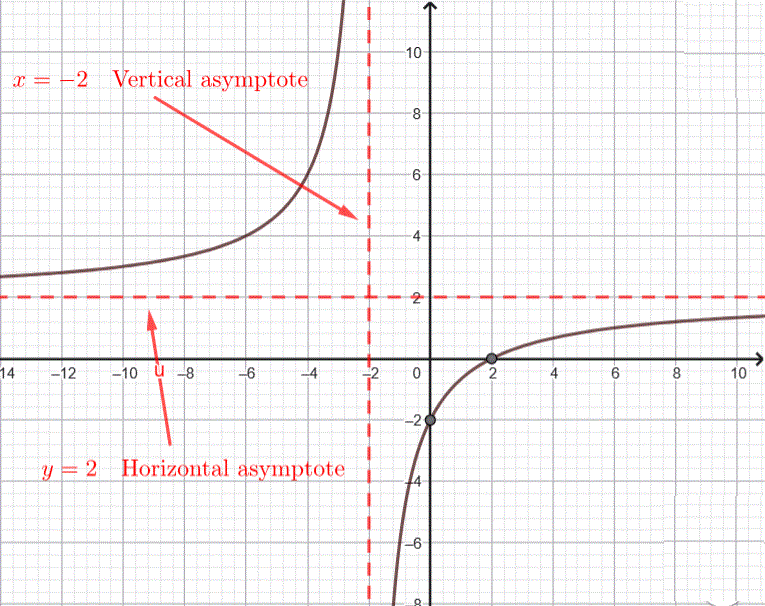
Given the function \[ y = \dfrac{2 x - 4}{x+2} \] a) Find the domain. b) Find intercepts. c) Find equations of all asymptotes. d) Sketch the graph.
Show Solution
a) Domain: All real numbers except where the denominator is zero. $x \neq -2$.
b) Intercepts:
- x-intercept (set $y=0$): $2x - 4 = 0 \implies x = 2$.
- y-intercept (set $x=0$): $y = -4/2 = -2$.
c) Asymptotes:
- Vertical: $x = -2$.
- Horizontal (limit as $x \to \infty$): $y = 2/1 = 2$.
Graph of $y = \dfrac{2 x - 4}{x+2}$:
Question 13
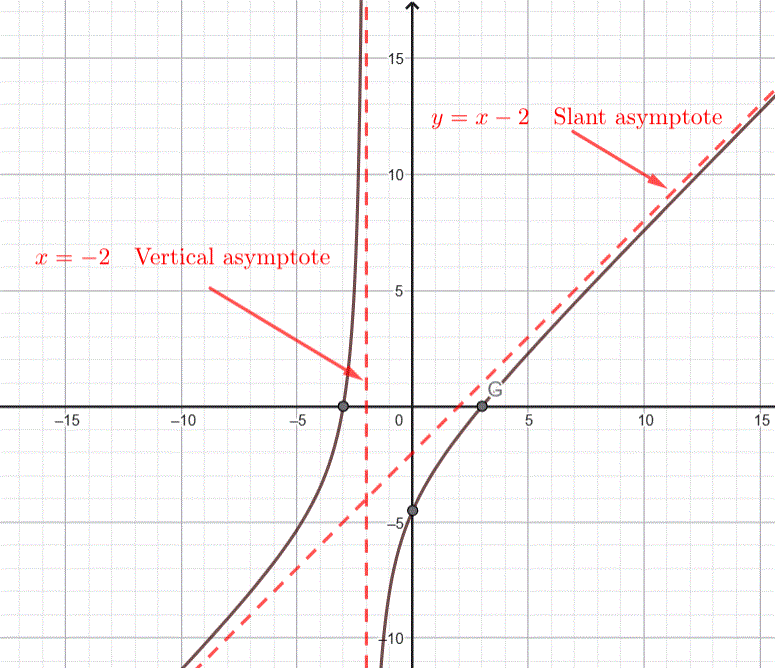
Given the function \[ y = \dfrac{x^2-9}{x+2} \] Find domain, intercepts, asymptotes, and sketch.
Show Solution
a) Domain: $x \in \mathbb{R}, x \neq -2$.
b) Intercepts: x-int at $x = \pm 3$; y-int at $y = -4.5$.
c) Asymptotes:
- Vertical: $x = -2$.
- Horizontal: None (degree of numerator > denominator).
- Slant (oblique): Use long division. $(x^2-9) \div (x+2) = (x-2)$ with remainder $-5$. Asymptote is $y = x - 2$.
- Table of signs \[ \begin{array}{|c|c|c|c|c|c|c|c|} \hline x & (-\infty, -3) & -3 & (-3, -2) & -2 & (-2, 3) & 3 & (3, \infty) \\ \hline (x+3) & - & 0 & + & + & + & + & + \\ \hline (x-3) & - & - & - & - & - & 0 & + \\ \hline (x+2) & - & - & - & \text{und} & + & + & + \\ \hline y = \dfrac{(x+3)(x-3)}{x+2} & \mathbf{-} & 0 & \mathbf{+} & \text{und} & \mathbf{-} & 0 & \mathbf{+} \\ \hline \text{Position} & \text{Below} & x\text{-int} & \text{Above} & \text{VA} & \text{Below} & x\text{-int} & \text{Above} \\ \hline \end{array} \]
- $ y = \dfrac{x^2-9}{x+2}$:
Question 14
Find the equation of the rational function $h(x)$ whose graph is shown below. Note: the graph contains a hole.

Show Solution
1. Identify the hole: The hole is at $x = 2$. This means $(x - 2)$ must be a factor in both the numerator and denominator.
2. Identify the Vertical Asymptote: VA at $x = 1$. This means $(x - 1)$ is a factor in the denominator.
3. Identify the Horizontal Asymptote (HA): The HA is at $y = 0$. This confirms that the degree of the denominator (degree 2) is greater than the degree of the numerator (which must be degree 1).
4. Construct the function:
\[ h(x) = a \cdot \dfrac{x - 2}{(x - 1)(x - 2)} = a \cdot \dfrac{1}{(x - 1)} \]5. Determine the constant \( a \) using the hole at $(2, 2)$ :
\[ 2 = a \cdot \dfrac{1}{(2 - 1)} \implies a = 2 \]6. Final Equation:
\[ h(x) = \dfrac{2(x - 2)}{(x - 1)(x - 2)} \]Note: The simplified form for sketching (excluding the hole) is \( y = \dfrac{2}{x - 1} \).
Question 15
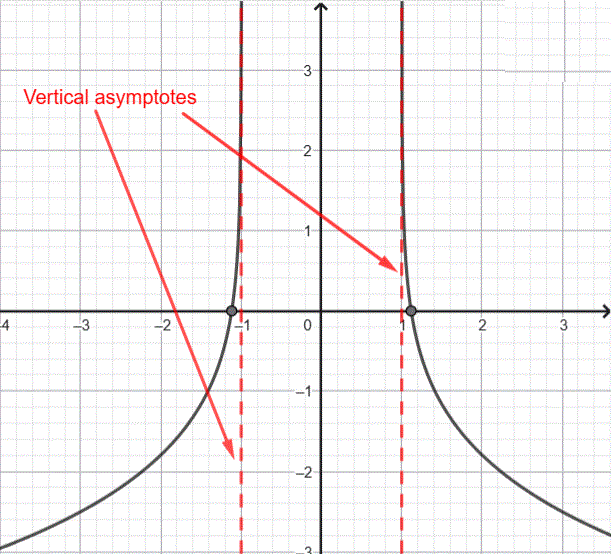
Given the function \( f(x) = -0.5 \log_2(x^2 - 1)-1 \), find the domain, intercepts, asymptotes, and sketch.
Show Solution
a) Domain: Argument must be positive. $x^2 - 1 > 0 \implies x^2 > 1 \implies x > 1$ or $x < -1$.
b) Intercepts: No y-intercept (0 is not in domain). For x-intercept, set $y=0$:
\[ -0.5 \log_2(x^2 - 1) = 1 \implies \log_2(x^2 - 1) = -2 \implies x^2 - 1 = 2^{-2} = 0.25 \] \[ x^2 = 1.25 \implies x \approx \pm 1.12 \]c) Asymptotes: Vertical asymptotes where argument approaches zero: $x = 1$ and $x = -1$.
d) Note that $f(-x) = f(x) $ and therefore the graph is symmetric with respect to the y-axis.
Graph of $ y = -0.5 \log_2(x^2 - 1)-1 $:
Question 16
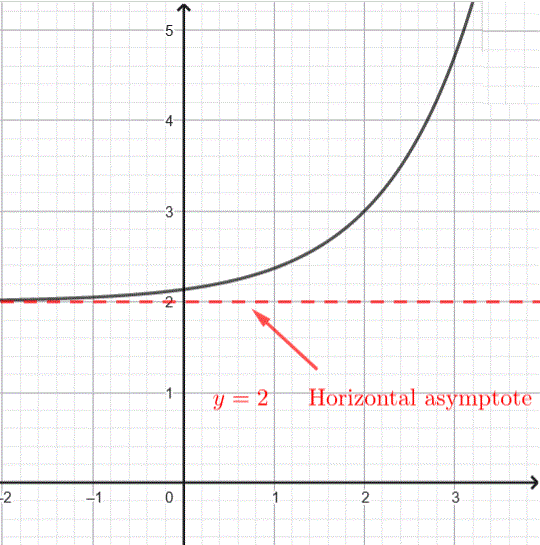
Given the function \( h(x) = 2 + e^{(x-2)} \), find the domain, intercepts, asymptotes, and sketch.
Show Solution
a) Domain: All real numbers $(-\infty, \infty)$.
b) Intercepts: y-intercept at $x = 0 \implies y = 2 + e^{-2} \approx 2.135$. No x-intercept because $e^{(x-2)} + 2$ is always greater than 2.
c) Asymptotes: Horizontal asymptote as $x \to -\infty$ is $y = 2$.
Graph of $ y = 2 + e^{(x-2)} $:
Question 17
Given the function \( h(x) = \ln (2x - 1) + 2 \):
a) Find the domain and range.
b) Find the inverse function and specify its domain and range.
Show Solution
a) Domain: $2x - 1 > 0 \implies x > 0.5$. Range: All real numbers.
b) Finding the inverse:
\[ x = \ln(2y - 1) + 2 \] \[ x - 2 = \ln(2y - 1) \] \[ e^{x-2} = 2y - 1 \] \[ y = \dfrac{e^{x-2} + 1}{2} \]Inverse Function: $h^{-1}(x) = 0.5(e^{x-2} + 1)$.
Inverse Domain: All real numbers. Inverse Range: $y > 0.5$.