This page is designed to help students, parents, and teachers master the Grade 7 mathematics curriculum through carefully selected questions. Click the arrow below each question to reveal the step-by-step solution.
Note: No calculator is to be used except for questions 35, 36, and 55.
The absolute value of a number represents its distance from zero on the number line, which is always positive or zero. Therefore, only statement b) is true.
On a number line, a number to the right is always larger than a number to the left.

a) -5 is to the right of -7, so $-5 > -7$ (False).
b) -6 is to the left of -2, so $-6 < -2$ (True).
c) -1 is to the left of 0, so $-1 < 0$ (False).
d) -4 is to the left of 0, so $-4 < 0$ (True).
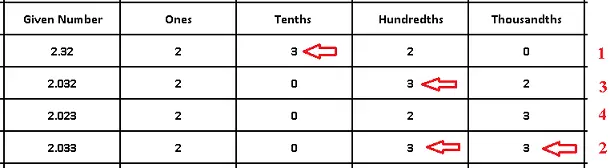
Write the numbers aligning their place values:
1) Compare the ones: all are 2.
2) Compare the tenths: 3 is the largest, so 2.32 is the largest.
3) Compare the thousandths for the remaining numbers: 2.033 has the largest thousandths digit (3).
Order: $2.32$, $2.033$, $2.032$, $2.023$
a) 4.01 has a 0 in the tenths place. No change to the ones digit. Answer: 4.
b) 6.8 has an 8 in the tenths place. Round up the ones digit. Answer: 7.
c) 11.5 has a 5 in the tenths place. Round up the ones digit. Answer: 12.
a) $0.15 \div 3 = \mathbf{0.05}$
b) Order of operations (multiply first): $5 - 0.24 = \mathbf{4.76}$
c) Order of operations (divide first): $2.3 - 0.1 = \mathbf{2.2}$
Factors of 18: 1, 2, 3, 6, 9, 18.
Factors of 24: 1, 2, 3, 4, 6, 8, 12, 24.
The GCF is 6.
Multiples of 8: 8, 16, 24, 32, 40, 48, 56, 64, 72, 80...
Multiples of 18: 18, 36, 54, 72, 90...
The LCM is 72.
A number is divisible by 5 if it ends in 0 or 5. Answers: b) 303090 and c) 145055.
A number is divisible by 2 if it ends in an even digit (0, 2, 4, 6, 8). Answers: a) 2798 and c) 6476.
A number is divisible by 3 if the sum of its digits is a multiple of 3.
a) 9+2+4+0 = 15 (Divisible).
b) 4+9+0+9 = 22 (Not divisible).
c) 3+2+8+2+9+0+0 = 24 (Divisible).
Answers: a) 9240 and c) 3282900.
a) Divide numerator and denominator by 5: $\dfrac{10 \div 5}{15 \div 5} = \mathbf{\dfrac{2}{3}}$
b) Multiply numerator and denominator by 2: $\dfrac{17 \times 2}{3 \times 2} = \mathbf{\dfrac{34}{6}}$
c) Multiply numerator and denominator by 4: $\dfrac{11 \times 4}{2 \times 4} = \mathbf{\dfrac{44}{8}}$
a) Common denominator is 10: $\dfrac{4}{10} + \dfrac{3}{10} - \dfrac{1}{10} = \dfrac{6}{10} = \mathbf{\dfrac{3}{5}}$
b) Multiply straight across and reduce: $\dfrac{15}{36} = \mathbf{\dfrac{5}{12}}$
c) Multiply by reciprocal: $\dfrac{11}{2} \times \dfrac{8}{1} = \dfrac{88}{2} = \mathbf{44}$
d) Subtract whole numbers and fractions: $(4 - 1) + (\dfrac{3}{4} - \dfrac{2}{4}) = \mathbf{3 \dfrac{1}{4}}$
e) Convert to improper fraction: $\dfrac{27}{4} \times \dfrac{1}{2} = \dfrac{27}{8} = \mathbf{3 \dfrac{3}{8}}$
f) Multiply by reciprocal: $\dfrac{3}{1} \times \dfrac{5}{3} = \mathbf{5}$
g) Convert both to improper fractions: $\dfrac{13}{5} \div \dfrac{18}{5} = \dfrac{13}{5} \times \dfrac{5}{18} = \mathbf{\dfrac{13}{18}}$
a) $0.2 = \dfrac{2}{10} = \mathbf{\dfrac{1}{5}}$
b) $1.24 = 1 \dfrac{24}{100} = \mathbf{1 \dfrac{6}{25}}$
c) $2.326 = 2 \dfrac{326}{1000} = \mathbf{2 \dfrac{163}{500}}$
a) $\dfrac{9}{100} = \mathbf{0.09}$
b) $\dfrac{17}{10000} = \mathbf{0.0017}$
c) $3 \dfrac{11}{100000} = \mathbf{3.00011}$
a) Common denominator is 20: $\dfrac{8}{20} < \dfrac{15}{20}$. True.
b) Common denominator is 30: $\dfrac{10}{30} < \dfrac{9}{30}$. False.
a) $3^4$
b) Group identical factors: $7 \times 4^3 \times 5^2$
a) $2 \times 2 \times 2 \times 2 = \mathbf{16}$
b) $9 \times 16 = \mathbf{144}$
c) Any non-zero number to the power of 0 is 1. $1 \times 16 = \mathbf{16}$
a) Triangles to squares: 4:7
b) Squares to triangles: 7:4
c) Squares to total (4+7=11): 7:11
School A: 1200 total - 400 boys = 800 girls. Ratio girls to boys = $800/400 = 2/1$.
School B: 800 total - 300 boys = 500 girls. Ratio girls to boys = $500/300 = 5/3$.
Compare $2/1$ ($6/3$) and $5/3$. School A has a higher ratio.
Unit rate = Total cost $\div$ Total amount. $\$15 \div 5 \text{ kg} = \mathbf{\$3 / \text{kg}}$.
Unit rate = $350 \text{ km} \div 5 \text{ hrs} = \mathbf{70 \text{ km/hr}}$.
1) Find constant speed: $240 \text{ km} \div 3 \text{ hrs} = 80 \text{ km/hr}$.
2) Calculate new time: $\text{Time} = \text{Distance} \div \text{Speed} = 400 \text{ km} \div 80 \text{ km/hr} = \mathbf{5 \text{ hrs}}$.
Let $x$ be the US dollars. $320 \text{ Dirhams} = x \times 4 \text{ Dhs/\$}$.
$x = 320 \div 4 = \mathbf{\$80}$.
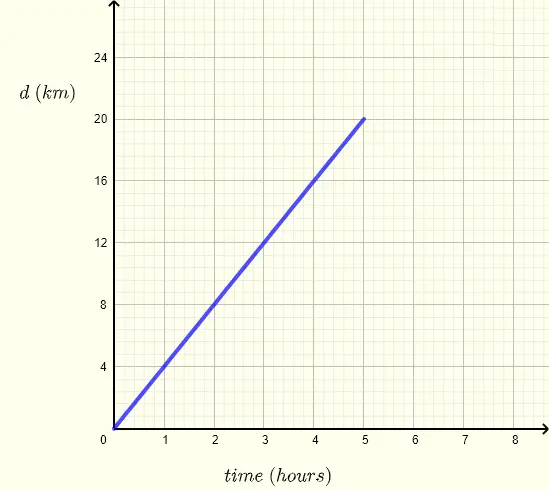
a) Distance = $k \times$ time. From the graph, at time = 2 hrs, distance = 8 km. So $k = 8/2 = 4$. For time = 2.5 hrs: Distance = $4 \times 2.5 = \mathbf{10 \text{ km}}$.
b) The speed is the constant $k = \mathbf{4 \text{ km/hr}}$.
c) $32 = 4 \times \text{time}$. Time = $32 / 4 = \mathbf{8 \text{ hrs}}$.
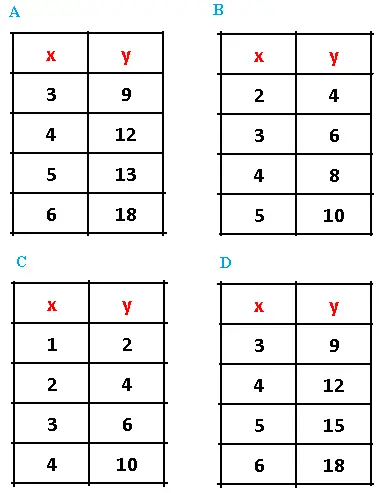
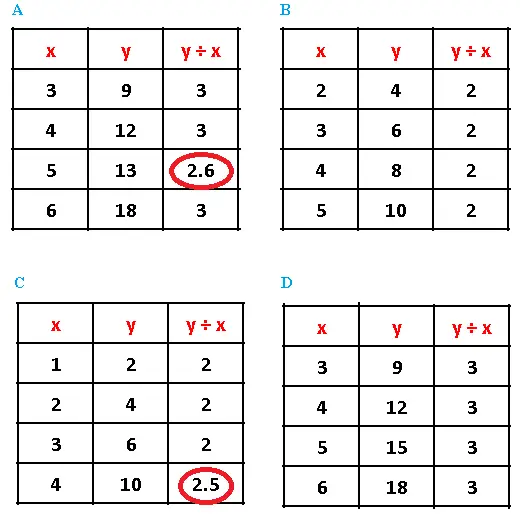
For $y$ to be proportional to $x$, the ratio $\frac{y}{x}$ must be constant.
Table B: $2/1 = 2$, $4/2 = 2$, $6/3 = 2$. Constant.
Table D: $3/1 = 3$, $6/2 = 3$, $9/3 = 3$. Constant.
Tables A and C do not have constant ratios. Therefore, Tables B and D represent proportional relationships.

$\dfrac{20}{100} \times 10 = \mathbf{2}$.
$\dfrac{50}{100} \times \dfrac{1}{4} = \dfrac{1}{2} \times \dfrac{1}{4} = \mathbf{\dfrac{1}{8}}$.
Multiply numerator and denominator by 20 to make the denominator 100: $\dfrac{3 \times 20}{5 \times 20} = \dfrac{60}{100} = \mathbf{60\%}$.
Percent = $\dfrac{600}{3000} = \dfrac{20}{100} = \mathbf{20\%}$.
Percent change = $\dfrac{\text{New Price} - \text{Old Price}}{\text{Old Price}} \times 100$.
$\dfrac{100 - 120}{120} = \dfrac{-20}{120} = \mathbf{-16.67\%}$. (It is a 16.67% decrease).
Let $x$ be the number. $\dfrac{10}{100} \times x = 3$. Multiply both sides by 100 to get $10x = 300$, so $x = \mathbf{30}$.
After 20% increase: $\$40 + (0.20 \times 40) = \$48$.
After 20% decrease on the new price: $\$48 - (0.20 \times 48) = 48 - 9.60 = \mathbf{\$38.40}$.
$1.2 \text{ km} \times \dfrac{1000 \text{ m}}{1 \text{ km}} = \mathbf{1200 \text{ m}}$.
$120 \text{ L} \times \dfrac{1 \text{ US gal}}{3.78541 \text{ L}} = \mathbf{31.70066 \text{ US gal}}$.
Square the conversion factor first: $1 \text{ m}^2 = (3.28084)^2 \text{ ft}^2 = 10.76391 \text{ ft}^2$.
$0.3 \text{ m}^2 \times 10.76391 = \mathbf{3.229173 \text{ ft}^2}$.
$\dfrac{60 \text{ km}}{1 \text{ hr}} = \dfrac{60 \times 1000 \text{ m}}{60 \text{ min}} = \mathbf{1000 \text{ m/min}}$.
Substitute $x = -2$: $2(-2) - 2 = -4 - 2 = \mathbf{-6}$.
Substitute $b = -10$: $|-5 + (-10)| = |-15| = \mathbf{15}$.
Substitute values: $-5 - (-8) = -5 + 8 = \mathbf{3}$.
a) Group like terms: $(3x + 4x) + (-2 - 5) = \mathbf{7x - 7}$.
b) Expand brackets: $3a + 3b + 6 + a + 4b - 12 = \mathbf{4a + 7b - 6}$.
c) Expand brackets: $2x + 3 + 3 = \mathbf{2x + 6}$.
d) Factor out $x$: $(0.2 + 1)x = \mathbf{1.2x}$.
a) Find the GCF of 14x and 2, which is 2. Factor out the 2: $2(7x) - 2(1) = \mathbf{2(7x - 1)}$.
b) Find the GCF, which is 9. Factor out the 9: $\mathbf{9(1 - 2x)}$.
c) Find the GCF, which is 4. Factor out the 4: $\mathbf{4(b - 4a + 1)}$.
a) $3x = 6 \rightarrow \mathbf{x = 2}$.
b) $6 = -x + 5 \rightarrow 1 = -x \rightarrow \mathbf{x = -1}$.
c) Multiply both sides by 3: $x = -7 \times 3 \rightarrow \mathbf{x = -21}$.
d) Expand brackets: $4x + 1 = -15 \rightarrow 4x = -16 \rightarrow \mathbf{x = -4}$.
e) Multiply by -3: $x + 2 = -9 \rightarrow \mathbf{x = -11}$.
f) Expand: $2x - 2 = 3x + 6 \rightarrow -8 = x \rightarrow \mathbf{x = -8}$.
g) Add $2\dfrac{1}{4}$ to both sides: $x = 3 + 2\dfrac{1}{4} \rightarrow \mathbf{x = 5\dfrac{1}{4}}$.
a) Perimeter formula: $P = 2(\text{length}) + 2(\text{width})$. Equation: $340 = 2(120) + 2x$.
b) Solve: $340 = 240 + 2x \rightarrow 100 = 2x \rightarrow \mathbf{x = 50 \text{ m}}$.
c) Check: $2(120) + 2(50) = 240 + 100 = \mathbf{340}$.
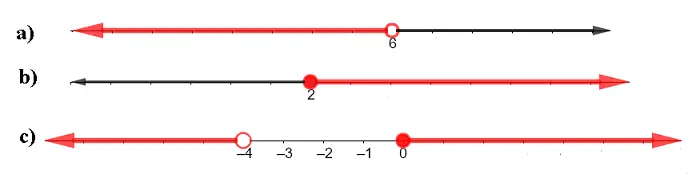
An open circle means the value is excluded ($<, >$). A closed circle means it is included ($\le, \ge$).

a) Add 2 to both sides: $4x > 20$. Divide by 4: $\mathbf{x > 5}$.
b) Expand brackets: $2x - 2 > 6$. Add 2 to both sides: $2x > 8$. Divide by 2: $\mathbf{x > 4}$.
The sum of angles in a triangle is 180°.
Third angle = $180 - (36 + 54) = 180 - 90 = 90^\circ$.
Because it has a 90° angle, it is a right triangle (b).
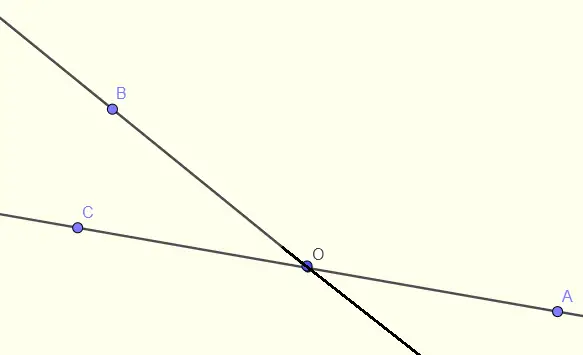
$\angle AOC$ forms a straight angle (180°), making $\angle AOB$ and $\angle COB$ supplementary.
$\angle AOB = 180^\circ - 27^\circ = \mathbf{153^\circ}$.
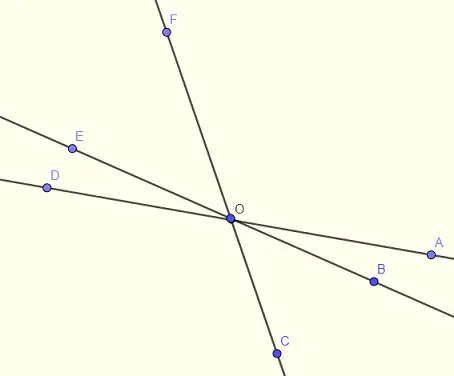
The vertical angle pairs are:
$\angle AOB$ and $\angle DOE$
$\angle BOC$ and $\angle EOF$
$\angle COD$ and $\angle FOA$
$\angle FOB$ and $\angle COE$
$\angle AOC$ and $\angle DOF$
$\angle BOD$ and $\angle EOA$
a) Hexagon: 6 sides
b) Pentagon: 5 sides
c) Octagon: 8 sides
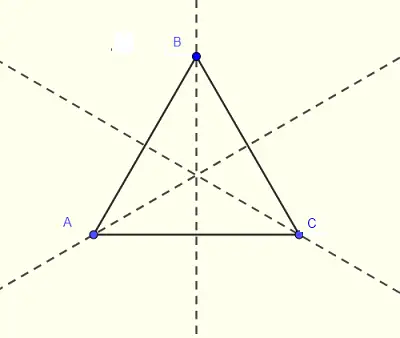
An equilateral triangle has 3 lines of symmetry.

Radius $r = \text{diameter} / 2 = 10 \text{ cm}$.
Area = $\pi \times r^2 = 3.14 \times 10^2 = 3.14 \times 100 = \mathbf{314 \text{ cm}^2}$.
Perimeter = $2(\text{length}) + 2(\text{width}) = 2(10) + 2(8) = 20 + 16 = \mathbf{36 \text{ inches}}$.
Area = $\frac{1}{2} \times \text{base} \times \text{height} = \frac{1}{2} \times 5 \times 10 = \mathbf{25 \text{ cm}^2}$.
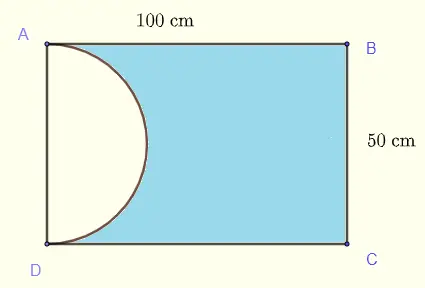
1) Area of full rectangle = $100 \times 50 = 5000 \text{ cm}^2$.
2) Area of semicircle (radius = $50 / 2 = 25 \text{ cm}$) = $\frac{1}{2} \times 3.14 \times 25^2 = 981.25 \text{ cm}^2$.
3) Shaded Area = Rectangle - Semicircle = $5000 - 981.25 = \mathbf{4018.75 \text{ cm}^2}$.
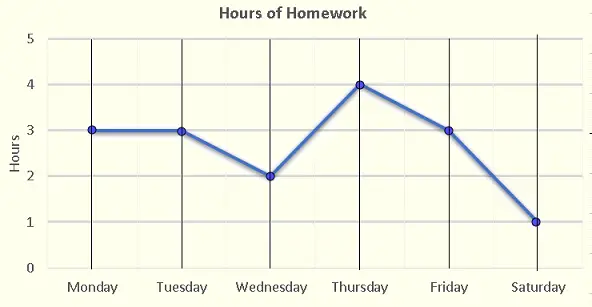
a) Saturday (1 hour).
b) Thursday (4 hours).
c) Total hours = $3 + 3 + 2 + 4 + 3 + 1 = \mathbf{16 \text{ hours}}$.
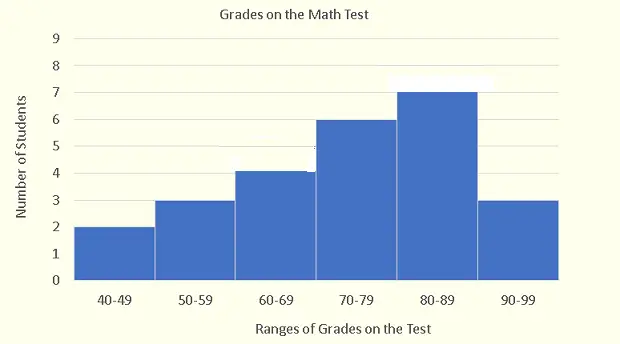
a) Sum of all bars: $2 + 3 + 4 + 6 + 7 + 3 = \mathbf{25 \text{ students}}$.
b) Bars for 70-79 and 80-89: $6 + 7 = \mathbf{13 \text{ students}}$.
c) Failed students (ranges 40-49 and 50-59) = $2 + 3 = 5$. Percent failed = $\dfrac{5}{25} \times 100 = \mathbf{20\%}$.
Mean: Sum divided by count. $\dfrac{36}{9} = \mathbf{4}$.
Arrange Data: $1, 2, 2, 3, \textbf{3}, 3, 4, 9, 9$.
Mode: Most frequent number is 3.
Median: The middle number in the ordered list is 3.
Let $x$ be the fourth score.
$\dfrac{78 + 95 + 92 + x}{4} = 90$
$\dfrac{265 + x}{4} = 90$
$265 + x = 360 \rightarrow x = 360 - 265 = \mathbf{95}$.
Multiply the number of choices for each category: $3 \times 5 \times 4 = \mathbf{60 \text{ ways}}$.
Dealership 1 choices: $3 \times 4 \times 3 = 36$.
Dealership 2 choices: $2 \times 5 \times 4 = 40$.
The second dealership has more choices.
A probability measure must be between 0 and 1 inclusive. Therefore, b) -0.5 (negative) and c) 2 (greater than 1) cannot be probabilities.
Coin (2 outcomes) $\times$ Cards (5 outcomes) = $2 \times 5 = \mathbf{10 \text{ outcomes}}$.
a) 0 (The die has no face with a zero).
b) $\mathbf{\dfrac{1}{6}}$ (Only one face has a 5).
c) $\mathbf{\dfrac{2}{6} = \dfrac{1}{3}}$ (Two faces, 5 and 6, are greater than 4).
If 5 out of 20 picked blue, then $20 - 5 = 15$ students picked a color that is not blue.
Probability = $\dfrac{15}{20} = \mathbf{\dfrac{3}{4}}$.