Natural Logarithm (ln x)
The natural logarithmic function is a fundamental concept in mathematics, particularly in calculus and modeling real-world continuous growth. This tutorial covers its formal definition, key properties, rules, graphs, and step-by-step applications.
Table of Contents
Natural Logarithmic Function and Graph
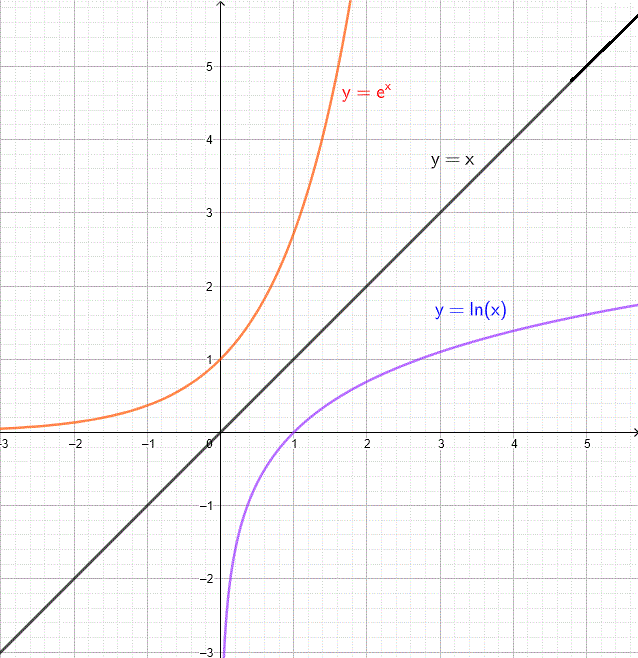
The natural logarithmic function, denoted as \( y = \ln(x) \), is the logarithm whose base is the Euler constant \( e \) (\( e \approx 2.71828 \)). It is the inverse function of the natural exponential function \( y = e^x \).
Domain restriction: \( x \gt 0 \).
The graphs of \( y = \ln(x) \) and its inverse \( y = e^x \) are shown below. Because they are inverse functions, each graph is a perfect reflection of the other across the diagonal line \( y = x \).
Inverse Identities and Composition
In general, the composition of a function \( f \) and its inverse \( f^{-1} \) satisfies \( f(f^{-1}(x)) = x \) and \( f^{-1}(f(x)) = x \). Since \( \ln(x) \) and \( e^x \) are inverses, we obtain the following identities:
Numerical Examples:
- \( \ln(e^3) = 3 \)
- \( \ln(1) = \ln(e^0) = 0 \)
- \( \ln(e) = \ln(e^1) = 1 \)
- \( \ln\left(\frac{1}{e}\right) = \ln(e^{-1}) = -1 \)
- \( \ln(\sqrt{e}) = \ln(e^{1/2}) = \frac{1}{2} \)
Verification: \( e^{\ln(5)} = 5 \) ✓ and \( \ln(e^{-2}) = -2 \) ✓
Properties and Rules of \( f(x) = \ln(x) \)
The natural logarithm function possesses several important characteristics:
| Property | Value |
|---|---|
| Domain | \( (0, +\infty) \) |
| Range | \( (-\infty, +\infty) \) |
| \( x \)-intercept | \( (1, 0) \) |
| Vertical Asymptote | \( x = 0 \) (since \( \lim_{x \to 0^{+}} \ln(x) = -\infty \)) |
| Monotonicity | Strictly increasing on \( (0, +\infty) \) |
| Continuity | Continuous and differentiable on \( (0, +\infty) \) |
| Derivative | \( \frac{d}{dx}[\ln(x)] = \frac{1}{x} \) |
| Integral | \( \int \ln(x)\,dx = x \ln(x) - x + C \) |
Rules of the Natural Logarithm
For any positive real numbers \( a \gt 0 \) and \( b \gt 0 \):
- Product Rule: \( \ln(ab) = \ln(a) + \ln(b) \)
- Quotient Rule: \( \ln\left(\dfrac{a}{b}\right) = \ln(a) - \ln(b) \)
- Power Rule: \( \ln(a^n) = n \ln(a) \)
- Reciprocal Rule: \( \ln\left(\dfrac{1}{a}\right) = -\ln(a) \)
- Identity: \( \ln(1) = 0 \) and \( \ln(e) = 1 \)
Table of Useful Values
The following table lists values of \( \ln(x) \) for common inputs:
| \( x \) | \( \ln(x) \) |
|---|---|
| 0.1 | −2.30259 |
| 0.5 | −0.69315 |
| 1 | 0 |
| 1.5 | 0.40547 |
| 2 | 0.69315 |
| e ≈ 2.71828 | 1 |
| 5 | 1.60944 |
| 10 | 2.30259 |
| 100 | 4.60517 |
Calculus Properties
The natural logarithm is preferred in calculus for several reasons:
- Simple derivative: \( \dfrac{d}{dx} \ln(x) = \dfrac{1}{x} \). This is the simplest derivative among all logarithms.
- Simple integral: \( \displaystyle\int \dfrac{1}{x}\,dx = \ln|x| + C \).
- General logarithm derivative: For base \( a \gt 0 \), \( a \neq 1 \): \( \dfrac{d}{dx} \log_a(x) = \dfrac{1}{x \ln(a)} \).
- Chain rule extension: \( \dfrac{d}{dx} \ln(u(x)) = \dfrac{u'(x)}{u(x)} \).
- Limit definition of e: \( e = \displaystyle\lim_{n \to \infty}\left(1 + \dfrac{1}{n}\right)^n \), and equivalently \( \ln(x) = \displaystyle\lim_{n \to \infty} n(x^{1/n} - 1) \).
Change of Base Formula
Any logarithm can be rewritten in terms of the natural logarithm using the change-of-base formula:
Valid for \( a \gt 0 \), \( a \neq 1 \), and \( x \gt 0 \).
Worked example: Evaluate \( \log_3(20) \).
\[ \log_3(20) = \frac{\ln(20)}{\ln(3)} = \frac{2.99573}{1.09861} \approx 2.7268 \]Check: \( 3^{2.7268} \approx 20 \) ✓
Similarly, \( \log_2(x) = \dfrac{\ln(x)}{\ln(2)} \) and \( \log_{10}(x) = \dfrac{\ln(x)}{\ln(10)} \).
Mathematical Models Using the Natural Logarithm
Natural logarithmic functions are frequently used to solve equations involving exponential growth or decay models.
Example 1: Population Growth Model
Show Solution
Problem: The population \( P \) of a small city varies continuously according to the model \( P = 10000 e^{0.025t} \), where \( t \) is the number of years after 2019. When will the population reach 12,000?
Solution
Set \( P = 12000 \):
\[ 12000 = 10000 e^{0.025t} \]
Divide both sides by 10,000:
\[ 1.2 = e^{0.025t} \]
Take the natural logarithm (\( \ln \)) of both sides to cancel out the base \( e \):
\[ \ln(1.2) = \ln(e^{0.025t}) \]
\[ \ln(1.2) = 0.025t \]
Solve for \( t \):
\[ t = \frac{\ln(1.2)}{0.025} \approx \frac{0.18232}{0.025} \approx 7.29 \text{ years} \]
Conclusion: Rounding to the nearest year, \( 2019 + 7 = 2026 \). The population will reach 12,000 in the year 2026.
Verification: \( P = 10000 e^{0.025(7.29)} \approx 10000 e^{0.1823} \approx 10000(1.2) = 12000 \) ✓
Example 2: Continuously Compounded Interest
Show Solution
Problem: For an account with continuous compounding, the balance \( B \) is given by \( B = Pe^{rt} \), where \( P \) is the principal and \( r \) is the annual interest rate. An amount of \( \$50,000 \) is invested at \( r = 5.5\% \) (or 0.055). How long will it take for the investment to reach $75,000?
Solution
Substitute the given values into the formula:
\[ 75000 = 50000 e^{0.055t} \]
Divide both sides by 50,000:
\[ 1.5 = e^{0.055t} \]
Take the natural logarithm of both sides:
\[ \ln(1.5) = \ln(e^{0.055t}) \]
\[ \ln(1.5) = 0.055t \]
Solve for \( t \):
\[ t = \frac{\ln(1.5)}{0.055} \approx \frac{0.40547}{0.055} \approx 7.37 \text{ years} \]
Conclusion: It will take approximately 7.4 years for the investment to reach $75,000.
Verification: \( B = 50000 e^{0.055(7.37)} \approx 50000 e^{0.4054} \approx 50000(1.5) = 75000 \) ✓
Example 3: Radioactive Decay (Half-Life)
Show Solution
Problem: The amount \( N \) of a radioactive substance at time \( t \) (in years) is given by \( N = N_0 e^{-kt} \). If a substance has a half-life of 30 years, find \( k \), then determine how long it takes for only 10% of the original amount to remain.
Solution
Step 1 — Find \( k \) using the half-life:
At \( t = 30 \), \( N = N_0/2 \):
\[ \frac{N_0}{2} = N_0 e^{-30k} \implies \frac{1}{2} = e^{-30k} \]Take \( \ln \) of both sides:
\[ \ln\left(\frac{1}{2}\right) = -30k \implies -\ln(2) = -30k \implies k = \frac{\ln(2)}{30} \approx 0.02310 \]Step 2 — Find \( t \) when \( N = 0.10 N_0 \):
\[ 0.10 = e^{-kt} \implies \ln(0.10) = -kt \] \[ t = \frac{-\ln(0.10)}{k} = \frac{2.30259}{0.02310} \approx 99.66 \text{ years} \]Conclusion: It takes approximately 99.7 years for only 10% of the original amount to remain.
Common Mistakes to Avoid
- Assuming \( \ln(a + b) = \ln(a) + \ln(b) \). This is false. The product rule is \( \ln(ab) = \ln(a) + \ln(b) \).
- Forgetting the domain. \( \ln(x) \) is only defined for \( x \gt 0 \). Expressions like \( \ln(-5) \) are undefined.
- Confusing \( \ln \) with \( \log \). \( \ln \) is base \( e \), while \( \log \) without a subscript usually means base 10.
- Incorrectly cancelling \( \ln \) and \( e \). \( e^{\ln(x)} = x \) is correct, but \( e^x \cdot \ln(x) \) does not simplify.
- Ignoring the absolute value in integrals. \( \int \frac{1}{x}\,dx = \ln|x| + C \), not \( \ln(x) + C \).
Frequently Asked Questions
What is the natural logarithm?
The natural logarithm, written \( \ln(x) \), is the logarithm with base \( e \) (Euler's number, approximately 2.71828). It is the inverse function of the natural exponential function \( e^x \). Formally, \( y = \ln(x) \) if and only if \( x = e^y \).
What is the derivative of \( \ln(x) \)?
The derivative of \( \ln(x) \) is \( \dfrac{1}{x} \) for \( x \gt 0 \). That is, \( \dfrac{d}{dx}[\ln(x)] = \dfrac{1}{x} \). This simple derivative is one reason the natural logarithm is preferred in calculus over logarithms with other bases.
What are the rules of natural logarithms?
For positive \( a \) and \( b \): (1) Product rule: \( \ln(ab) = \ln(a) + \ln(b) \). (2) Quotient rule: \( \ln(a/b) = \ln(a) - \ln(b) \). (3) Power rule: \( \ln(a^n) = n\ln(a) \). (4) \( \ln(1) = 0 \). (5) \( \ln(e) = 1 \). (6) \( \ln(e^x) = x \) and \( e^{\ln(x)} = x \).
What is the domain and range of \( \ln(x) \)?
The domain of \( \ln(x) \) is \( (0, +\infty) \) because the argument of a logarithm must be strictly positive. The range is \( (-\infty, +\infty) \) because \( \ln(x) \) produces every real number as \( x \) varies over the positive reals.
How is the natural logarithm used in real life?
The natural logarithm appears in many real-world models: continuous compounding of interest (\( B = Pe^{rt} \)), population growth and radioactive decay (\( N = N_0 e^{kt} \)), the pH scale in chemistry, entropy in information theory, and Newton's law of cooling.
What is the relationship between \( \ln(x) \) and \( e^x \)?
\( \ln(x) \) and \( e^x \) are inverse functions. This means \( \ln(e^x) = x \) for all real \( x \), and \( e^{\ln(x)} = x \) for all \( x \gt 0 \). Their graphs are reflections of each other across the line \( y = x \).
Can the natural logarithm take negative values?
\( \ln(x) \) is negative when \( 0 \lt x \lt 1 \) and positive when \( x \gt 1 \). It equals zero at \( x = 1 \). Although the input must be positive, the output of \( \ln(x) \) can be any real number.
More References
- Logarithmic Functions Overview
- Natural Exponential Function
- Euler's Constant e
- Change of Base Formula for Logarithms
- Convert Logarithms and Exponentials
- Find Logarithmic Functions from Graphs
- Precalculus - Mathematics for Calculus - 7th Edition - James Stewart, Lothar Redlin, Saleem Watson
- Calculus: Early Transcendentals - 8th Edition - James Stewart