Skills Needed for Mathematical Problem Solving (Part 3)
In Part 2, we examined the phases of problem solving. In this part, we turn to the factors and skills that determine whether a student succeeds, and how instructors can facilitate their development.
3. Factors and Skills Involved in Problem Solving
The fact that mathematical problem solving is a process depending on many skills and factors makes it complex to learn and to teach. Figure 3 shows the most important skills and factors necessary for successful problem solving [3]. Routine problems may not need all the skills listed below; however, challenging problems need a strategy involving most, if not all, the skills and attitudes shown in Figure 3. In fact, the latest development in mathematics education is to teach some of these skills through problem solving [9].
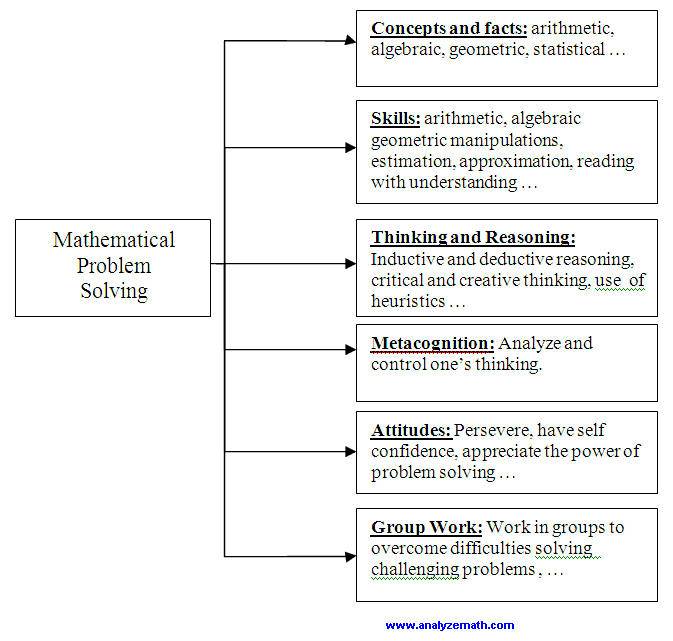
Based on my experience and the experience of others, I will discuss and suggest ways to facilitate some of the most important factors that affect the performance of students when solving a mathematical problem.
Facilitating Problem Solving
Facilitating and guiding students is one of the most efficient ways to "teach" problem solving [12]. Facilitating is suitable for creating opportunities where students learn by doing. Mathematical problem solving is a constructivist process in which students learn to solve problems by making connections to what they already know. Instructors can guide students to make these connections.
Continue Reading
Navigate through the sections of this research paper: