|
|
|
La fonction trigonometrique sinus
f(x) = a*sin(bx+c)+d
ainsi que son amplitude, sa période et sa phase sont étudiées dynamiquement utilisant une applet. L'étude est faite en changeant les valeurs des coefficients a, b, c and d. Pour une compréhension profonde des effets de chaque coefficient sur le graphe de la fonction, on change un coefficient a la fois.
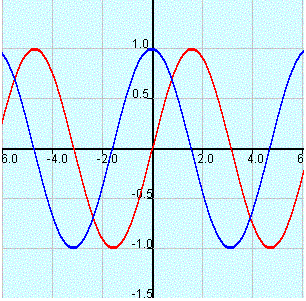
Exploration and understanding of the phase shift is done by comparing the shift between the graphs of the two functions:
f(x) = a*sin(bx + c) + d in blue and
g(x) = a*sin(bx) + d
in red as shown in the figure below.
You may also want to consider another tutorial on the trigonometric unit circle .
Once you finish the present tutorial, you may want to work through a self test on trigonometric graphs .
Interactive Tutorial Using Java Applet
How do the 4 coefficients a,b,c and d affect the graph of f(x)?
Amplitude
- use the scrollbar to set a=1,b=1,c=0 and d=0. Write down f(x) and take note of the amplitude, period and phase shift of f(x)? Now change a , how does it affect the graph? The amplitude is defined as |a|.
Answer
Period
- set a=1,c=0,d=0 and change b. Find the period from the graph and compare it to 2pi/|b|. How does b affect the graph of f(x)? The period is the horizontal distance (along the x-axis) between two points: one is the starting point of a cycle and the second is the end point of the same cycle.
Answer
Phase Shift
- set a=1,b=1,d=0 and change c starting from zero going slowly to positive larger values. Take note of the shift, is it left or right?
Answer
- set a=1,b=1,d=0 and change c starting from zero going slowly to negative smaller values. Take note of the shift, is it left or right?
Answer
- repeat the above for b=2,3 and 4, measure the shift and compare it to -c/b (the phase shift).
Answer
Vertical Shift
- set a,b and c to non zero values and change d. What is the direction of the shift of the graph?
Answer
More references and links on sine functions.
|
|