Questions and Problems
Use the grid to determine the dimensions needed to find the areas of the composite shapes shown below.

Key Strategy: Decomposition
The main idea is to decompose the given composite shape into known basic shapes (such as squares, rectangles, triangles, parallelograms, and trapezoids). Once decomposed, you can use addition (adding basic shapes together) or subtraction (subtracting empty spaces from a larger bounding shape) to calculate the final area.
Shape A
View Solution for Shape A
The shape in part a) is shown below with a large bounding rectangle completed (dotted lines).

The area \(A\) of the given shape is calculated in 3 steps using subtraction:
- Calculate the area of the large bounding rectangle \(ABWF\):
\(A_1 = \text{Length} \times \text{Width} = 5 \times 3 = 15 \text{ units}^2\) - Calculate the area of the small empty rectangle \(CWED\):
\(A_2 = CW \times WE = 3 \times 1 = 3 \text{ units}^2\) - Subtract the area of the small empty rectangle from the large bounding rectangle:
\(A = A_1 - A_2 = 15 - 3 = 12 \text{ units}^2\)
Shape B
View Solution for Shape B
The shape in part b) is shown below with the large bounding rectangle completed.
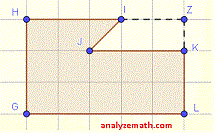
The area \(A\) of the given shape is calculated using 3 steps:
- Calculate the area of the large bounding rectangle \(GHZL\):
\(A_1 = \text{Length} \times \text{Width} = 5 \times 3 = 15 \text{ units}^2\) - Calculate the area of the empty trapezoid \(JIZK\) at the top right:
The parallel bases are \(IZ = 2\) and \(JK = 3\), and the height is \(ZK = 1\).
\(A_2 = \dfrac{1}{2} \times \text{Height} \times (\text{Base}_1 + \text{Base}_2)\)
\(A_2 = \dfrac{1}{2} \times 1 \times (2 + 3) = \dfrac{1}{2} \times 5 = 2.5 \text{ units}^2\) - Subtract the area of the trapezoid from the large bounding rectangle:
\(A = A_1 - A_2 = 15 - 2.5 = 12.5 \text{ units}^2\)
Shape C
View Solution for Shape C
The shape in part c) is shown below with the large bounding rectangle completed.
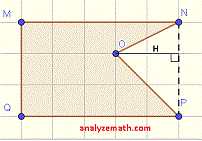
The area \(A\) of the given shape is calculated using 3 steps:
- Calculate the area of the large bounding rectangle \(QMNP\):
\(A_1 = \text{Length} \times \text{Width} = 5 \times 3 = 15 \text{ units}^2\) - Calculate the area of the empty triangle \(NOP\):
The base is \(NP = 3\) and the height is \(H = 2\).
\(A_2 = \dfrac{1}{2} \times \text{Base} \times \text{Height} = \dfrac{1}{2} \times 3 \times 2 = 3 \text{ units}^2\) - Subtract the area of the triangle from the large bounding rectangle:
\(A = A_1 - A_2 = 15 - 3 = 12 \text{ units}^2\)
Shape D
View Solution for Shape D
The shape in part d) is shown below with the large bounding rectangle completed.
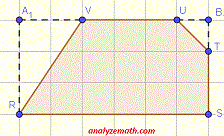
The area \(A\) of the given shape is calculated using 4 steps:
- Calculate the area of the large bounding rectangle \(RA_1BS\):
\(A_1 = \text{Length} \times \text{Width} = 6 \times 3 = 18 \text{ units}^2\) - Calculate the area of the first empty triangle \(RA_1V\) (top left):
\(A_2 = \dfrac{1}{2} \times RA_1 \times A_1V = \dfrac{1}{2} \times 3 \times 2 = 3 \text{ units}^2\) - Calculate the area of the second empty triangle \(UBT\) (bottom right):
\(A_3 = \dfrac{1}{2} \times UB \times BT = \dfrac{1}{2} \times 1 \times 1 = 0.5 \text{ units}^2\) - Subtract the areas of the two empty triangles from the large bounding rectangle:
\(A = A_1 - A_2 - A_3 = 18 - 3 - 0.5 = 14.5 \text{ units}^2\)