Grade 7 Math Practice Test: Questions and Step-by-Step Solutions

This page is designed to help students, parents, and teachers master the Grade 7 mathematics curriculum through carefully selected questions. Click the arrow below each question to reveal the step-by-step solution.

Note: No calculator is to be used except for questions 35, 36, and 55.

1 - Integers

  1. Question: Which of the following statements is always true?
    a) The absolute value of a negative integer is a negative integer.
    b) The absolute value of a negative integer is a positive integer.
    c) The absolute value of a positive integer is a negative integer.
    d) The absolute value of an integer may be negative, positive or equal to zero.
    View Step-by-Step Solution ▼

    The absolute value of a number represents its distance from zero on the number line, which is always positive or zero. Therefore, only statement b) is true.

  2. Question: Which of the following statements is true?
    a) $-5 < -7$
    b) $-6 < -2$
    c) $-1 > 0$
    d) $-4 < 0$
    View Step-by-Step Solution ▼

    On a number line, a number to the right is always larger than a number to the left. Number Line Solution

    a) -5 is to the right of -7, so $-5 > -7$ (False).
    b) -6 is to the left of -2, so $-6 < -2$ (True).
    c) -1 is to the left of 0, so $-1 < 0$ (False).
    d) -4 is to the left of 0, so $-4 < 0$ (True).

  3. Question: Evaluate the following expressions:
    a) $(-20) \times [(-12) + (-4)]$
    b) $(-5) \times (-2) + (7) \times (-4)$
    c) $[(-2) \times (-24) - (-2) \times (11)] \div 14$
    View Step-by-Step Solution ▼
    a) \((-20) \times [(-12) + (-4)] = (-20) \times [-16] = 320\)
    b) \((-5) \times (-2) + (7) \times (-4) = 10 - 28 = -18\)
    c) \([(-2) \times (-24) - (-2) \times (11)] \div 14 = [48 + 22] \div 14 = 70 \div 14 = 5 \)
2 - Decimals

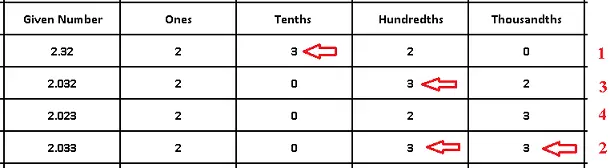
  1. Question: Order the numbers from largest to smallest: $2.32$, $2.032$, $2.023$, $2.033$
    View Step-by-Step Solution ▼

    Write the numbers aligning their place values: Table of Place Values
    1) Compare the ones: all are 2.
    2) Compare the tenths: 3 is the largest, so 2.32 is the largest.
    3) Compare the thousandths for the remaining numbers: 2.033 has the largest thousandths digit (3).
    Order: $2.32$, $2.033$, $2.032$, $2.023$

  2. Question: Round to the nearest whole number: a) 4.01   b) 6.8   c) 11.5
    View Step-by-Step Solution ▼

    a) 4.01 has a 0 in the tenths place. No change to the ones digit. Answer: 4.
    b) 6.8 has an 8 in the tenths place. Round up the ones digit. Answer: 7.
    c) 11.5 has a 5 in the tenths place. Round up the ones digit. Answer: 12.

  3. Question: Evaluate the following expressions:
    a) $0.15 \div 3$
    b) $5 - 1.2 \times 0.2$
    c) $2.3 - 0.7 \div 7$
    View Step-by-Step Solution ▼

    a) $0.15 \div 3 = \mathbf{0.05}$
    b) Order of operations (multiply first): $5 - 0.24 = \mathbf{4.76}$
    c) Order of operations (divide first): $2.3 - 0.1 = \mathbf{2.2}$

3 - Factors, Multiples and Divisibility

  1. Question: What is the Greatest Common Factor (GCF) of 24 and 18?
    View Step-by-Step Solution ▼

    Factors of 18: 1, 2, 3, 6, 9, 18.
    Factors of 24: 1, 2, 3, 4, 6, 8, 12, 24.
    The GCF is 6.

  2. Question: What is the Least Common Multiple (LCM) of 8 and 18?
    View Step-by-Step Solution ▼

    Multiples of 8: 8, 16, 24, 32, 40, 48, 56, 64, 72, 80...
    Multiples of 18: 18, 36, 54, 72, 90...
    The LCM is 72.

  3. Question: Which of the following numbers is divisible by 5? a) 1234   b) 303090   c) 145055
    View Step-by-Step Solution ▼

    A number is divisible by 5 if it ends in 0 or 5. Answers: b) 303090 and c) 145055.

  4. Question: Which of the following numbers is divisible by 2? a) 2798   b) 30675   c) 6476
    View Step-by-Step Solution ▼

    A number is divisible by 2 if it ends in an even digit (0, 2, 4, 6, 8). Answers: a) 2798 and c) 6476.

  5. Question: Which of the following numbers is divisible by 3? a) 9240   b) 4909   c) 3282900
    View Step-by-Step Solution ▼

    A number is divisible by 3 if the sum of its digits is a multiple of 3.
    a) 9+2+4+0 = 15 (Divisible).
    b) 4+9+0+9 = 22 (Not divisible).
    c) 3+2+8+2+9+0+0 = 24 (Divisible).
    Answers: a) 9240 and c) 3282900.

4 - Fractions and Mixed Numbers

  1. Question: Find the missing numerator or denominator:
    a) $\dfrac{10}{15} = \dfrac{?}{3}$   b) $\dfrac{17}{3} = \dfrac{34}{?}$   c) $\dfrac{11}{2} = \dfrac{?}{8}$
    View Step-by-Step Solution ▼

    a) Divide numerator and denominator by 5: $\dfrac{10 \div 5}{15 \div 5} = \mathbf{\dfrac{2}{3}}$
    b) Multiply numerator and denominator by 2: $\dfrac{17 \times 2}{3 \times 2} = \mathbf{\dfrac{34}{6}}$
    c) Multiply numerator and denominator by 4: $\dfrac{11 \times 4}{2 \times 4} = \mathbf{\dfrac{44}{8}}$

  2. Question: Evaluate the following expressions:
    a) $\dfrac{2}{5} + \dfrac{3}{10} - \dfrac{1}{10}$
    b) $\dfrac{5}{9} \times \dfrac{3}{4}$
    c) $\dfrac{11}{2} \div \dfrac{1}{8}$
    d) $4 \dfrac{3}{4} - 1 \dfrac{1}{2}$
    e) $6 \dfrac{3}{4} \div 2$
    f) $3 \div \dfrac{3}{5}$
    g) $2 \dfrac{3}{5} \div 3 \dfrac{3}{5}$
    View Step-by-Step Solution ▼

    a) Common denominator is 10: $\dfrac{4}{10} + \dfrac{3}{10} - \dfrac{1}{10} = \dfrac{6}{10} = \mathbf{\dfrac{3}{5}}$
    b) Multiply straight across and reduce: $\dfrac{15}{36} = \mathbf{\dfrac{5}{12}}$
    c) Multiply by reciprocal: $\dfrac{11}{2} \times \dfrac{8}{1} = \dfrac{88}{2} = \mathbf{44}$
    d) Subtract whole numbers and fractions: $(4 - 1) + (\dfrac{3}{4} - \dfrac{2}{4}) = \mathbf{3 \dfrac{1}{4}}$
    e) Convert to improper fraction: $\dfrac{27}{4} \times \dfrac{1}{2} = \dfrac{27}{8} = \mathbf{3 \dfrac{3}{8}}$
    f) Multiply by reciprocal: $\dfrac{3}{1} \times \dfrac{5}{3} = \mathbf{5}$
    g) Convert both to improper fractions: $\dfrac{13}{5} \div \dfrac{18}{5} = \dfrac{13}{5} \times \dfrac{5}{18} = \mathbf{\dfrac{13}{18}}$

  3. Question: Write the decimals as fractions or mixed numbers in reduced form: a) 0.2   b) 1.24   c) 2.326
    View Step-by-Step Solution ▼

    a) $0.2 = \dfrac{2}{10} = \mathbf{\dfrac{1}{5}}$
    b) $1.24 = 1 \dfrac{24}{100} = \mathbf{1 \dfrac{6}{25}}$
    c) $2.326 = 2 \dfrac{326}{1000} = \mathbf{2 \dfrac{163}{500}}$

  4. Question: Write as a decimal: a) $\dfrac{9}{100}$   b) $\dfrac{17}{10000}$   c) $3 \dfrac{11}{100000}$
    View Step-by-Step Solution ▼

    a) $\dfrac{9}{100} = \mathbf{0.09}$
    b) $\dfrac{17}{10000} = \mathbf{0.0017}$
    c) $3 \dfrac{11}{100000} = \mathbf{3.00011}$

  5. Question: Which of the following is true? a) $\dfrac{2}{5} < \dfrac{3}{4}$   b) $\dfrac{1}{3} < \dfrac{3}{10}$
    View Step-by-Step Solution ▼

    a) Common denominator is 20: $\dfrac{8}{20} < \dfrac{15}{20}$. True.
    b) Common denominator is 30: $\dfrac{10}{30} < \dfrac{9}{30}$. False.

5 - Exponents

  1. Question: Simplify using exponents: a) $3 \times 3 \times 3 \times 3$   b) $7 \times 4 \times 4 \times 4 \times 5 \times 5$
    View Step-by-Step Solution ▼

    a) $3^4$
    b) Group identical factors: $7 \times 4^3 \times 5^2$

  2. Question: Evaluate: a) $2^4$   b) $3^2 \times 4^2$   c) $10^0 \times 4^2$
    View Step-by-Step Solution ▼

    a) $2 \times 2 \times 2 \times 2 = \mathbf{16}$
    b) $9 \times 16 = \mathbf{144}$
    c) Any non-zero number to the power of 0 is 1. $1 \times 16 = \mathbf{16}$

6 - Ratios and Rates

  1. Question: There are 4 triangles and 7 squares. What is the ratio of a) triangles to squares? b) squares to triangles? c) squares to total numbers of figures?
    View Step-by-Step Solution ▼

    a) Triangles to squares: 4:7
    b) Squares to triangles: 7:4
    c) Squares to total (4+7=11): 7:11

  2. Question: School A has 1200 students including 400 boys. School B has 800 students including 300 boys. Which school has a higher ratio of girls to boys?
    View Step-by-Step Solution ▼

    School A: 1200 total - 400 boys = 800 girls. Ratio girls to boys = $800/400 = 2/1$.
    School B: 800 total - 300 boys = 500 girls. Ratio girls to boys = $500/300 = 5/3$.
    Compare $2/1$ ($6/3$) and $5/3$. School A has a higher ratio.

  3. Question: Sam bought 5 kilograms of tomatoes at the cost of $15. Find the unit rate (or price) in dollars/kilogram.
    View Step-by-Step Solution ▼

    Unit rate = Total cost $\div$ Total amount. $\$15 \div 5 \text{ kg} = \mathbf{\$3 / \text{kg}}$.

  4. Question: A car traveled 350 kilometers (km) in 5 hours (hrs). Find the unit rate in km/hrs.
    View Step-by-Step Solution ▼

    Unit rate = $350 \text{ km} \div 5 \text{ hrs} = \mathbf{70 \text{ km/hr}}$.

7 - Proportionality and Related Problems

  1. Question: A car travels 240 kilometers in 3 hours at a constant speed. How many hours are needed to travel 400 kilometers in the same car at the same constant speed?
    View Step-by-Step Solution ▼

    1) Find constant speed: $240 \text{ km} \div 3 \text{ hrs} = 80 \text{ km/hr}$.
    2) Calculate new time: $\text{Time} = \text{Distance} \div \text{Speed} = 400 \text{ km} \div 80 \text{ km/hr} = \mathbf{5 \text{ hrs}}$.

  2. Question: The money used in the UAE is called the Dirham with an exchange rate of 4 Dirhams to 1 US dollar. How many US Dollars are needed to buy 320 Dirhams at the given rate?
    View Step-by-Step Solution ▼

    Let $x$ be the US dollars. $320 \text{ Dirhams} = x \times 4 \text{ Dhs/\$}$.
    $x = 320 \div 4 = \mathbf{\$80}$.

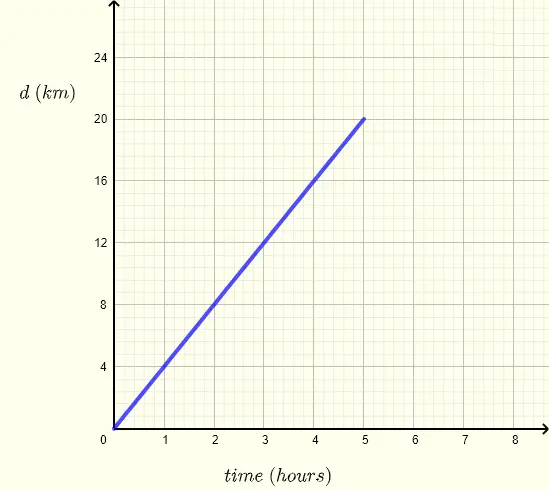
  3. Question: Joan went for a 5-hour walk, and the graph below shows the distance (in km) walked after time (in hours).
    a) Assuming that the distance walked is proportional to the time, what distance did she walk for the first 2.5 hours?
    b) What is the walking speed (rate) of Joan?
    c) Two weeks later, she decided to go for a longer walk at the same rate. How many hours were needed to cover 32 kilometers?
    Distance Against Time Graph
    View Step-by-Step Solution ▼

    a) Distance = $k \times$ time. From the graph, at time = 2 hrs, distance = 8 km. So $k = 8/2 = 4$. For time = 2.5 hrs: Distance = $4 \times 2.5 = \mathbf{10 \text{ km}}$.
    b) The speed is the constant $k = \mathbf{4 \text{ km/hr}}$.
    c) $32 = 4 \times \text{time}$. Time = $32 / 4 = \mathbf{8 \text{ hrs}}$.

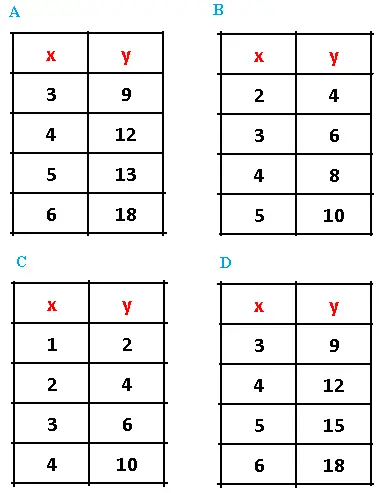
  4. Question: Which of the following tables indicates that $y$ is proportional to $x$?
    Tables of Proportionality
    View Step-by-Step Solution ▼

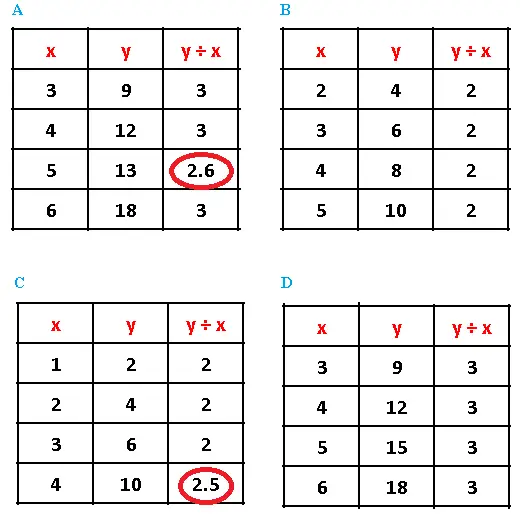
    For $y$ to be proportional to $x$, the ratio $\frac{y}{x}$ must be constant.
    Table B: $2/1 = 2$, $4/2 = 2$, $6/3 = 2$. Constant.
    Table D: $3/1 = 3$, $6/2 = 3$, $9/3 = 3$. Constant.
    Tables A and C do not have constant ratios. Therefore, Tables B and D represent proportional relationships.
    Tables of Proportionality Solution

8 - Percent and Related Problems

  1. Question: What is 20% of 10?
    View Step-by-Step Solution ▼

    $\dfrac{20}{100} \times 10 = \mathbf{2}$.

  2. Question: What is 50% of $\dfrac{1}{4}$?
    View Step-by-Step Solution ▼

    $\dfrac{50}{100} \times \dfrac{1}{4} = \dfrac{1}{2} \times \dfrac{1}{4} = \mathbf{\dfrac{1}{8}}$.

  3. Question: Write the fraction $\dfrac{3}{5}$ as a percentage.
    View Step-by-Step Solution ▼

    Multiply numerator and denominator by 20 to make the denominator 100: $\dfrac{3 \times 20}{5 \times 20} = \dfrac{60}{100} = \mathbf{60\%}$.

  4. Question: Amanda has a monthly salary of \( \$3000 \). She spends $600 per month on clothes. What percent of her monthly salary does Amanda spend on clothes?
    View Step-by-Step Solution ▼

    Percent = $\dfrac{600}{3000} = \dfrac{20}{100} = \mathbf{20\%}$.

  5. Question: The price of an item changed from \( \$120 \) to \( \$100 \). What was the change in percent?
    View Step-by-Step Solution ▼

    Percent change = $\dfrac{\text{New Price} - \text{Old Price}}{\text{Old Price}} \times 100$.
    $\dfrac{100 - 120}{120} = \dfrac{-20}{120} = \mathbf{-16.67\%}$. (It is a 16.67% decrease).

  6. Question: 10% of a number is 3. What is the number?
    View Step-by-Step Solution ▼

    Let $x$ be the number. $\dfrac{10}{100} \times x = 3$. Multiply both sides by 100 to get $10x = 300$, so $x = \mathbf{30}$.

  7. Question: A shirt initially costs $40. The price of the shirt is increased by 20% then the price of the same shirt is decreased by 20% (from the price after the increase). What is the final price of the shirt?
    View Step-by-Step Solution ▼

    After 20% increase: $\$40 + (0.20 \times 40) = \$48$.
    After 20% decrease on the new price: $\$48 - (0.20 \times 48) = 48 - 9.60 = \mathbf{\$38.40}$.

9 - Convert Units of Measurement

  1. Question: How many meters (m) are in 1.2 kilometers (km) knowing that 1 km = 1000 m?
    View Step-by-Step Solution ▼

    $1.2 \text{ km} \times \dfrac{1000 \text{ m}}{1 \text{ km}} = \mathbf{1200 \text{ m}}$.

  2. Question: How many US gallons (US gal) are in 120 liters (L) knowing that 1 US gal = 3.78541 L?
    View Step-by-Step Solution ▼

    $120 \text{ L} \times \dfrac{1 \text{ US gal}}{3.78541 \text{ L}} = \mathbf{31.70066 \text{ US gal}}$.

  3. Question: How many square feet are in 0.3 square meters ($m^2$) knowing that 1 m = 3.28084 ft?
    View Step-by-Step Solution ▼

    Square the conversion factor first: $1 \text{ m}^2 = (3.28084)^2 \text{ ft}^2 = 10.76391 \text{ ft}^2$.
    $0.3 \text{ m}^2 \times 10.76391 = \mathbf{3.229173 \text{ ft}^2}$.

  4. Question: Convert the rate of 60 kilometers per hour into meters per minute?
    View Step-by-Step Solution ▼

    $\dfrac{60 \text{ km}}{1 \text{ hr}} = \dfrac{60 \times 1000 \text{ m}}{60 \text{ min}} = \mathbf{1000 \text{ m/min}}$.

10 - Evaluate Expressions

  1. Question: Evaluate the expression $2x - 2$ for $x = -2$.
    View Step-by-Step Solution ▼

    Substitute $x = -2$: $2(-2) - 2 = -4 - 2 = \mathbf{-6}$.

  2. Question: Evaluate the expression $|-5 + b|$ for $b = -10$.
    View Step-by-Step Solution ▼

    Substitute $b = -10$: $|-5 + (-10)| = |-15| = \mathbf{15}$.

  3. Question: Evaluate the expression $a - b$ for $a = -5$ and $b = -8$.
    View Step-by-Step Solution ▼

    Substitute values: $-5 - (-8) = -5 + 8 = \mathbf{3}$.

11 - Algebra

  1. Question: Simplify the expressions:
    a) $3x - 2 + 4x - 5$
    b) $3(a + b + 2) + a + 4b - 12$
    c) $\dfrac{1}{3}(6x + 9) + 3$
    d) $0.2x + x$
    View Step-by-Step Solution ▼

    a) Group like terms: $(3x + 4x) + (-2 - 5) = \mathbf{7x - 7}$.
    b) Expand brackets: $3a + 3b + 6 + a + 4b - 12 = \mathbf{4a + 7b - 6}$.
    c) Expand brackets: $2x + 3 + 3 = \mathbf{2x + 6}$.
    d) Factor out $x$: $(0.2 + 1)x = \mathbf{1.2x}$.

  2. Question: Factor the expressions:
    a) $14x - 2$
    b) $9 - 18x$
    c) $4b - 16a + 4$
    View Step-by-Step Solution ▼

    a) Find the GCF of 14x and 2, which is 2. Factor out the 2: $2(7x) - 2(1) = \mathbf{2(7x - 1)}$.
    b) Find the GCF, which is 9. Factor out the 9: $\mathbf{9(1 - 2x)}$.
    c) Find the GCF, which is 4. Factor out the 4: $\mathbf{4(b - 4a + 1)}$.

12 - Equation with One Variable and Related Problems

  1. Question: Solve the equations:
    a) $3x - 2 = 4$
    b) $9 - 3 = -x + 5$
    c) $\dfrac{x}{3} = -7$
    d) $4\left(x + \dfrac{1}{4}\right) = -15$
    e) $\dfrac{x+2}{-3} = 3$
    f) $2(x-1) = 3(x+2)$
    g) $x - 2\dfrac{1}{4} = 3$
    View Step-by-Step Solution ▼

    a) $3x = 6 \rightarrow \mathbf{x = 2}$.
    b) $6 = -x + 5 \rightarrow 1 = -x \rightarrow \mathbf{x = -1}$.
    c) Multiply both sides by 3: $x = -7 \times 3 \rightarrow \mathbf{x = -21}$.
    d) Expand brackets: $4x + 1 = -15 \rightarrow 4x = -16 \rightarrow \mathbf{x = -4}$.
    e) Multiply by -3: $x + 2 = -9 \rightarrow \mathbf{x = -11}$.
    f) Expand: $2x - 2 = 3x + 6 \rightarrow -8 = x \rightarrow \mathbf{x = -8}$.
    g) Add $2\dfrac{1}{4}$ to both sides: $x = 3 + 2\dfrac{1}{4} \rightarrow \mathbf{x = 5\dfrac{1}{4}}$.

  2. Question: The perimeter of a rectangular garden is 340 m and its length is 120 m. Let $x$ be the width of the garden.
    a) Write an equation in $x$ to solve for the width.
    b) Solve the equation.
    c) Check your answer.
    View Step-by-Step Solution ▼

    a) Perimeter formula: $P = 2(\text{length}) + 2(\text{width})$. Equation: $340 = 2(120) + 2x$.
    b) Solve: $340 = 240 + 2x \rightarrow 100 = 2x \rightarrow \mathbf{x = 50 \text{ m}}$.
    c) Check: $2(120) + 2(50) = 240 + 100 = \mathbf{340}$.

13 - Inequality with One Variable

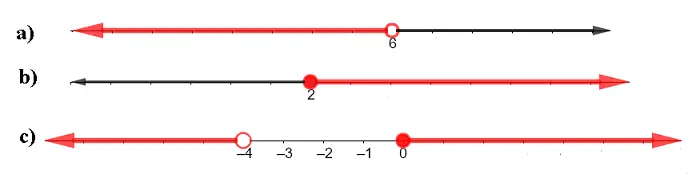
  1. Question: Represent the inequalities on a number line:
    a) $x < 6$   b) $x \ge 2$   c) $x < -4$ or $x \ge 0$
    View Step-by-Step Solution ▼

    An open circle means the value is excluded ($<, >$). A closed circle means it is included ($\le, \ge$).
    Inequalities on a Number Line

  2. Question: Solve the inequalities:
    a) $4x - 2 > 18$
    b) $2(x - 1) > 6$
    View Step-by-Step Solution ▼

    a) Add 2 to both sides: $4x > 20$. Divide by 4: $\mathbf{x > 5}$.
    b) Expand brackets: $2x - 2 > 6$. Add 2 to both sides: $2x > 8$. Divide by 2: $\mathbf{x > 4}$.

14 - Two-Dimensional Figures

  1. Question: A triangle has two angles that measure 36° and 54°. Which of the following is true?
    a) This is an isosceles triangle.
    b) This is a right triangle.
    c) This is an equilateral triangle.
    View Step-by-Step Solution ▼

    The sum of angles in a triangle is 180°.
    Third angle = $180 - (36 + 54) = 180 - 90 = 90^\circ$.
    Because it has a 90° angle, it is a right triangle (b).

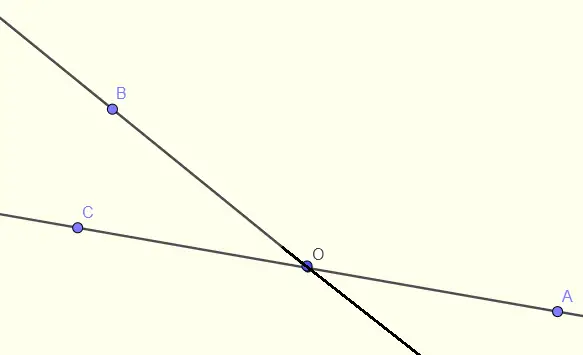
  2. Question: Two straight lines intersect at point O. What is the size of $\angle AOB$ if $\angle COB = 27^\circ$?
    Supplementary Angles
    View Step-by-Step Solution ▼

    $\angle AOC$ forms a straight angle (180°), making $\angle AOB$ and $\angle COB$ supplementary.
    $\angle AOB = 180^\circ - 27^\circ = \mathbf{153^\circ}$.

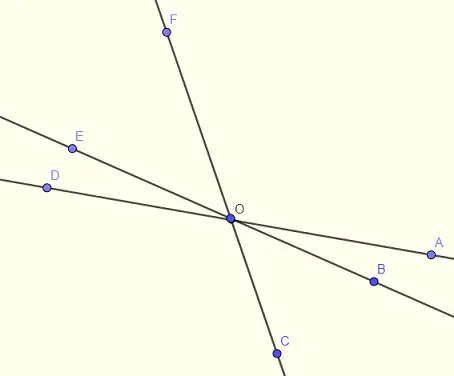
  3. Question: Three straight lines intersect at point O. List all the pairs of vertical angles in the figure below.
    Vertical Angles
    View Step-by-Step Solution ▼

    The vertical angle pairs are:
    $\angle AOB$ and $\angle DOE$
    $\angle BOC$ and $\angle EOF$
    $\angle COD$ and $\angle FOA$
    $\angle FOB$ and $\angle COE$
    $\angle AOC$ and $\angle DOF$
    $\angle BOD$ and $\angle EOA$

  4. Question: Give the number of sides of each of the polygons listed below:
    a) Hexagon   b) Pentagon   c) Octagon
    View Step-by-Step Solution ▼

    a) Hexagon: 6 sides
    b) Pentagon: 5 sides
    c) Octagon: 8 sides

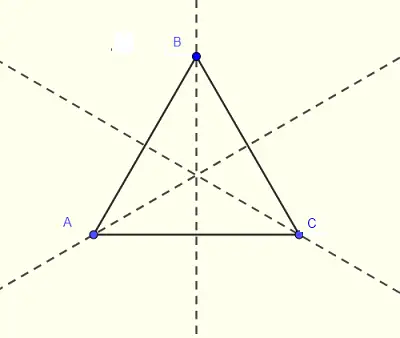
  5. Question: How many lines of symmetry does an equilateral triangle have?
    View Step-by-Step Solution ▼

    An equilateral triangle has 3 lines of symmetry.
    Lines of Symmetry

15 - Perimeter and Area of Planar Figures

  1. Question: Calculate the area of a circle with a diameter of 20 cm.
    View Step-by-Step Solution ▼

    Radius $r = \text{diameter} / 2 = 10 \text{ cm}$.
    Area = $\pi \times r^2 = 3.14 \times 10^2 = 3.14 \times 100 = \mathbf{314 \text{ cm}^2}$.

  2. Question: Calculate the perimeter of a rectangle with a length of 10 inches and a width of 8 inches.
    View Step-by-Step Solution ▼

    Perimeter = $2(\text{length}) + 2(\text{width}) = 2(10) + 2(8) = 20 + 16 = \mathbf{36 \text{ inches}}$.

  3. Question: Calculate the area of a triangle of height 10 cm and base 5 cm.
    View Step-by-Step Solution ▼

    Area = $\frac{1}{2} \times \text{base} \times \text{height} = \frac{1}{2} \times 5 \times 10 = \mathbf{25 \text{ cm}^2}$.

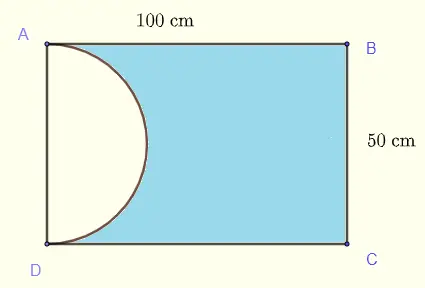
  4. Question: ABCD is a rectangle bounded on the left side by a semicircle. Find the area of the shaded (in blue) surface.
    Rectangle with a Semicircle
    View Step-by-Step Solution ▼

    1) Area of full rectangle = $100 \times 50 = 5000 \text{ cm}^2$.
    2) Area of semicircle (radius = $50 / 2 = 25 \text{ cm}$) = $\frac{1}{2} \times 3.14 \times 25^2 = 981.25 \text{ cm}^2$.
    3) Shaded Area = Rectangle - Semicircle = $5000 - 981.25 = \mathbf{4018.75 \text{ cm}^2}$.

16 - Data and Interpretation of Graphs

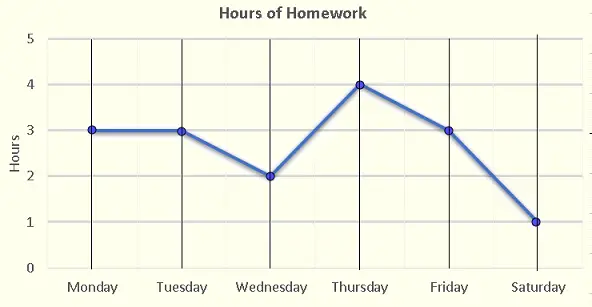
  1. Question: The line plot below shows the number of hours spent on homework by Mathew for 6 days preparing for his exam.
    a) On which day did Mathew spend the smallest number of hours on homework?
    b) On which day did Mathew spend the largest number of hours on homework?
    c) How many hours did Mathew spend on homework preparing for his exam?
    Line Plot
    View Step-by-Step Solution ▼

    a) Saturday (1 hour).
    b) Thursday (4 hours).
    c) Total hours = $3 + 3 + 2 + 4 + 3 + 1 = \mathbf{16 \text{ hours}}$.

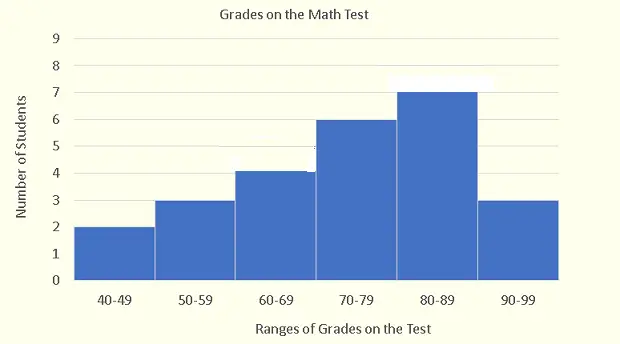
  2. Question: The histogram below shows the range of scores (horizontal axis) and the number of students (vertical axis) who scored on that range for a class on a math test.
    a) How many students are in this class?
    b) How many students scored between 70 and 89 inclusive?
    c) Anyone who scored less than 60 is supposed to have failed. What percent of the total number of students failed the test?
    Histogram
    View Step-by-Step Solution ▼

    a) Sum of all bars: $2 + 3 + 4 + 6 + 7 + 3 = \mathbf{25 \text{ students}}$.
    b) Bars for 70-79 and 80-89: $6 + 7 = \mathbf{13 \text{ students}}$.
    c) Failed students (ranges 40-49 and 50-59) = $2 + 3 = 5$. Percent failed = $\dfrac{5}{25} \times 100 = \mathbf{20\%}$.

17 - Statistics

  1. Question: Calculate the mean, mode and median of the data set: $\{ 9, 4, 3, 2, 3, 2, 3, 1, 9 \}$
    View Step-by-Step Solution ▼

    Mean: Sum divided by count. $\dfrac{36}{9} = \mathbf{4}$.
    Arrange Data: $1, 2, 2, 3, \textbf{3}, 3, 4, 9, 9$.
    Mode: Most frequent number is 3.
    Median: The middle number in the ordered list is 3.

  2. Question: Joel scored 78, 95 and 92 on her first 3 quizzes. What should be the score on her fourth quiz so that the average of the 4 quizzes is 90?
    View Step-by-Step Solution ▼

    Let $x$ be the fourth score.
    $\dfrac{78 + 95 + 92 + x}{4} = 90$
    $\dfrac{265 + x}{4} = 90$
    $265 + x = 360 \rightarrow x = 360 - 265 = \mathbf{95}$.

18 - Counting Principle

  1. Question: At a restaurant, lunch is offered with a choice of three salads, five main dishes and four desserts. In how many ways can one order his lunch?
    View Step-by-Step Solution ▼

    Multiply the number of choices for each category: $3 \times 5 \times 4 = \mathbf{60 \text{ ways}}$.

  2. Question: There are two car dealerships in town. The first one has 3 body styles, 4 colors and 3 models. The second one has 2 body styles, 5 colors and 4 models. Which car dealership has more choices?
    View Step-by-Step Solution ▼

    Dealership 1 choices: $3 \times 4 \times 3 = 36$.
    Dealership 2 choices: $2 \times 5 \times 4 = 40$.
    The second dealership has more choices.

19 - Probabilities

  1. Question: Which of the following cannot be a measure of probability?
    a) 1   b) -0.5   c) 2   d) 0   e) 0.0001
    View Step-by-Step Solution ▼

    A probability measure must be between 0 and 1 inclusive. Therefore, b) -0.5 (negative) and c) 2 (greater than 1) cannot be probabilities.

  2. Question: How many outcomes are possible if you flip a coin and select one of five different cards at random?
    View Step-by-Step Solution ▼

    Coin (2 outcomes) $\times$ Cards (5 outcomes) = $2 \times 5 = \mathbf{10 \text{ outcomes}}$.

  3. Question: A die, with numbers from 1 to 6 on the faces, is rolled. What is the probability that the number obtained is:
    a) equal to 0?
    b) equal to 5?
    c) greater than 4?
    View Step-by-Step Solution ▼

    a) 0 (The die has no face with a zero).
    b) $\mathbf{\dfrac{1}{6}}$ (Only one face has a 5).
    c) $\mathbf{\dfrac{2}{6} = \dfrac{1}{3}}$ (Two faces, 5 and 6, are greater than 4).

  4. Question: Linda surveyed 20 students in her school about their favorite color and 5 said blue was their favorite color. What is the probability that the next student surveyed will pick a color that is not blue?
    View Step-by-Step Solution ▼

    If 5 out of 20 picked blue, then $20 - 5 = 15$ students picked a color that is not blue.
    Probability = $\dfrac{15}{20} = \mathbf{\dfrac{3}{4}}$.

More References and links

Return to Home Page