Convert Polar and Rectangular Coordinates
Rectangular coordinates \( (x, y) \) and polar coordinates \( (R, t) \) are related by the following formulas.
\[
x = R \cos t \qquad \text{and} \qquad y = R \sin t
\]
\[
R^2 = x^2 + y^2 \qquad \text{and} \qquad \tan t = \frac{y}{x}
\]
These formulas allow us to convert points from one coordinate system to the other.
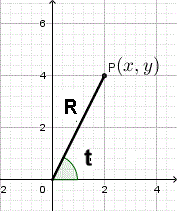
To find the polar angle \( t \), you must take into account the signs of \( x \) and \( y \), which determine the correct quadrant.
The angle \( t \) is usually taken in the interval
\[
[0, 2\pi) \quad \text{or} \quad [0^\circ, 360^\circ)
\]
Examples on Converting Polar and Rectangular Coordinates
Example 1
Convert the polar coordinates \( (5, 2.01) \) and \( (0.2, 53^\circ) \) to rectangular coordinates, rounding to three decimal places.
Solution to Example 1
-
First point: \( (5, 2.01) \)
Here \( R = 5 \) and \( t = 2.01 \) radians. Set the calculator to radians.
\[
x = R \cos t = 5 \cos(2.01) = -2.126
\]
\[
y = R \sin t = 5 \sin(2.01) = 4.525
\]
-
Second point: \( (0.2, 53^\circ) \)
Here \( R = 0.2 \) and \( t = 53^\circ \). Set the calculator to degrees.
\[
x = R \cos t = 0.2 \cos(53^\circ) = 0.120
\]
\[
y = R \sin t = 0.2 \sin(53^\circ) = 0.160
\]
Example 2
Convert the rectangular coordinates \( (1, 1) \) and \( (-2, -4) \) to polar coordinates, rounding to three decimal places.
Express the polar angle \( t \) in both radians and degrees.
Solution to Example 2
-
For the point \( (1, 1) \), compute \( R \):
\[
R = \sqrt{x^2 + y^2} = \sqrt{1^2 + 1^2} = \sqrt{2}
\]
-
Compute \( \tan t \):
\[
\tan t = \frac{y}{x} = \frac{1}{1} = 1
\]
-
Using the inverse tangent:
\[
t = \frac{\pi}{4} \quad \text{or} \quad 45^\circ
\]
-
The polar form of \( (1, 1) \) is:
\[
(\sqrt{2}, \tfrac{\pi}{4}) \quad \text{or} \quad (\sqrt{2}, 45^\circ)
\]
-
For the point \( (-2, -4) \), compute \( R \):
\[
R = \sqrt{(-2)^2 + (-4)^2} = \sqrt{20} = 2\sqrt{5}
\]
-
Compute \( \tan t \):
\[
\tan t = \frac{-4}{-2} = 2
\]
-
Using the inverse tangent:
\[
t = 1.107 \text{ radians} \quad \text{or} \quad 63.435^\circ
\]
-
Since both \( x \) and \( y \) are negative, the point lies in quadrant III.
Add \( \pi \) (or \( 180^\circ \)) to get the correct angle:
\[
t = 4.249 \text{ radians} \quad \text{or} \quad 243.435^\circ
\]
-
The polar form of \( (-2, -4) \) is:
\[
(2\sqrt{5}, 4.249) \quad \text{or} \quad (2\sqrt{5}, 243.435^\circ)
\]
More References on Polar Coordinates
Convert Polar to Rectangular Coordinates Calculator
Polar Coordinates – Geometry Overview
Trigonometry Tutorials and Practice Problems