Questions and Step-by-Step Solutions
-
Question 1: True or False: Two parallel lines intersect.
► Solution to Question 1
False: Two parallel lines do not intersect.
-
Question 2: A triangle is a closed planar shape with
- 2 sides
- 4 sides
- 3 sides
- 5 sides
► Solution to Question 2
A triangle has 3 sides (tri in the word triangle means three, from Latin).
Therefore, option C is correct.
-
Question 3: A closed planar shape with 5 sides is called a
- pentagon
- hexagon
- square
- heptagon
► Solution to Question 3
A 5-sided shape is a pentagon (penta in the word pentagon means five, from Greek).
Therefore, option A is correct.
-
Question 4: A closed planar shape with 4 sides is called a
- segment
- hexagon
- quadrilateral
- heptagon
► Solution to Question 4
A 4-sided shape is a quadrilateral (quadri in the word quadrilateral means four, from Latin).
Therefore, option C is correct.
-
Question 5: A line segment is defined by
- 1 point
- 3 points
- 2 points
- 4 points
► Solution to Question 5
A line segment is a part of a line that has two distinct endpoints, so it is defined by 2 points.
Therefore, option C is correct.
-
Question 6: An equilateral triangle has
- only 2 equal sides
- all 3 sides equal
- no equal sides
- one right angle
► Solution to Question 6
An equilateral triangle has all three sides equal and all three angles equal.
Therefore, option B is correct.
-
Question 7: Which of the statements below best describes a square?
- A square has 4 equal sides and 4 right angles.
- A square has 4 equal sides.
- A square has 4 right angles.
- 2 pairs of parallel sides.
► Solution to Question 7
A square has 4 equal sides and 4 right angles. This is the most precise and complete definition among the choices.
Therefore, option A is correct.
-
Question 8: Which pair of lines are parallel?

► Solution to Question 8
The pair of lines in A are parallel because they run side-by-side and do not intersect.
-
Question 9: Which of these shapes are
i) quadrilaterals?
ii) triangles?
iii) squares?
► Solution to Question 9
i) Quadrilaterals have 4 sides: shapes B, E, F.
ii) Triangles have 3 sides: shapes A, D.
iii) Squares have 4 equal sides and 4 right angles: shape F. -
Question 10: Which of these shapes are
i) right triangles?
ii) rectangles?
► Solution to Question 10
i) Right triangles have 1 right angle: shape B.
ii) Rectangles have 2 pairs of parallel sides and 4 right angles: shapes D and E. -
Question 11: Which pair of lines are
i) parallel?
ii) perpendicular?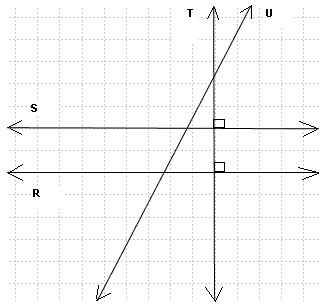
► Solution to Question 11
i) Parallel lines do not intersect. Lines S and R are parallel.
ii) Perpendicular lines intersect and form a right angle (90 degrees). T and S, and T and R are pairs of perpendicular lines. -
Question 12: Find the perimeter and area of each shape.

► Solution to Question 12
Shape A:
Perimeter = \(5 + 5 + 5 + 5 = 20\)
Area = \(5 \times 5 = 25\)Shape B:
Perimeter = \(9 + 6 + 9 + 6 = 30\)
Area = \(9 \times 6 = 54\)Shape C:
Perimeter = \(10 + 2 + 10 + 2 = 24\)
Area = \(10 \times 2 = 20\)Shape D:
Perimeter = \(5 + 4 + 5 + 4 = 18\)
Area = \(5 \times 4 = 20\) -
Question 13: Find the perimeter and area of each shape.

► Solution to Question 13
Shape A:
Perimeter is obtained by adding all outer sides starting from the top side:
Perimeter = \(4 + 4 + 4 + 4 + 8 + 8 = 32\)
Area is equal to the area of the large square of side 8 minus the area of the small top-right square of side 4:
Area = \(8 \times 8 - 4 \times 4 = 64 - 16 = 48\)Shape B:
Perimeter is obtained by adding all outer sides:
Perimeter = \(8 + 2 + 4 + 4 + 4 + 2 + 8 + 8 = 40\)
Area is equal to the area of the square on the left of side 8 plus the area of the small square on the right of side 4:
Area = \(8 \times 8 + 4 \times 4 = 64 + 16 = 80\) -
Question 14: Which of these is an isosceles triangle?

► Solution to Question 14
An isosceles triangle has two equal sides: shape B.
-
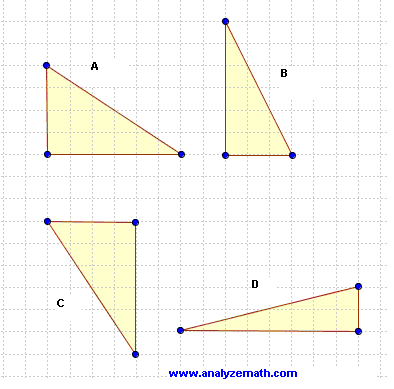
Question 15: Which pair of triangles are congruent?
► Solution to Question 15
Congruent shapes have identical shapes and sides of equal length: shapes A and C.
-
Question 16: Point O is the center of the circle below. What do you call the segments
i) AB?
ii) CD?
iii) OD?
► Solution to Question 16
i) AB: A segment whose endpoints are on a circle is called a chord, so AB is a chord.
ii) CD: A chord that passes through the center of a circle is called a diameter, so CD is a diameter.
iii) OD: A segment with one endpoint at the center and the other on the circle is called a radius, so OD is a radius.