Vertex and Intercepts of Quadratic Functions
This page presents a collection of problems focused on finding the vertex, the \(x\)- and \(y\)-intercepts, and the axis of symmetry of quadratic functions. Each problem includes a detailed analytical solution and a graph.
Interactive verification tool: use our Vertex and Intercepts Calculator to check your manual work.
Review: Vertex and Intercepts Formulas
A quadratic function in general form is written as:
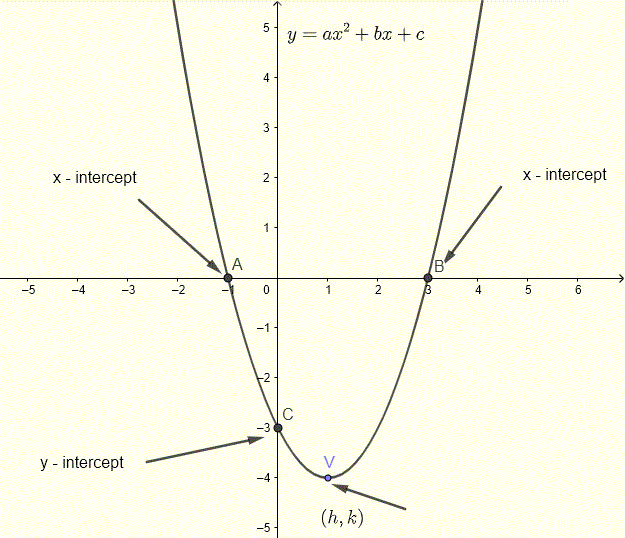
\[ f(x) = ax^2 + bx + c. \]Its graph is a vertical parabola whose axis of symmetry is parallel to the \(y\)-axis. The key features are:
- Vertex \(V(h, k)\): \[ h = -\frac{b}{2a}, \qquad k = f(h) = c - \frac{b^2}{4a}. \]
- Opening direction: if \(a > 0\), the parabola opens upward and the vertex is a minimum; if \(a < 0\), it opens downward and the vertex is a maximum.
- Vertex form: \[ f(x) = a(x - h)^2 + k. \]
- Axis of symmetry: the vertical line \(x = h\).
- \(x\)-intercepts: solutions of \(ax^2 + bx + c = 0\) via the quadratic formula \[ x_{1,2} = \frac{-b \pm \sqrt{b^2 - 4ac}}{2a}. \] Real solutions exist only when the discriminant \(b^2 - 4ac \ge 0\). In that case the axis of symmetry is the midpoint of the roots: \(h = \dfrac{x_1 + x_2}{2}\).
- Factored form: when real \(x_1, x_2\) exist, \(f(x) = a(x - x_1)(x - x_2)\).
- \(y\)-intercept: the point \(\bigl(0,\, f(0)\bigr) = (0, c)\).
Practice Problems and Step-by-Step Solutions
Problem 1
Find the vertex, the \(x\)- and \(y\)-intercepts, and the axis of symmetry of
\[ f(x) = -x^2 - 2x + 3. \]Show solution
1. Identify coefficients: \(a = -1\), \(b = -2\), \(c = 3\).
2. Vertex \((h, k)\):
\[ h = -\frac{b}{2a} = -\frac{-2}{2(-1)} = -1 \] \[ k = f(-1) = -(-1)^2 - 2(-1) + 3 = -1 + 2 + 3 = 4 \]The vertex is \((-1, 4)\), a maximum since \(a = -1 < 0\).
3. \(x\)-intercepts: set \(f(x) = 0\):
\[ -x^2 - 2x + 3 = 0 \;\Rightarrow\; -(x^2 + 2x - 3) = 0 \;\Rightarrow\; -(x-1)(x+3) = 0, \] so \(x = 1\) or \(x = -3\). The \(x\)-intercepts are \((1, 0)\) and \((-3, 0)\).4. \(y\)-intercept: \(f(0) = 3\), so the point is \((0, 3)\).
5. Axis of symmetry: the vertical line \(x = -1\).

Problem 2
Find a quadratic function whose graph has \(x\)-intercepts at \(x = -4\) and \(x = 6\), and whose maximum value is \(6\).
Show solution
1. Factored form:
\[ f(x) = a(x + 4)(x - 6). \]2. Vertex \(x\)-coordinate: the midpoint of the roots,
\[ h = \frac{-4 + 6}{2} = 1. \]3. Find \(a\) from \(f(1) = 6\):
\[ a(1 + 4)(1 - 6) = 6 \;\Rightarrow\; a(5)(-5) = 6 \;\Rightarrow\; -25a = 6 \;\Rightarrow\; a = -\frac{6}{25}. \]4. Function:
\[ f(x) = -\frac{6}{25}(x + 4)(x - 6) = -\frac{6}{25}x^2 + \frac{12}{25}x + \frac{144}{25}. \]
Problem 3
A parabola with a vertical axis has vertex \((1, -8)\) and passes through \((2, -6)\). Find its \(x\)-intercepts.
Show solution
1. Vertex form:
\[ f(x) = a(x - 1)^2 - 8. \]2. Find \(a\) using \((2, -6)\):
\[ -6 = a(2 - 1)^2 - 8 \;\Rightarrow\; -6 = a - 8 \;\Rightarrow\; a = 2. \]3. \(x\)-intercepts: set \(f(x) = 0\):
\[ 2(x - 1)^2 - 8 = 0 \;\Rightarrow\; (x - 1)^2 = 4 \;\Rightarrow\; x - 1 = \pm 2 \;\Rightarrow\; x = 3 \text{ or } x = -1. \]The \(x\)-intercepts are \((3, 0)\) and \((-1, 0)\).
Problem 4
A quadratic function has a minimum value of \(-2\), a \(y\)-intercept at \((0, 6)\), and an \(x\)-intercept at \((3, 0)\). Find all possible equations.
Show solution
1. Vertex form. Since the minimum value is \(-2\), the vertex is \((h, -2)\):
\[ f(x) = a(x - h)^2 - 2. \]2. Use the \(y\)-intercept \((0, 6)\):
\[ 6 = a(0 - h)^2 - 2 \;\Rightarrow\; 8 = ah^2 \;\Rightarrow\; a = \frac{8}{h^2}. \]3. Use the \(x\)-intercept \((3, 0)\):
\[ 0 = a(3 - h)^2 - 2 \;\Rightarrow\; 2 = \frac{8}{h^2}(3 - h)^2 \;\Rightarrow\; 2h^2 = 8(3 - h)^2. \] Expanding and simplifying: \[ 2h^2 = 72 - 48h + 8h^2 \;\Rightarrow\; 6h^2 - 48h + 72 = 0 \;\Rightarrow\; h^2 - 8h + 12 = 0, \] \[ (h - 2)(h - 6) = 0 \;\Rightarrow\; h = 2 \text{ or } h = 6. \]4. Corresponding functions:
- If \(h = 2\): \(a = \frac{8}{4} = 2\), so \( f(x) = 2(x - 2)^2 - 2 \).
- If \(h = 6\): \(a = \frac{8}{36} = \frac{2}{9}\), so \( f(x) = \frac{2}{9}(x - 6)^2 - 2 \).
Both functions satisfy the given conditions. The problem therefore has two solutions.

Challenging Vertex Problems
Problem 5 Challenge
A parabola has vertex on the line \(y = 2x - 3\), passes through the points \((1, 1)\) and \((3, 9)\). Find all possible equations of the parabola.
Show solution
1. Vertex form. Write the vertex as \((h, k)\), with the constraint \(k = 2h - 3\):
\[ f(x) = a(x - h)^2 + (2h - 3). \]2. Use the point \((1, 1)\):
\[ 1 = a(1 - h)^2 + 2h - 3 \;\Rightarrow\; 4 - 2h = a(1 - h)^2. \quad \text{(Eq. 1)} \]3. Use the point \((3, 9)\):
\[ 9 = a(3 - h)^2 + 2h - 3 \;\Rightarrow\; 12 - 2h = a(3 - h)^2. \quad \text{(Eq. 2)} \]4. Divide Eq. 2 by Eq. 1 (valid when \(h \neq 1\) and the numerators are non-zero):
\[ \frac{12 - 2h}{4 - 2h} = \frac{(3 - h)^2}{(1 - h)^2}. \] Simplify the left side: \(\dfrac{12-2h}{4-2h} = \dfrac{6-h}{2-h}\).Substituting \(u = h\) and cross-multiplying:
\[ (6 - h)(1 - h)^2 = (2 - h)(3 - h)^2. \] Expand both sides: \[ (6 - h)(1 - 2h + h^2) = (2 - h)(9 - 6h + h^2). \] Left: \(6 - 12h + 6h^2 - h + 2h^2 - h^3 = -h^3 + 8h^2 - 13h + 6\).Right: \(18 - 12h + 2h^2 - 9h + 6h^2 - h^3 = -h^3 + 8h^2 - 21h + 18\).
Equating: \(-13h + 6 = -21h + 18 \Rightarrow 8h = 12 \Rightarrow h = \dfrac{3}{2}\).
5. Compute \(a\) and \(k\). With \(h = \tfrac{3}{2}\):
\[ k = 2\cdot\tfrac{3}{2} - 3 = 0, \qquad 4 - 2h = 4 - 3 = 1 = a\left(1 - \tfrac{3}{2}\right)^2 = a\cdot\tfrac{1}{4}, \] so \(a = 4\).6. Equation:
\[ \boxed{f(x) = 4\left(x - \tfrac{3}{2}\right)^2} \]Expand if desired: \(f(x) = 4x^2 - 12x + 9\). Check: \(f(1) = 4 - 12 + 9 = 1\), \(f(3) = 36 - 36 + 9 = 9\), and the vertex \(\left(\tfrac{3}{2}, 0\right)\) satisfies \(y = 2x - 3\).
Problem 6 Challenge
The vertex of the parabola \(y = f(x)\) is \((2, 5)\). Find the vertex of the transformed parabola:
- \(y = f(x - 3) + 4\)
- \(y = -2f(x) + 1\)
- \(y = f(2x)\)
Show solution
The key idea: the vertex of the transformed parabola is the image of \((2, 5)\) under the same transformation that maps \(f(x)\) to the new function.
(a) \(y = f(x - 3) + 4\). This is a shift right by 3 and up by 4, so the vertex moves to
\[ (2 + 3,\; 5 + 4) = (5, 9). \](b) \(y = -2f(x) + 1\). This reflects vertically, stretches by 2, and shifts up by 1. The \(x\)-coordinate of the vertex does not move (there is no horizontal transformation); the \(y\)-coordinate becomes \(-2\cdot 5 + 1 = -9\). So the vertex is
\[ (2, -9). \](c) \(y = f(2x)\). This compresses horizontally by a factor of 2. Replacing \(x\) with \(2x\) means the new \(x\)-coordinate solves \(2x = 2\), so \(x = 1\). The \(y\)-coordinate is unchanged. The vertex is
\[ (1, 5). \]Problem 7 Challenge
Find the value of \(c\) so that the parabola \(y = x^2 - 4x + c\) is tangent to the \(x\)-axis. Then state its vertex.
Show solution
1. Tangency condition. A parabola is tangent to the \(x\)-axis exactly when its discriminant is zero:
\[ b^2 - 4ac = 0 \;\Rightarrow\; (-4)^2 - 4(1)(c) = 0 \;\Rightarrow\; 16 - 4c = 0 \;\Rightarrow\; c = 4. \]2. Equation: \( y = x^2 - 4x + 4 = (x - 2)^2 \).
3. Vertex. With \(a = 1\), \(b = -4\), \(c = 4\):
\[ h = -\frac{b}{2a} = \frac{4}{2} = 2, \qquad k = f(2) = 0. \]The vertex is \(\boxed{(2, 0)}\) — on the \(x\)-axis, as expected for a tangent parabola. The single \(x\)-intercept is \((2, 0)\), a double root.