This page presents a set of problems related to the vertex, the x- and y-intercepts, and the axis of symmetry of quadratic functions. Each problem is solved analytically and illustrated graphically.
You may also use this calculator for finding the vertex and intercepts of quadratic functions to verify your results.
A quadratic function in standard form is given by
\[ f(x) = ax^2 + bx + c \]Its graph is a vertical parabola with an axis of symmetry parallel to the \(y\)-axis. The parabola has:
If \(a > 0\), the parabola opens upward and the vertex is the minimum point. If \(a < 0\), the parabola opens downward and the vertex is the maximum point.
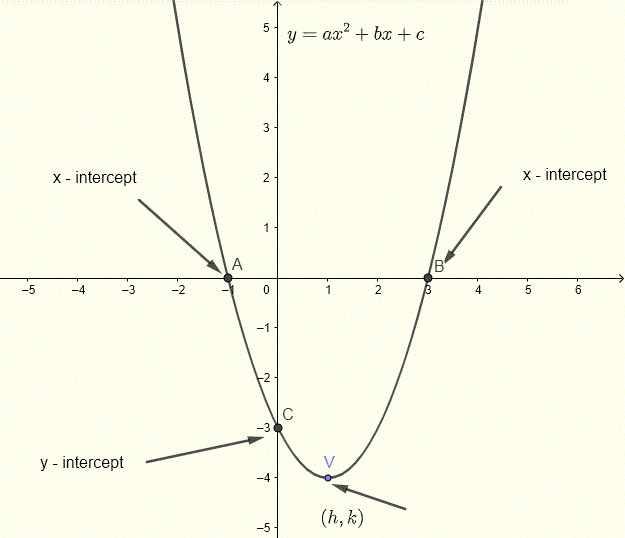
The coordinates of the vertex are given by:
\[ h = -\frac{b}{2a}, \qquad k = f(h) = c - \frac{b^2}{4a} \]A quadratic function with vertex \((h,k)\) can be written in vertex form as:
\[ f(x) = a(x - h)^2 + k \]The axis of symmetry is the vertical line:
\[ x = h \]The \(x\)-intercepts (if they exist) are solutions of:
\[ ax^2 + bx + c = 0 \]Using the quadratic formula, the solutions are:
\[ x_1 = \frac{-b + \sqrt{b^2 - 4ac}}{2a}, \qquad x_2 = \frac{-b - \sqrt{b^2 - 4ac}}{2a} \]It can be shown that:
\[ h = \frac{x_1 + x_2}{2} \]If the \(x\)-intercepts are \(x_1\) and \(x_2\), then the function may also be written as:
\[ f(x) = a(x - x_1)(x - x_2) \]Find the vertex, the \(x\)- and \(y\)-intercepts, and the axis of symmetry of:
\[ f(x) = -x^2 - 2x + 3 \]Solution
We identify the coefficients:
\[ a = -1, \quad b = -2, \quad c = 3 \]The vertex coordinates are:
\[ h = -\frac{-2}{2(-1)} = -1 \] \[ k = f(-1) = -(-1)^2 - 2(-1) + 3 = 4 \]The vertex is at \((-1,4)\).
To find the \(x\)-intercepts, solve \(f(x) = 0\):
\[ -x^2 - 2x + 3 = 0 \] \[ -(x - 1)(x + 3) = 0 \]Thus, the \(x\)-intercepts are:
\[ (1,0) \quad \text{and} \quad (-3,0) \]The \(y\)-intercept is:
\[ f(0) = 3 \]So the \(y\)-intercept is \((0,3)\).
The axis of symmetry is:
\[ x = -1 \]
Find a quadratic function whose graph has \(x\)-intercepts at \(x=-4\) and \(x=6\), and whose highest point has a \(y\)-coordinate equal to \(6\).
Solution
\[ f(x) = a(x + 4)(x - 6) \]The vertex lies midway between the \(x\)-intercepts:
\[ h = \frac{-4 + 6}{2} = 1 \]Since the vertex is \((1,6)\), substitute \(x=1\):
\[ a(1+4)(1-6) = 6 \] \[ -25a = 6 \quad \Rightarrow \quad a = -\frac{6}{25} \]The quadratic function is:
\[ f(x) = -\frac{6}{25}(x + 4)(x - 6) \]
A parabola with vertical axis has vertex \((1,-8)\) and passes through \((2,-6)\). Find its \(x\)-intercepts.
Solution
\[ f(x) = a(x - 1)^2 - 8 \] \[ -6 = a(2 - 1)^2 - 8 \] \[ a = 2 \] \[ f(x) = 2(x - 1)^2 - 8 \]Solve \(f(x)=0\):
\[ 2(x - 1)^2 = 8 \] \[ (x - 1)^2 = 4 \] \[ x = 3 \quad \text{or} \quad x = -1 \]The \(x\)-intercepts are \((3,0)\) and \((-1,0)\).
A quadratic function has a minimum value of \(-2\), a \(y\)-intercept at \((0,6)\), and an \(x\)-intercept at \((3,0)\). Find a possible equation.
Solution
\[ f(x) = a(x - h)^2 - 2 \]Using the \(y\)-intercept:
\[ 6 = ah^2 - 2 \quad \Rightarrow \quad a = \frac{8}{h^2} \]Using the \(x\)-intercept:
\[ 0 = a(3 - h)^2 - 2 \] \[ 0 = \frac{8}{h^2}(3 - h)^2 - 2 \] \[ h^2 - 8h + 12 = 0 \] \[ h = 2 \quad \text{or} \quad h = 6 \]Corresponding functions:
\[ f(x) = 2(x - 2)^2 - 2 \] \[ f(x) = \frac{2}{9}(x - 6)^2 - 2 \]