What is the difference quotient in calculus?
We start with the definition and then calculate the difference quotient for different functions as examples with detailed explanations.
Note that a difference quotient calculator is included and may be used to check results and generate further practice.
Definition of Difference Quotient
Let \( f \) be a function whose graph is shown below.
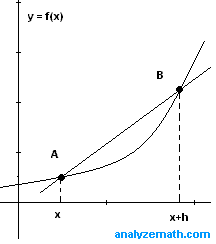
\( A \) and \( B \) are points on the graph of \( f \). A line passing through the two points \( A(x, f(x)) \) and \( B(x+h, f(x+h)) \) is called a secant line. The slope \( m \) of the secant line may be calculated as follows:
\[ m = \dfrac{f(x + h) - f(x)}{(x + h) - x} \]Simplify the denominator to obtain:
The slope \( m \) is called the difference quotient. It is a very important concept in calculus where it is used to define the derivative of function \( f \), which in turn defines the local variation of a function in mathematics.
Examples with Solutions
In the examples below, we calculate and simplify the difference quotients of different functions.
Example 1
Find the difference quotient of function \( f \) defined by:
\[ f(x) = 2x + 5 \]Solution to Example 1
We first need to calculate \( f(x + h) \):
\[ f(x + h) = 2(x + h) + 5 \]We now substitute \( f(x + h) \) and \( f(x) \) into the definition of the difference quotient:
\[ \dfrac{f(x + h) - f(x)}{h} = \dfrac{2(x + h) + 5 - (2x + 5)}{h} \]We simplify the above expression:
\[ = \dfrac{2h}{h} = 2 \]The answer is 2, which is also the slope of the line defined by function \( f \). Why? Because linear functions have a constant rate of change equal to their slope!
Example 2
Find the difference quotient of the following function:
\[ f(x) = 2x^2 + x - 2 \]Solution to Example 2
We first calculate \( f(x + h) \):
\[ f(x + h) = 2(x + h)^2 + (x + h) - 2 \]We now substitute \( f(x + h) \) and \( f(x) \) into the difference quotient:
\[ \dfrac{f(x + h) - f(x)}{h} = \dfrac{2(x + h)^2 + (x + h) - 2 - (2x^2 + x - 2)}{h} \]We expand the expressions in the numerator and group like terms:
\[ = \dfrac{2(x^2 + 2xh + h^2) + x + h - 2 - 2x^2 - x + 2}{h} \] \[ = \dfrac{2x^2 + 4xh + 2h^2 + x + h - 2 - 2x^2 - x + 2}{h} \] \[ = \dfrac{4xh + 2h^2 + h}{h} = 4x + 2h + 1 \]Example 3
Find the difference quotient of function \( f \) given by:
\[ f(x) = \sin x \]and write the result as a product.
Solution to Example 3
We first calculate \( f(x + h) \):
\[ f(x + h) = \sin(x + h) \]We now substitute \( f(x + h) \) and \( f(x) \) into the difference quotient:
\[ \dfrac{f(x + h) - f(x)}{h} = \dfrac{\sin(x + h) - \sin x}{h} \]We use the trigonometric formula that transforms a difference \( \sin(x + h) - \sin x \) into a product:
\[ \sin(x + h) - \sin x = 2 \cos\left(\dfrac{2x + h}{2}\right) \sin\left(\frac{h}{2}\right) \]We substitute the above expression into the difference quotient to obtain:
\[ \dfrac{f(x + h) - f(x)}{h} = \dfrac{2 \cos\left(\dfrac{2x + h}{2}\right) \sin\left(\frac{h}{2}\right)}{h} = \dfrac{\cos\left(\dfrac{2x + h}{2}\right) \sin\left(\frac{h}{2}\right)}{\frac{h}{2}} \]