How to maximize the volume of a box using the first derivative of the volume. A volume optimization problem with solution.
In what follows, \( C \) represents the constant of integration where applicable.
Problem
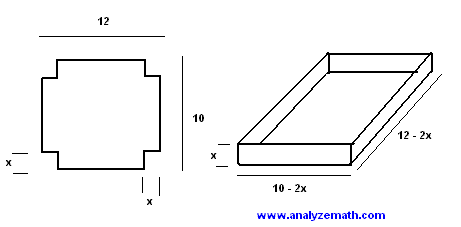
A sheet of metal 12 inches by 10 inches is to be used to make an open box. Squares of equal sides \( x \) are cut out of each corner, and then the sides are folded to make the box. Find the value of \( x \) that makes the volume maximum.
Show Solution to Problem
We first use the formula for the volume of a rectangular box:
\[ V = L \times W \times H \]The box to be made has the following dimensions:
- \( L = 12 - 2x \)
- \( W = 10 - 2x \)
- \( H = x \)
We now write the volume of the box as a function of \( x \):
\[ V(x) = x(12 - 2x)(10 - 2x) = 4x(6 - x)(5 - x) = 4x(x^2 - 11x + 30) = 4x^3 - 44x^2 + 120x \]We now determine the domain of the function \( V(x) \). All dimensions of the box must be non-negative:
\[ x \ge 0, \quad 12 - 2x \ge 0 \implies x \le 6, \quad 10 - 2x \ge 0 \implies x \le 5 \]Solving this system of inequalities gives the domain of \( V(x) \):
\[ 0 \le x \le 5 \]We now find the first derivative of \( V(x) \):
\[ \frac{dV}{dx} = \frac{d}{dx}\left(4(3x^2 - 22x + 30)\right) = 4(3x^2 - 22x + 30) = 12x^2 - 88x + 120 \]To find the critical points, set \( \dfrac{dV}{dx} = 0 \) by solving the quadratic equation \( 3x^2 - 22x + 30 = 0 \):
\[ x = \frac{22 \pm \sqrt{(-22)^2 - 4(3)(30)}}{2(3)} = \frac{22 \pm \sqrt{484 - 360}}{6} = \frac{22 \pm \sqrt{124}}{6} \approx \frac{22 \pm 11.1355}{6} \]This yields two solutions:
\[ x_1 \approx \frac{33.1355}{6} \approx 5.52, \quad x_2 \approx \frac{10.8645}{6} \approx 1.81 \]The value \( x \approx 5.52 \) is outside the domain \( [0, 5] \) and is therefore rejected. Thus, the only critical point in the domain is \( x \approx 1.81 \).
We now evaluate \( V(x) \) at the critical point and the endpoints of the domain:
- \( V(0) = 0 \)
- \( V(5) = 0 \)
- \( V(1.81) \approx 4(1.81)(1.81^2 - 11(1.81) + 30) \approx 96.77 \) cubic inches
Therefore, \( V(x) \) achieves its maximum when \( x \approx 1.81 \) inches. The graph of function \( V(x) \) is shown below, confirming the maximum near \( x = 1.81 \).
