Graphing Rational Functions

How to graph a rational function? A step by step tutorial. The properties such as domain, vertical and horizontal asymptotes of a rational function are also investigated. Free graph paper is available.

Definition of a Rational Function

A rational function f has the form \[ f(x) = \dfrac{g(x)}{h(x)} \] where \( g (x) \) and \( h (x) \) are polynomial functions.

The domain of \( f \) is the set of all real numbers except the values of \( x \) that make the denominator \( h (x) \) equal to zero.

In what follows, we assume that \( g (x) \) and \( h (x) \) have no common factors.

Vertical Asymptotes of Rational Functions

Let \[ f(x) = \dfrac{2}{x-3} \] The domain of \( f \) is the set of all real numbers except \( 3 \), since 3 makes the denominator equal to zero and the division by zero is not allowed in mathematics. However we can try to find out how does the graph of \( f \) behave close to \( 3\).

let us evaluate function \( f \) at values of \( x \) close to \( 3 \) such that \( x \lt 3 \). The values are shown in the table below: \[ \begin{array}{|c|c|c|c|c|c|c|c|c|} \hline x & 1 & 2 & 2.5 & 2.8 & 2.9 & 2.99 & 2.999 & 2.99999 \\ \hline f(x) & -1 & -2 & -4 & -10 & -20 & -200 & -2000 & -2 \times 10^5 \\ \hline \end{array} \] Let us now evaluate \( f \) at values of \( x \) close to 3 such that \( x \gt 3\). \[ \begin{array}{|c|c|c|c|c|c|c|c|c|} \hline x & 5 & 4 & 3.5 & 3.2 & 3.1 & 3.01 & 3.001 & 3.00001 \\ \hline f(x) & 1 & 2 & 4 & 10 & 20 & 200 & 2000 & 2 \times 10^5 \\ \hline \end{array} \]

The graph of \( f \) is shown below.

vertical asymptote

Notes that

1) As \( x \) approaches 3 from the left or by values smaller than 3, \( f (x) \) decreases without bound.

2) As \( x \) approaches 3 from the right or by values larger than 3, \( f (x) \) increases without bound. We say that the line \( x = 3 \), broken line, is the vertical asymptote for the graph of \( f \). In general, the line \( x = a \) is a vertical asymptote for the graph of f if \( f (x) \) either increases or decreases without bound as x approaches a from the right or from the left. This is symbolically written as:

f(x) approaches increases without bound or decreases without bound as x approaches 3

Horizontal Asymptotes of Rational Functions

Let \[ f(x) = \dfrac{2x + 1}{x} \] 1) Let \( x \) increase and find values of \( f (x) \). \[ \begin{array}{|c|c|c|c|c|} \hline x & 1 & 10 & 10^3 & 10^6 \\ \hline f(x) & 3 & 2.1 & 2.001 & 2.000001 \\ \hline \end{array} \] 2) Let \( x \) decrease and find values of \( f (x) \). \[ \begin{array}{|c|c|c|c|c|} \hline x & -1 & -10 & -10^3 & -10^6 \\ \hline f(x) & 1 & 1.9 & 1.999 & 1.999999 \\ \hline \end{array} \] As \( | x | \) increases, the numerator is dominated by the term \( 2 x \) and the numerator has only one term x. Therefore \( f(x) \) takes values close to \( \dfrac{2x}{2} = 2 \). See graphical behaviour below. horizontal asymptotes

In general, the line \( y = b \) is a horizontal asymptote for the graph of \( f \) if \( f (x) \) approaches a constant \( b \) as \( x \) increases or decreases without bound.

How to find the horizontal asymptote?

Let \( f \) be a rational function defined as follows \[ f(x) = \dfrac{a_m x^m + ..... a_1 x + a_0 }{b_n x^n + ..... b_1 x + b_0} \]

Theorem

\( m \) is the degree of the polynomial in the numerator and \( n \) is the degree of the polynomial in the numerator.

case 1: For \( m \lt n \) , the horizontal asymptote is the line \( y = 0 \).

case 2: For \( m = n \) , the horizontal asymptote is the line \( y = a_m / b_n \)

case 3: For \( m \gt n \) , the graph has no horizontal asymptote.

Example

Let \( f \) be a rational function defined by \[f(x) = \dfrac{x + 1}{x-1} \] a - Find the domain of \( f \).

b - Find the \( x \) and \( y \) intercepts of the graph of \( f \).

c - Find the vertical and horizontal asymptotes for the graph of \( f \) if there are any.

d - Use your answers to parts a, b and c above to sketch the graph of function \( f \).

Detailed Solution to Example 1

a - The domain of \( f \) is the set of all real numbers except \( x = 1\) , since this value of \( x \) makes the denominator zero.

b - The \( x \) intercept is found by solving \( f (x) = 0 \) or \( x+1 = 0\). The x intercept is at the point \( (-1 , 0) \).

The \( y \) intercept is at the point \( (0 , f(0)) = (0 , -1) \).

c - The vertical asymptote is given by the zero of the denominator \( x = 1\).

The degree of the numerator is 1 and the degree of the denominator is 1. They are equal and according to the theorem above, the horizontal asymptote is the line \( y = 1 / 1 = 1 \).

d - Although parts a, b and c give some important information about the graph of \( f \), we still need to construct a sign table for function f in order to be able to sketch with ease.

The sign of \( f (x) \) changes at the zeros of the numerator and denominator. To find the sign table, we proceed as in solving rational inequalities. The zeros of the numerator and denominator which are -1 and 1 divides the real number line into 3 intervals: \[ (- \infty , -1) , (-1 , 1) , (1 , + \infty) \] We select a test value within each interval and find the sign of \( f (x) \).

In the interval \( (- \infty , -1) \) , select -2 and find \( f (-2) = ( -2 + 1) / (-2 - 1) = 1 / 3 \gt 0 \).

In \( (-1 , 1) \) , select 0 and find \( f(0) = -1 \lt 0 \).

In \( (1 , + \infty) \) , select 2 and find \( f (2) = ( 2 + 1) / (2 - 1) = 3 \gt 0 \).

Let us put all the information about function \( f \) in a table. \[ \begin{array}{|c|c|c|c|c|c|} \hline x & -\infty & -1 & & 1 & +\infty \\ \hline f(x) & + & 0 \ (\text{x-intercept}) & - & \text{V.A.} & + \\ \hline \end{array} \] In the table above V.A means vertical asymptote.

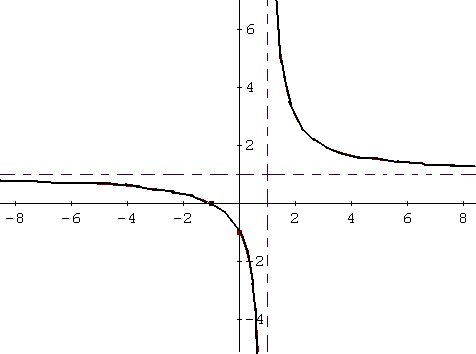
To sketch the graph of \( f \), we start by sketching the \( x \) and \( y \) intercepts and the vertical and horizontal asymptotes in broken lines. See sketch below.

vertical and horizontal asymptotes

We now start sketching the graph of f starting from the left.

In the interval \( (-\infty , -1) \) , \( f (x) \) is positive hence the graph is above the \( x \) axis. Starting from left, we graph \( f \) taking into account the fact that \( y = 1 \) is a horizontal asymptote: The graph of \( f \) is close to this line on the left. See graph below.

graph of f, left part

Between -1 and 1 \( f (x) \) is negative, hence the graph of \( f \) is below the x axis. \( (0 , -1) \) is a y intercept and \( x =1 \) is a vertical asymptote: as x approaches 1 from left \( f (x) \) deceases without bound because \( f (x) \lt 0 \) in \( ( -1 , 1) \). See graph below.

graph of f, middle part

For \( x \gt 1 \) , \( f (x) \gt 0 \) hence the graph is above the x axis. As x approaches 1 from the right, the graph of f increases without bound ( \( f(x) \gt 0 \) ). Also as x increases, the graph of f approaches \( y = 1 \) the horizontal asymptote. See graph below.

graph of f, right part

We now put all "pieces" of the graph of f together to obtain the graph of f.

graph of f

Example 2

Let \( f \) be a rational function defined by \[ f(x) = \dfrac{-x + 2}{x+4} \] a - Find the domain of \( f \).

b - Find the x and y intercepts of the graph of \( f \).

c - Find the vertical and horizontal asymptotes for the graph of \( f \) if there are any.

d - Use your answers to parts a, b and c above to sketch the graph of function \( f \).

Answers to Example 2

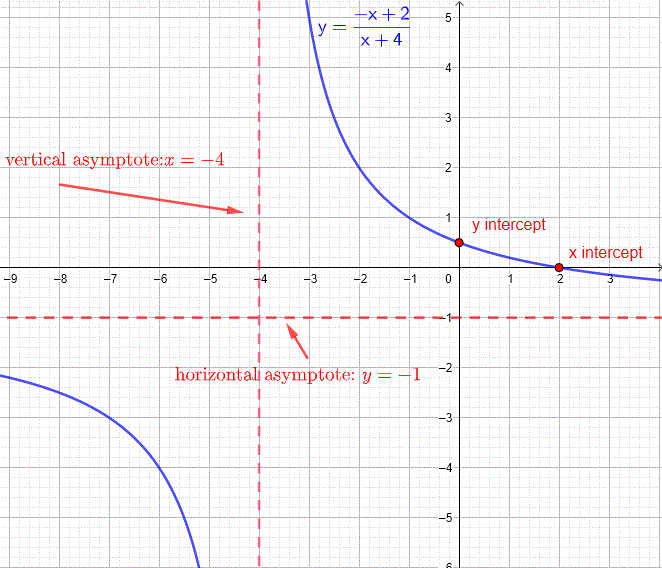
a) All real numbers except \( x = - 4 \)

b) x intercept at \( (2 , 0) \) , y intercept at \( (0 , 1/2) \).

c) vertical asymptote: \( x = - 4 \) , horizontal asymptote: \( y = - 1 \).

d) The graph is shown below.

graph of rational function f(x) = (- x + 2 )/(x + 4) , example 2

More References and Links on Graphing and Rational Functions