Problems and Solutions
Problem 1
Write the quadratic function \( f(x) = -2x^2 - 12x - 20 \) in standard form (or vertex form).
View Solution
To write the function in vertex form, complete the square:
\[ f(x) = -2(x^2 + 6x) - 20 \] \[ f(x) = -2(x^2 + 6x + 9 - 9) - 20 \] \[ f(x) = -2((x + 3)^2 - 9) - 20 \] \[ f(x) = -2(x + 3)^2 + 18 - 20 \] \[ f(x) = -2(x + 3)^2 - 2 \]Problem 2
Let \( f(x) = -2x^2 + 4x + 6 \).
- a) Find the vertex of the graph of \( f \).
- b) Find the range of \( f \).
- c) Find the x-intercepts of the graph of \( f \).
- d) Find the y-intercept of the graph of \( f \).
View Solution
- a) Vertex: \((1, 8)\)
- b) Range: \((-\infty, 8]\)
- c) x-intercepts: \((-1, 0)\) and \((3, 0)\)
- d) y-intercept: \((0, 6)\)
Problem 3
\( f \) is a quadratic function whose graph has a vertex at the point \((-3 , 2)\) and has a y-intercept at the point \((0 , -16)\).
- a) Find the equation for function \( f \).
- b) Find the x-intercepts of the graph of \( f \).
View Solution
- a) Using vertex form \( f(x) = a(x - h)^2 + k \): \[ f(x) = a(x + 3)^2 + 2 \] Substitute the y-intercept \((0, -16)\): \[ -16 = a(0 + 3)^2 + 2 \implies -18 = 9a \implies a = -2 \] Equation: \( f(x) = -2(x + 3)^2 + 2 \)
- b) Set \( f(x) = 0 \): \[ -2(x + 3)^2 + 2 = 0 \implies (x + 3)^2 = 1 \implies x + 3 = \pm 1 \] x-intercepts: \((-2, 0)\) and \((-4, 0)\)
Problem 4
Find all values of \( b \) and \( c \) so that the quadratic function \( f(x) = x^2 + bx + c \) has a graph that is tangent to the x-axis and a y-intercept at \((0 , 4)\).
View Solution
The y-intercept at \((0, 4)\) gives \( c = 4 \).
For the graph to be tangent to the x-axis, the discriminant must be zero (\( b^2 - 4ac = 0 \)):
\[ b^2 - 4(1)(4) = 0 \implies b^2 = 16 \implies b = 4 \text{ or } b = -4 \]Solution: \( c = 4 \) and \( b = 4 \) or \( b = -4 \).
Problem 5
Find the equation of a quadratic function \( f \) whose graph has a vertical axis of symmetry \( x = -2 \), the range of \( f \) is given by the interval \([4 , +\infty)\) and \( f(2) = 8 \).
View Solution
Axis of symmetry \( x = -2 \) means \( h = -2 \), and range \([4, +\infty)\) means \( k = 4 \) and \( a > 0 \). Thus:
\[ f(x) = a(x + 2)^2 + 4 \]Use \( f(2) = 8 \) to find \( a \):
\[ 8 = a(2 + 2)^2 + 4 \implies 4 = 16a \implies a = \frac{1}{4} \]Equation: \( f(x) = \dfrac{1}{4}(x + 2)^2 + 4 \)
Problem 6
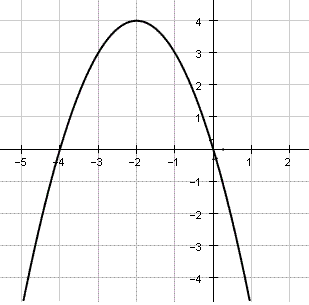
A graph of a parabola is shown below. Find:
- a) The vertex of the parabola (round coordinates to the nearest integer).
- b) The x and y intercepts of the parabola.
- c) The equation of the axis of symmetry of the parabola.
- d) The equation of the line tangent to the parabola at the vertex.
- e) The equation of the parabola.
View Solution
- a) Vertex: \((-2, 4)\)
- b) Intercepts: x-intercepts: \((-4, 0)\), \((0, 0)\); y-intercept: \((0, 0)\)
- c) Axis of symmetry: \( x = -2 \)
- d) Tangent line at vertex: \( y = 4 \)
- e) Equation: \( y = -(x + 2)^2 + 4 \)
Problem 7
A rectangular picture measuring \( 10 \) cm by \( 15 \) cm is surrounded by a frame with uniform width \( x \). Write a quadratic function that gives the area \( A \) of the frame as a function of \( x \).
View Solution
The total dimensions including the frame are \((10 + 2x)\) by \((15 + 2x)\).
The total area minus the picture area gives the area \( A \) of the frame:
\[ A = (10 + 2x)(15 + 2x) - 10 \times 15 = 150 + 30x + 20x + 4x^2 - 150 = 4x^2 + 50x \]Problem 8
Function \( g \) is given by \( g(x) = 2(x - 3)(x - 7) \). Find the value of \( x \) that makes \( g(x) \) maximum.
View Solution
\( g(x) \) is maximum at \( x = 10 \).