Introduction aux solides de révolution
Apprenez à trouver le volume d'un solide de révolution généré par la rotation d'une région délimitée par des courbes autour de l'axe des x ou de l'axe des y. Ce tutoriel utilise des intégrales définies et couvre à la fois la méthode des disques (pour les formes pleines) et la méthode des rondelles (pour les formes à centre creux), avec des formules, des figures visuelles et des problèmes pratiques étape par étape.
Dans ce qui suit, \( C \) représente la constante d'intégration.
Formules de volume
Formule 1 : Méthode des disques (Autour de l'axe des x)
Si \( f \) est une fonction telle que \( f(x) \geq 0 \) pour tout \( x \) dans l'intervalle \( [x_1 , x_2] \), le volume du solide généré par la rotation autour de l'axe des x de la région délimitée par le graphique de \( f \), l'axe des x (\( y = 0 \)) et les droites verticales \( x = x_1 \) et \( x = x_2 \) est donné par :
\[ \text{Volume} = \int_{x_1}^{x_2} \pi [f(x)]^2 \, dx \]
Formule 2 : Méthode des rondelles (Autour de l'axe des x)
Si \( f \) et \( h \) sont des fonctions telles que \( f(x) \geq h(x) \) pour tout \( x \) dans l'intervalle \( [x_1 , x_2] \), le volume du solide généré par la rotation autour de l'axe des x de la région délimitée par les graphiques de \( f \) et \( h \) est donné par :
\[ \text{Volume} = \int_{x_1}^{x_2} \pi [f(x)^2 - h(x)^2] \, dx \]
Formule 3 : Méthode des disques (Autour de l'axe des y)
Si \( z \) est une fonction de \( y \) telle que \( x = z(y) \) et \( z(y) \geq 0 \) pour tout \( y \) dans l'intervalle \( [y_1 , y_2] \), le volume généré par la rotation autour de l'axe des y de la région délimitée par \( z \), l'axe des y (\( x = 0 \)) et les droites horizontales \( y = y_1 \) et \( y = y_2 \) est :
\[ \text{Volume} = \int_{y_1}^{y_2} \pi [z(y)]^2 \, dy \]
Formule 4 : Méthode des rondelles (Autour de l'axe des y)
Si \( z \) et \( w \) sont des fonctions de \( y \) telles que \( z(y) \geq w(y) \) pour tout \( y \) dans l'intervalle \( [y_1 , y_2] \), le volume généré par la rotation autour de l'axe des y de la région délimitée par \( z \) et \( w \) est donné par :
\[ \text{Volume} = \int_{y_1}^{y_2} \pi [z(y)^2 - w(y)^2] \, dy \]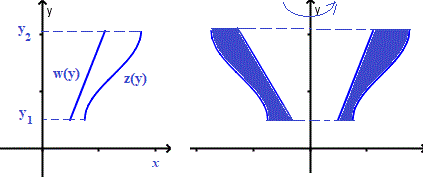
Exemples avec solutions détaillées
Cliquez sur chaque exemple pour afficher sa solution détaillée étape par étape.
Exemple 1
Trouvez le volume du solide généré par la rotation de la région délimitée par le graphique de \( y = x \), \( y = 0 \), \( x = 0 \) et \( x = 2 \) autour de l'axe des x.

Afficher la solution
Méthode 1 : Formule géométrique
Puisque \( y = x \) forme un triangle, sa rotation crée un cône circulaire droit de rayon 2 et de hauteur 2. En utilisant la formule géométrique :
\[ \text{Volume} = \frac{1}{3} \pi (\text{rayon})^2 (\text{hauteur}) = \frac{1}{3} \pi (2)^2 (2) = \frac{8\pi}{3} \]Méthode 2 : Intégrale définie (Méthode des disques)
Soit \( f(x) = x \). En utilisant la formule 1, le volume est donné par l'intégrale définie de 0 à 2 :
\[ \text{Volume} = \int_{0}^{2} \pi x^2 \, dx = \left[ \pi \frac{x^3}{3} \right]_0^2 = \frac{8\pi}{3} \]Exemple 2
Trouvez le volume du solide généré par la rotation du demi-cercle \( y = \sqrt{r^2 - x^2} \) autour de l'axe des x, où \( r > 0 \).

Afficher la solution
Le graphique de \( y = \sqrt{r^2 - x^2} \) est délimité de \( x = -r \) à \( x = r \). Le volume est donné par la méthode des disques (Formule 1) :
\[ \text{Volume} = \int_{-r}^{r} \pi \left(\sqrt{r^2 - x^2}\right)^2 \, dx = \int_{-r}^{r} \pi (r^2 - x^2) \, dx \]Trouvez l'antidérivée et évaluez aux limites :
\[ = \pi \left[ r^2 x - \frac{x^3}{3} \right]_{-r}^r \] \[ = \pi \left[ \left(r^3 - \frac{r^3}{3}\right) - \left(-r^3 + \frac{r^3}{3}\right) \right] = \frac{4}{3} \pi r^3 \]Ceci permet de déduire la formule bien connue du volume d'une sphère !
Exemple 3
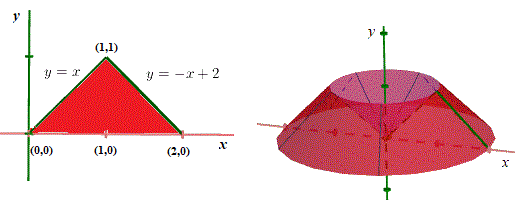
Trouvez le volume du solide généré par la rotation de la région ombragée délimitée par \( y = x \), \( y = -x + 2 \) et l'axe des x autour de l'axe des y.
Afficher la solution
Puisque le solide est généré par rotation autour de l'axe des y, nous devons réécrire nos équations en fonction de \( y \) (\( x = z(y) \)). Les limites d'intégration le long de l'axe des y vont de \( y = 0 \) à \( y = 1 \) (là où les droites s'intersectent).
La courbe de droite est \( y = -x + 2 \implies x = 2 - y \).
La courbe de gauche est \( y = x \implies x = y \).
En utilisant la méthode des rondelles (Formule 4) :
\[ \text{Volume} = \int_{0}^{1} \pi [ (2-y)^2 - y^2 ] \, dy \]Développez le binôme et simplifiez l'intégrande :
\[ = \int_{0}^{1} \pi [ 4 - 4y + y^2 - y^2 ] \, dy = \int_{0}^{1} \pi [ 4 - 4y ] \, dy \]Intégrez et évaluez :
\[ = \pi \left[ 4y - 2y^2 \right]_0^1 = \pi (4 - 2) = 2\pi \]Exemple 4
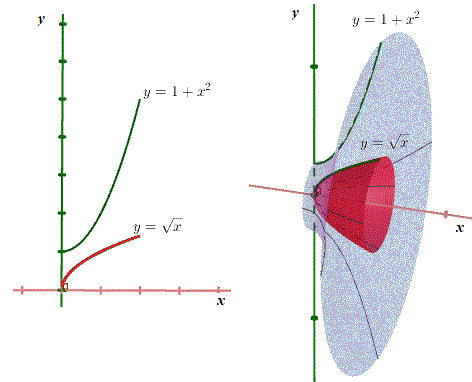
Trouvez le volume du solide généré par la rotation de la région délimitée par les courbes \( y = 1 + x^2 \) et \( y = \sqrt{x} \), autour de l'axe des x de \( x = 0 \) à \( x = 2 \).
Afficher la solution
Nous utilisons la méthode des rondelles le long de l'axe des x (Formule 2). Soient \( f(x) = 1 + x^2 \) (le rayon extérieur) et \( h(x) = \sqrt{x} \) (le rayon intérieur).
\[ \text{Volume} = \int_{0}^{2} \pi ( f(x)^2 - h(x)^2 ) \, dx \] \[ = \int_{0}^{2} \pi \left( (1+x^2)^2 - (\sqrt{x})^2 \right) \, dx \]Développez les carrés :
\[ = \pi \int_{0}^{2} ( 1 + 2x^2 + x^4 - x ) \, dx \]Intégrez à l'aide de la règle des puissances :
\[ = \pi \left[ x + \frac{2x^3}{3} + \frac{x^5}{5} - \frac{x^2}{2} \right]_0^2 \]Évaluez en \( x = 2 \) :
\[ = \pi \left( 2 + \frac{16}{3} + \frac{32}{5} - 2 \right) = \frac{176\pi}{15} \]Exemple 5
Trouvez le volume du tore généré lorsque le cercle de centre \( (0, R) \) et de rayon \( r \) est mis en rotation autour de l'axe des x.

Afficher la solution
L'équation du cercle est donnée par \( x^2 + (y - R)^2 = r^2 \).
Résolvez l'équation pour \( y \) afin d'obtenir les parties supérieure et inférieure du cercle :
- Demi-cercle supérieur : \( f(x) = R + \sqrt{r^2 - x^2} \)
- Demi-cercle inférieur : \( h(x) = R - \sqrt{r^2 - x^2} \)
En raison de la symétrie par rapport à l'axe des y, nous pouvons intégrer de \( x = 0 \) à \( x = r \), puis multiplier le résultat par 2 pour trouver le volume total. En utilisant la méthode des rondelles (Formule 2) :
\[ \frac{1}{2} \text{Volume} = \int_{0}^{r} \pi [ f(x)^2 - h(x)^2 ] \, dx \] \[ = \pi \int_{0}^{r} \left[ (R + \sqrt{r^2 - x^2})^2 - (R - \sqrt{r^2 - x^2})^2 \right] \, dx \]En développant et en soustrayant les carrés, les termes \( R^2 \) et \( (r^2 - x^2) \) s'annulent, ce qui laisse :
\[ = 4 R \pi \int_{0}^{r} \sqrt{r^2 - x^2} \, dx \]L'intégrale de \( \sqrt{r^2 - x^2} \) donne l'aire d'un quart de cercle, que nous pouvons résoudre en utilisant les règles standard de substitution trigonométrique :
\[ = 4 R \pi \left( \frac{1}{2} \right) \left[ x \sqrt{r^2-x^2} + r^2\arcsin\left(\frac{x}{r}\right) \right]_0^r \] \[ = 2 R \pi \left( r^2 \arcsin(1) - 0 \right) = 2 R \pi \left( r^2 \frac{\pi}{2} \right) = \pi^2 R r^2 \]Puisque cela ne représentait que la moitié du tore, le volume total est le double du résultat ci-dessus :
\[ \text{Volume} = 2 \pi^2 R r^2 \](Remarque : Une légère erreur typographique dans la démonstration initiale de l'analyse pour le terme en arcsin a été corrigée ici pour plus de rigueur mathématique).
Exercices pratiques
Cliquez sur chaque exercice pour révéler la solution détaillée étape par étape.
Exercice 1
Trouvez le volume du solide généré lorsque la région entre les graphiques de \( f(x) = x^2 + 2 \) et \( h(x) = x \) est mise en rotation autour de l'axe des x sur l'intervalle \( [0, 1] \).
Afficher la solution
Utilisez la méthode des rondelles autour de l'axe des x :
\[ \text{Volume} = \pi \int_{0}^{1} \left[ (x^2 + 2)^2 - (x)^2 \right] \, dx \] \[ = \pi \int_{0}^{1} (x^4 + 4x^2 + 4 - x^2) \, dx = \pi \int_{0}^{1} (x^4 + 3x^2 + 4) \, dx \]Intégrez et évaluez aux bornes :
\[ = \pi \left[ \frac{x^5}{5} + x^3 + 4x \right]_0^1 = \pi \left( \frac{1}{5} + 1 + 4 \right) = \frac{26\pi}{5} \]Exercice 2
Trouvez le volume généré lorsque la région finie délimitée par les courbes \( y = x^3 \) et \( y = x^2 \) est mise en rotation autour de l'axe des y.
Afficher la solution
Tout d'abord, trouvez les points d'intersection en posant \( x^3 = x^2 \). Les courbes s'intersectent en \( x = 0 \) et \( x = 1 \), ce qui correspond à \( y = 0 \) et \( y = 1 \).
Puisque nous effectuons une rotation autour de l'axe des y, nous devons exprimer \( x \) en fonction de \( y \). Dans l'intervalle \( y \in [0, 1] \), \( y = x^3 \implies x = y^{1/3} \) est le rayon extérieur, et \( y = x^2 \implies x = y^{1/2} \) est le rayon intérieur.
Utilisez la méthode des rondelles autour de l'axe des y :
\[ \text{Volume} = \pi \int_{0}^{1} \left[ (y^{1/3})^2 - (y^{1/2})^2 \right] \, dy = \pi \int_{0}^{1} (y^{2/3} - y) \, dy \]Intégrez et évaluez :
\[ = \pi \left[ \frac{3}{5}y^{5/3} - \frac{y^2}{2} \right]_0^1 = \pi \left( \frac{3}{5} - \frac{1}{2} \right) = \frac{\pi}{10} \]