Trouvez le volume d'un solide de révolution généré par la rotation d'une région délimitée par le graphique d'une fonction autour de l'un des axes en utilisant des intégrales définies et la méthode des coquilles cylindriques où l'intégration est perpendiculaire à l'axe de rotation. Des exercices avec leurs réponses sont présentés au bas de la page.
Dans ce qui suit, \( C \) représente la constante d'intégration.
Formule - Méthode des coquilles cylindriques
Si \( f \) est une fonction telle que \( f(x) \geq 0 \) pour tout \( x \) dans l'intervalle \( [x_1, x_2] \), le volume du solide généré par la rotation autour de l'axe des \( y \) de la région délimitée par le graphique de \( f \), l'axe des \( x \) (\( y = 0 \)) et les droites verticales \( x = x_1 \) et \( x = x_2 \) est donné par l'intégrale :
\[ \Large \text{Volume} = \int_{x_1}^{x_2} 2\pi x f(x) \, dx \]
Si \( g \) est une fonction telle que \( g(y) \geq 0 \) pour tout \( y \) dans l'intervalle \( [y_1, y_2] \), le volume du solide généré par la rotation autour de l'axe des \( x \) de la région délimitée par le graphique de \( g \), l'axe des \( y \) (\( x = 0 \)) et les droites horizontales \( y = y_1 \) et \( y = y_2 \) est donné par l'intégrale :
\[ \Large \text{Volume} = \int_{y_1}^{y_2} 2\pi y g(y) \, dy \]Exemples avec solutions détaillées
Cliquez sur chaque exemple pour afficher sa solution détaillée étape par étape.
Exemple 1 : Volume du solide généré par la rotation d'un triangle autour de l'axe des \( y \)
Solution de l'exemple 1 :
Notez que ce problème a été résolu dans Volume d'un solide de révolution en utilisant la méthode des rondelles. Résolvons-le maintenant en utilisant la méthode des coquilles cylindriques.
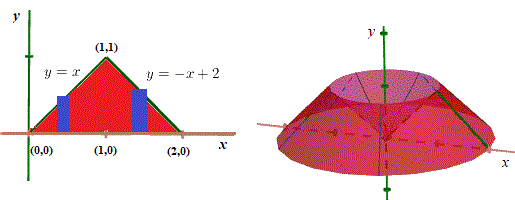
La région à faire tourner est délimitée par \( x = 0 \), \( y = 0 \) et deux courbes \( y = x \) et \( y = -x + 2 \) avec un point d'intersection en \( (1, 1) \). Nous divisons donc l'intégrale en deux parties :
\[ \text{Volume} = \int_{0}^{1} 2\pi x(x) \, dx + \int_{1}^{2} 2\pi x(-x + 2) \, dx \]Intégrez :
\[ = 2\pi \left[\dfrac{x^3}{3}\right]_0^1 + 2\pi \left[-\dfrac{x^3}{3} + x^2\right]_1^2 \]Évaluez :
\[ = \dfrac{2\pi}{3} + 2\pi \left[\left(-\dfrac{8}{3} + 4\right) - \left(-\dfrac{1}{3} + 1\right)\right] \] \[ = \dfrac{2\pi}{3} + 2\pi \left[\dfrac{4}{3} - \dfrac{2}{3}\right] = \dfrac{2\pi}{3} + \dfrac{4\pi}{3} = 2\pi \]Exemple 2 : Volume du solide généré par une région de courbe cubique dans le premier quadrant
Solution de l'exemple 2 :
Les graphiques de \( y = -x^3 + 2x^2 - x + 2 \) et \( y = -x + 1 \) sont présentés ci-dessous.

L'intersection avec l'axe des \( x \) de \( y = -x^3 + 2x^2 - x + 2 \) se trouve en résolvant :
\[ -x^3 + 2x^2 - x + 2 = 0 \implies x^2(-x + 2) + 1(-x + 2) = 0 \implies (-x + 2)(x^2 + 1) = 0 \]Cela donne \( x = 2 \). L'intersection avec l'axe des \( x \) de \( y = -x + 1 \) est \( x = 1 \).
De \( x = 0 \) à \( x = 1 \), la région est délimitée au-dessus par \( f(x) = -x^3 + 2x^2 - x + 2 \) et en dessous par \( h(x) = -x + 1 \). Le volume \( V_1 \) est :
\[ V_1 = \int_{0}^{1} 2\pi x (f(x) - h(x)) \, dx = 2\pi \int_{0}^{1} x (-x^3 + 2x^2 - x + 2 - (-x + 1)) \, dx \] \[ = 2\pi \int_{0}^{1} (-x^4 + 2x^3 + x) \, dx = 2\pi \left[ -\dfrac{x^5}{5} + \dfrac{x^4}{2} + \dfrac{x^2}{2} \right]_0^1 = \dfrac{8\pi}{5} \]De \( x = 1 \) à \( x = 2 \), la région est délimitée au-dessus par \( f(x) \) et en dessous par \( y = 0 \). Le volume \( V_2 \) est :
\[ V_2 = \int_{1}^{2} 2\pi x f(x) \, dx = 2\pi \int_{1}^{2} x (-x^3 + 2x^2 - x + 2) \, dx \] \[ = 2\pi \left[ -\dfrac{x^5}{5} + \dfrac{x^4}{2} - \dfrac{x^3}{3} + x^2 \right]_1^2 = \dfrac{59\pi}{15} \]Volume total \( V = V_1 + V_2 = \dfrac{8\pi}{5} + \dfrac{59\pi}{15} = \dfrac{83\pi}{15} \).
Exemple 3 : Volume généré par une région de courbe sinusoïdale autour de l'axe des \( y \)
Solution de l'exemple 3 :

Trouvez une formule pour le volume délimité par \( y = 0 \), \( x = 0 \) et \( y = a + \sin(x) \) pour \( 0 \leq x \leq 2\pi \) et \( a \geq 1 \) autour de l'axe des \( y \) :
\[ V = \int_{0}^{2\pi} 2\pi x (a + \sin(x)) \, dx = 2\pi \int_{0}^{2\pi} ax \, dx + 2\pi \int_{0}^{2\pi} x \sin(x) \, dx \]Évaluation de la première intégrale \( I_1 \) :
\[ I_1 = 2\pi a \left[ \dfrac{x^2}{2} \right]_0^{2\pi} = 4\pi^3 a \]Évaluation de la seconde intégrale \( I_2 \) à l'aide d'une intégration par parties (\( u = x \), \( dv = \sin(x) \, dx \)) :
\[ I_2 = 2\pi \left[ -x \cos(x) \right]_0^{2\pi} + 2\pi \int_{0}^{2\pi} \cos(x) \, dx = -4\pi^2 + 0 = -4\pi^2 \]Volume total : \( V = I_1 + I_2 = 4\pi^3 a - 4\pi^2 \).
Exemple 4 : Volume généré par une ellipse dans le premier quadrant autour de l'axe des \( x \)
Solution de l'exemple 4 :
Utilisez les coquilles cylindriques pour trouver une formule du volume du solide généré par la rotation de l'aire délimitée par \( y = 0 \), \( x = 0 \) et \( \left(\dfrac{x}{a}\right)^2 + \left(\dfrac{y}{b}\right)^2 = 1 \) dans le premier quadrant autour de l'axe des \( x \) (\( a, b > 0 \)).

En exprimant \( x \) en fonction de \( y \) : \( x = a \sqrt{1 - \left(\dfrac{y}{b}\right)^2} \).
Puisque la rotation se fait autour de l'axe des \( x \), les coquilles sont parallèles à l'axe des \( x \) :
\[ V = \int_{0}^{b} 2\pi y \left( a \sqrt{1 - \left(\dfrac{y}{b}\right)^2} \right) dy \]En utilisant la substitution \( u = 1 - \left(\dfrac{y}{b}\right)^2 \) et en évaluant, on obtient :
\[ V = \dfrac{2\pi a b^2}{3} \]Exercices
Calculez les intégrales suivantes. Cliquez sur chaque exercice pour afficher la solution détaillée étape par étape.
Exercice 1 : Trouvez le volume du solide généré lorsqu'une partie du graphique de \( f(x) = -x^4 + 3x^3 - x + 3 \) dans le quadrant I est mise en rotation autour de l'axe des \( y \).
Solution :
Trouvez l'intersection avec l'axe des \( x \) en résolvant \( -x^4 + 3x^3 - x + 3 = 0 \implies x^3(3 - x) + 1(3 - x) = (x^3 + 1)(3 - x) = 0 \implies x = 3 \) (dans le quadrant I).
En utilisant la formule des coquilles cylindriques de \( x = 0 \) à \( x = 3 \) :
\[ V = \int_{0}^{3} 2\pi x (-x^4 + 3x^3 - x + 3) \, dx = 2\pi \int_{0}^{3} (-x^5 + 3x^4 - x^2 + 3x) \, dx \]En intégrant terme à terme :
\[ = 2\pi \left[ -\dfrac{x^6}{6} + \dfrac{3x^5}{5} - \dfrac{x^3}{3} + \dfrac{3x^2}{2} \right]_0^3 = \dfrac{288\pi}{5} \]