Cette page contient une collection de problèmes textuels d'optimisation de Calcul I avec des applications du monde réel et des solutions complètes étape par étape. Les sujets abordés incluent l'aire maximale, la distance minimale, la maximisation du profit, le volume d'une boîte, les rectangles sous des courbes et l'optimisation d'un cône à l'aide des dérivées.
Étapes générales pour résoudre des problèmes d'optimisation
- Identifier la quantité à optimiser (maximiser ou minimiser).
- Dessiner un schéma si possible. Noter les données connues et inconnues.
- Écrire une fonction ou une formule représentant la quantité à optimiser.
- Réduire le nombre de variables dans la fonction à une seule, en utilisant les relations connues.
- Trouver les points critiques en posant la première dérivée égale à zéro ou en déterminant où elle n'est pas définie.
- Tester les points critiques et les bornes dans le domaine pour déterminer les extrema. Utiliser la dérivée seconde ou l'analyse des signes pour confirmer si les extrema sont des minima ou des maxima.
Exemples de problèmes d'optimisation
Problème 1 : Somme minimale avec un produit fixe
Trouver deux nombres positifs dont le produit est égal à 10 et dont la somme est la plus petite possible. Vérifiez votre réponse graphiquement.
Solution
Soit \( x \) le premier nombre et \( y \) le deuxième nombre, avec \( x > 0 \) et \( y > 0 \). Soit \( S \) la somme à minimiser.
- Somme : \( S = x + y \) ← C'est la fonction à minimiser
- Contrainte sur le produit : \( x \cdot y = 10 \) ← Relation entre les variables
À partir de la contrainte, isoler \( y \) : \( y = \dfrac{10}{x} \)
Substituer dans la fonction de la somme pour obtenir une fonction d'une seule variable : \[ S(x) = x + \dfrac{10}{x} = \dfrac{x^2 + 10}{x} \quad \text{avec le domaine} \quad x > 0 \]
Calculer la première dérivée de \( S(x) \) : \[ S'(x) = \dfrac{d}{dx}\left(x + \dfrac{10}{x}\right) = 1 - \dfrac{10}{x^2} \]
Poser la dérivée égale à zéro pour trouver les points critiques : \[ 1 - \dfrac{10}{x^2} = 0 \quad \Rightarrow \quad x^2 = 10 \quad \Rightarrow \quad x = \sqrt{10} \]
Nous rejetons \( x = -\sqrt{10} \) car \( x \) doit être positif. Donc \( x = \sqrt{10} \) est un point critique.
Vérifier la dérivée seconde pour déterminer la concavité : \[ S''(x) = \dfrac{20}{x^3} \] Puisque \( x > 0 \), \( S''(x) > 0 \), le graphique est donc concave vers le haut. Par conséquent, \( x = \sqrt{10} \) est un minimum.
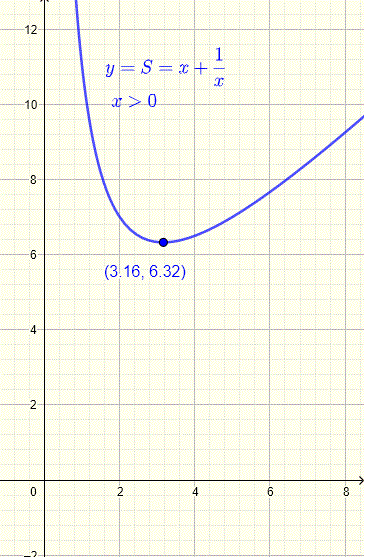
Les deux nombres sont : \[ x = \sqrt{10} \approx 3.16, \quad y = \dfrac{10}{\sqrt{10}} = \sqrt{10} \approx 3.16 \]
Le graphique de \( S(x) = x + \dfrac{10}{x} \) montre une valeur minimale en \( x \approx 3.16 \), ce qui confirme le résultat.
Problème 2 : Maximiser le produit de deux nombres soumis à une contrainte linéaire
Trouver deux nombres positifs tels que la somme de six fois le premier et de deux fois le second soit égale à 150, et dont le produit soit le plus grand possible.
Solution
Soit \( x \) le premier nombre et \( y \) le deuxième nombre. Soit \( P \) le produit à maximiser.
La fonction objectif est : \( P = x \cdot y \)
La contrainte est : \( 6x + 2y = 150 \)
Isoler \( y \) dans la contrainte : \( y = 75 - 3x \)
Substituer dans la fonction du produit : \( P(x) = x(75 - 3x) = 75x - 3x^2 \)
Calculer la première dérivée : \( P'(x) = 75 - 6x \)
Poser la dérivée égale à zéro pour trouver les points critiques : \( 75 - 6x = 0 \Rightarrow x = \dfrac{75}{6} = \dfrac{25}{2} \)
Calculer la dérivée seconde : \( P''(x) = -6 \). Puisque \( P''(x) < 0 \), la fonction est concave vers le bas, ce qui confirme un maximum.
Trouver maintenant \( y \) : \( y = 75 - 3 \cdot \dfrac{25}{2} = \dfrac{75}{2} \)
Conclusion : Les deux nombres positifs qui maximisent le produit sont :
- \( x = \dfrac{25}{2} = 12.5 \)
- \( y = \dfrac{75}{2} = 37.5 \)
Problème 3 : Maximiser l'aire de deux rectangles
Supposons que vous deviez clôturer deux champs rectangulaires ayant les mêmes dimensions, avec un côté en commun, en utilisant 180 mètres de clôture. Trouvez les dimensions des rectangles de sorte que l'aire totale clôturée soit maximale.
Solution
Soit \( L \) la longueur et \( W \) la largeur de chaque rectangle. La largeur correspond au côté partagé.

Aire totale : \( A = 2LW \)
Contrainte de clôture : \( 4L + 3W = 180 \).
Isoler \( W \) : \( W = 60 - \dfrac{4}{3}L \).
Aire en fonction de \( L \) :
\[ A(L) = 2L \left(60 - \dfrac{4}{3}L \right) = -\dfrac{8}{3}L^2 + 120L \]
D'après la contrainte, le domaine est \( L \in [0, 45] \).
Dérivée : \( A'(L) = -\dfrac{16}{3}L + 120 \).
Résoudre \( A'(L) = 0 \implies L = 22.5 \).
Évaluer :
- \( A(0) = 0 \)
- \( A(45) = 0 \)
- \( A(22.5) = -\dfrac{8}{3}(22.5)^2 + 120 \cdot 22.5 = 1350 \)
L'aire maximale se produit pour \( L = 22.5 \), \( W = 60 - \dfrac{4}{3} \cdot 22.5 = 30 \).
Dimensions : \( 22.5 \) m par \( 30 \) m.
Problème 4 : Minimiser l'aire d'un carré et d'un cercle formés à partir d'un fil de 100 cm
Un fil de 100 cm de long est coupé en deux morceaux. Un morceau est façonné en un carré, et l'autre en un cercle. Trouvez les longueurs des deux morceaux de sorte que la somme des aires délimitées par le carré et le cercle soit minimale.
Solution
Soit \( x \) la longueur du fil utilisé pour le carré et \( y \) pour le cercle. Fil total : \( x + y = 100 \).
Étape 1 : Exprimer les aires en fonction de \( x \)
Pour le carré : \( x = 4s \implies s = \dfrac{x}{4} \implies A_{\text{carré}} = \dfrac{x^2}{16} \)
Pour le cercle : \( y = 2\pi r \implies r = \dfrac{y}{2\pi} \implies A_{\text{cercle}} = \dfrac{y^2}{4\pi} \)
Aire totale : \( A(x) = \dfrac{x^2}{16} + \dfrac{(100 - x)^2}{4\pi} \)
Étape 2 : Minimiser l'aire
Dérivée : \( A'(x) = \dfrac{x}{8} - \dfrac{1}{2\pi}(100 - x) \)
Poser la dérivée égale à 0 :
\[ \dfrac{x}{8} = \dfrac{1}{2\pi}(100 - x) \implies 2\pi x = 8(100 - x) \implies x = \dfrac{800}{2\pi + 8} = \dfrac{400}{\pi + 4} \]
En valeur approchée : \( x \approx 56 \) cm, \( y = 100 - x \approx 44 \) cm.
Étape 3 : Vérifier le minimum
\( A(0) \approx 795 \), \( A(100) = 625 \), \( A(56) \approx 350 \).
Réponse finale
- Utiliser environ 56 cm pour le carré.
- Utiliser environ 44 cm pour le cercle.
Problème 5 : Volume maximal d'une boîte à sections carrées
Une boîte avec des sections carrées de côté \( x \) et une longueur \( L \) doit être fabriquée de telle sorte que \( L + 4x = 4 \) mètres. Trouvez les dimensions de la boîte qui maximisent son volume.
Solution
Volume : \( V = x^2 L \)
Contrainte : \( L + 4x = 4 \implies L = 4 - 4x \)
Substitution : \( V(x) = x^2(4 - 4x) \) avec le domaine \( [0, 1] \).
Dérivée : \( V'(x) = 8x - 12x^2 \)
Points critiques : \( 8x - 12x^2 = 0 \implies x(8 - 12x) = 0 \implies x = 0 \) ou \( x = \dfrac{2}{3} \).
Évaluation : \( V(0) = 0 \), \( V\left(\dfrac{2}{3}\right) = \dfrac{16}{27} \), \( V(1) = 0 \).
Maximum atteint en \( x = \dfrac{2}{3} \) mètres.
\( L = 4 - 4 \cdot \dfrac{2}{3} = \dfrac{4}{3} \) mètres.
Réponse finale : Sections carrées de côté \( \dfrac{2}{3} \) mètre et longueur de \( \dfrac{4}{3} \) mètre, donnant un volume maximal de \( \dfrac{16}{27} \text{ m}^3 \).
Problème 6 : Maximiser le profit de la vente de calculatrices électroniques
Le coût total d'une calculatrice électronique est de 21 $. Si la machine est vendue à un prix de \( x \) dollars l'unité, le nombre \( n \) de machines vendues est donné par \( n(x) = \dfrac{200}{x - 21} + 10(50 - x) \).
Solution
Fonction de profit : \( P(x) = n(x - 21) = \left( \dfrac{200}{x - 21} + 10(50 - x) \right)(x - 21) \)
Simplification : \( P(x) = -10x^2 + 710x - 10300 \) pour le domaine \( x \in (21, \infty) \).
Dérivée : \( P'(x) = -20x + 710 \)
Poser égal à zéro : \( -20x + 710 = 0 \implies x = 35.5 \).
Dérivée seconde : \( P''(x) = -20 < 0 \) (concave vers le bas, maximum).
Réponse finale
Le prix de vente qui maximise le profit est \( \boxed{x = 35.5 \text{ dollars}} \).
Problème 7 : Le plus grand rectangle sous la courbe \( y = \dfrac{1}{x^2+1} \)
Trouvez les dimensions du rectangle de plus grande aire inscrit sous la courbe \( y = \dfrac{1}{x^2 + 1} \) et au-dessus de l'axe des x.
Solution
Soit \( x \) la moitié de la longueur de la base. Aire : \( A(x) = 2x \cdot \dfrac{1}{x^2 + 1} = \dfrac{2x}{x^2 + 1} \).

Dérivée : \( A'(x) = \dfrac{2(1 - x^2)}{(x^2+1)^2} \)
Poser à zéro : \( 1 - x^2 = 0 \implies x = 1 \).
Le test de la dérivée seconde confirme un maximum en \( x = 1 \).
Réponse finale
Longueur = \( 2(1) = 2 \), Largeur = \( \dfrac{1}{1^2+1} = \dfrac{1}{2} \). Les dimensions sont 2 unités par 0,5 unité.
Problème 8 : Le plus grand rectangle inscrit dans un triangle rectangle
Trouvez les dimensions du rectangle de plus grande aire inscrit dans un triangle rectangle de hauteur 4 et d'hypoténuse 5.
Solution
Base du triangle : \( BC = \sqrt{5^2 - 4^2} = 3 \).

Par les triangles semblables : \( \dfrac{4 - h}{w} = \dfrac{4}{3} \implies h = -\dfrac{4}{3} w + 4 \).
Aire : \( A(w) = w\left(-\dfrac{4}{3} w + 4\right) = -\dfrac{4}{3} w^2 + 4w \).
Dérivée : \( A'(w) = -\dfrac{8}{3} w + 4 = 0 \implies w = \dfrac{3}{2} = 1.5 \).
Hauteur : \( h = -\dfrac{4}{3}(\dfrac{3}{2}) + 4 = 2 \).
Réponse finale
Dimensions : \( w = 1.5 \), \( h = 2 \).
Problème 9 : Démontrer analytiquement que \( f(x) = -5 - 4 \cos(x) + \cos(2x) \) n'est jamais positif
Démontrer analytiquement que \( f(x) = -5 - 4 \cos(x) + \cos(2x) \) pour \( 0 \leq x \leq 2\pi \) n'est jamais positif.
Solution
Dérivée : \( f'(x) = 4 \sin(x) - 2 \sin(2x) = 4 \sin(x) (1 - \cos(x)) \).
Points critiques dans \( [0, 2\pi] \) : \( x = 0, \pi, 2\pi \).
Évaluation : \( f(0) = -8 \), \( f(2\pi) = -8 \), \( f(\pi) = 0 \).
Conclusion
Puisque la valeur maximale de \( f(x) \) sur \( [0, 2\pi] \) est \( 0 \), la fonction n'est jamais positive.
Problème 10 : Maximiser le volume d'un cône avec une génératrice fixe
Trouver le rayon \( r \) et la hauteur \( h \) d'un cône de génératrice 5 cm qui maximisent son volume.
Solution
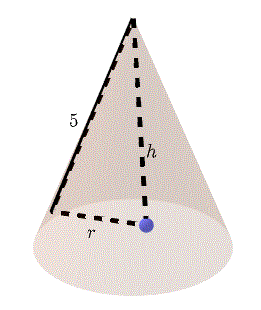
Volume : \( V = \dfrac{1}{3} \pi r^2 h \)
Contrainte : \( h^2 + r^2 = 25 \implies h = \sqrt{25 - r^2} \)
Fonction volume : \( V(r) = \dfrac{1}{3} \pi r^2 \sqrt{25 - r^2} \)
Dérivée : \( V'(r) = \dfrac{\pi}{3} \dfrac{50r - 3r^3}{\sqrt{25 - r^2}} \)
Point critique : \( 50r - 3r^3 = 0 \implies r = \sqrt{\dfrac{50}{3}} \approx 4.08 \).
Hauteur : \( h = \sqrt{25 - \dfrac{50}{3}} = \dfrac{5}{\sqrt{3}} \approx 2.88 \).
Problème 11 : Trouver le point sur une droite le plus proche d'un point donné
Trouver le point sur la droite \( y = 4 - x \) qui est le plus proche de \( (6, 3) \).
Solution
Point sur la droite : \( M = (x, 4 - x) \).
Carré de la distance : \( D^2 = (x - 6)^2 + (1 - x)^2 = 2x^2 - 14x + 37 \).
Dérivée : \( 4x - 14 = 0 \implies x = \dfrac{7}{2} \).
\( y = 4 - \dfrac{7}{2} = \dfrac{1}{2} \).
Réponse finale : \( \boxed{\left( \dfrac{7}{2}, \dfrac{1}{2} \right)} \).

Problème 12 : Minimiser le coût total de construction d'un pipeline en mer et le long de la côte
Trouver les distances en mer et le long de la côte qui minimisent le coût total du pipeline sachant que le coût en mer est de \( 3k \) et le coût sur la côte est de \( k \).

Solution
Soit \( x \) la distance le long de la côte de \( B \) à \( D \). Longueur sur la côte \( CD = 40 - x \), longueur en mer \( y = \sqrt{30^2 + (40-x)^2} \).
Coût total : \( C_t(x) = kx + 3ky = kx + 3k\sqrt{900 + (40-x)^2} \).
La résolution de la dérivée et du point critique donne \( x \approx 29.40 \) km et une distance en mer \( y \approx 31.81 \) km.
Problème 13 : Démontrer le produit maximal sous la contrainte \( x + y = K \)
Montrer que si \( x + y = K \), alors \( x \cdot y \le \left(\dfrac{K}{2}\right)^2 \).
Solution
Fonction produit : \( P(x) = x(K - x) = -x^2 + Kx \).
Dérivée : \( P'(x) = -2x + K = 0 \implies x = \dfrac{K}{2} \).
La dérivée seconde \( P''(x) = -2 < 0 \) confirme un maximum en \( x = \dfrac{K}{2}, y = \dfrac{K}{2} \).
Produit maximal : \( \left(\dfrac{K}{2}\right)^2 \).