Nous présentons une introduction et la définition du concept de fonctions continues en analyse, accompagnées d'exemples. De plus, les théorèmes de continuité et leur utilisation en analyse sont discutés.
Introduction et définition des fonctions continues
Commençons d'abord par les graphiques de plusieurs fonctions continues. Les fonctions dont les graphiques sont représentés ci-dessous sont dites continues car ces graphiques ne présentent ni "coupures", ni "lacunes", ni "trous".

Présentons maintenant des exemples de fonctions discontinues. Ces graphiques comportent des coupures, des lacunes ou des points pour lesquels ils ne sont pas définis.
Cas 1 : Non défini en un point (Trou)
Dans le graphique ci-dessous, la fonction n'est pas définie en \( x = 2 \). Le graphique présente un trou en \( x = 2 \) et la fonction est dite discontinue.

Cas 2 : Les limites à gauche et à droite ne correspondent pas
Dans le graphique ci-dessous, les limites de la fonction à gauche et à droite ne sont pas égales, et par conséquent la limite en \( x = 3 \) n'existe pas. La fonction est dite discontinue.

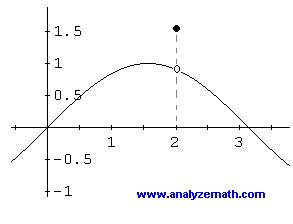
Cas 3 : La limite n'est pas égale à la valeur de la fonction
La limite de la fonction en \( x = 2 \) existe, mais elle n'est pas égale à la valeur de la fonction en \( x = 2 \). Cette fonction est également discontinue.
Cas 4 : Asymptote verticale (La limite n'existe pas)
La limite de la fonction en \( x = 3 \) n'existe pas puisque, à gauche et à droite de 3, la fonction augmente ou diminue indéfiniment. Cette fonction est également discontinue.

En tenant compte de toutes les informations tirées des exemples de fonctions continues et discontinues présentés ci-dessus, nous définissons une fonction continue de la manière suivante :
La fonction \( f \) est continue en un point \( a \) si les trois conditions suivantes sont satisfaites :
- 1. \( f(a) \) est définie
- 2. \( \lim_{x\to a} f(x) \) existe
- 3. \( \lim_{x\to a} f(x) = f(a) \)
Exemples avec solutions
Exemple 1 : Discontinuité due à une division par zéro
Montrez que la fonction \( f \) définie ci-dessous n'est pas continue en \( x = -2 \) :
\[ f(x) = \frac{1}{x + 2} \]Solution :
\( f(-2) \) n'est pas définie (la division par 0 n'est pas autorisée) ; par conséquent, la fonction \( f \) est discontinue en \( x = -2 \).
Exemple 2 : Continuité d'une fonction rationnelle
Montrez que la fonction \( f \) est continue pour toutes les valeurs de \( x \) dans \( \mathbb{R} \) :
\[ f(x) = \frac{1}{x^4 + 6} \]Solution :
La fonction \( f \) est définie pour toutes les valeurs de \( x \) dans \( \mathbb{R} \). La limite de \( f \) en tout point \( x = a \) est donnée par le quotient de deux limites : la constante 1 et la limite de \( x^4 + 6 \), qui est une fonction polynomiale dont la limite est \( a^4 + 6 \). Ainsi :
\[ \lim_{x\to a} f(x) = \frac{1}{a^4 + 6} \]Puisque \( f(a) = \frac{1}{a^4 + 6} \), nous avons :
\[ \lim_{x\to a} f(x) = f(a) \]Les trois conditions de continuité sont satisfaites, et par conséquent \( f \) est continue pour toutes les valeurs de \( x \) dans \( \mathbb{R} \).
Exemple 3 : Continuité d'une fonction valeur absolue
Montrez que la fonction \( f \) est continue pour toutes les valeurs de \( x \) dans \( \mathbb{R} \) :
\[ f(x) = |x - 5| \]Solution :
Écrivons \( f(x) \) par morceaux :
- \( f(x) = x - 5 \) si \( x > 5 \)
- \( f(x) = -(x - 5) \) si \( x < 5 \)
- \( f(x) = 0 \) si \( x = 5 \)
\( f(x) \) est donnée par les fonctions polynomiales \( x - 5 \) et \( -(x - 5) \) pour \( x > 5 \) et \( x < 5 \) respectivement, et par conséquent \( f(x) \) est continue pour ces valeurs de \( x \).
Vérifions maintenant le point \( x = 5 \). Considérons les limites lorsque \( x \) tend vers \( 5 \) par la gauche (\( x < 5 \)) :
\[ \lim_{x\to 5^{-}} f(x) = \lim_{x\to 5^{-}} -(x - 5) = 0 \]Considérons les limites lorsque \( x \) tend vers \( 5 \) par la droite (\( x > 5 \)) :
\[ \lim_{x\to 5^{+}} f(x) = \lim_{x\to 5^{+}} (x - 5) = 0 \]Puisque les limites unilatérales sont égales, la limite \( \lim_{x\to 5} f(x) \) existe et vaut 0. Ainsi, \( \lim_{x\to 5} f(x) = 0 = f(5) \), et la fonction \( f \) est continue en \( x = 5 \). Combiné avec les intervalles ci-dessus, \( f \) est continue pour toutes les valeurs de \( x \) dans \( \mathbb{R} \).