Le théorème des gendarmes, également appelé théorème d'encadrement, est utilisé pour trouver des limites.
Dans ce qui suit, \( C \) représente la constante d'intégration le cas échéant.
Théorème des gendarmes
Si \( f \), \( g \) et \( h \) sont des fonctions telles que :
\[ f(x) \le g(x) \le h(x) \]pour toutes les valeurs de \( x \) dans un intervalle ouvert contenant \( a \) (sauf éventuellement en \( a \)), et si :
\[ \lim_{x \to a} f(x) = \lim_{x \to a} h(x) = L \]alors :
\[ \lim_{x \to a} g(x) = L \]Exemples avec solutions
Cliquez sur chaque exemple pour afficher sa solution détaillée étape par étape.
Exemple 1
Trouvez la limite :
\[ \lim_{x \to 0} x^2 \cos\left(\dfrac{1}{x}\right) \]Afficher la solution de l'exemple 1
Lorsque \( x \) s'approche de \( 0 \), \( \dfrac{1}{x} \) devient très grand en valeur absolue, et \( \cos\left(\dfrac{1}{x}\right) \) oscille fortement.
Cependant, \( \cos\left(\dfrac{1}{x}\right) \) prend des valeurs comprises dans l'intervalle \([-1, 1]\), qui est l'ensemble image de la fonction cosinus. Par conséquent :
\[ -1 \le \cos\left(\dfrac{1}{x}\right) \le 1 \]Multipliez tous les termes de l'inégalité ci-dessus par \( x^2 \) (en sachant que \( x^2 > 0 \) pour \( x \neq 0 \)) :
\[ -x^2 \le x^2 \cos\left(\dfrac{1}{x}\right) \le x^2 \]L'inégalité ci-dessus est valable pour toute valeur de \( x \) sauf \( 0 \), où \( x^2 \cos\left(\dfrac{1}{x}\right) \) n'est pas défini. Lorsque \( x \) s'approche de \( 0 \), à la fois \( -x^2 \) et \( x^2 \) s'approchent de \( 0 \) :
\[ \lim_{x \to 0} (-x^2) = 0 \quad \text{et} \quad \lim_{x \to 0} x^2 = 0 \]Par conséquent, d'après le théorème des gendarmes, nous obtenons :
\[ \lim_{x \to 0} x^2 \cos\left(\dfrac{1}{x}\right) = 0 \]Exemple 2
Trouvez la limite :
\[ \lim_{x \to 0} \dfrac{\sin x}{x} \]Afficher la solution de l'exemple 2
Supposons que \( 0 < x < \pi/2 \) et considérons le cercle trigonométrique ainsi qu'un secteur \( OAC \) d'angle central \( x \) en position standard. \( A \) est un point sur le cercle trigonométrique, et \( AB \) est tangent au cercle au point \( A \), formant un angle droit en ce point.
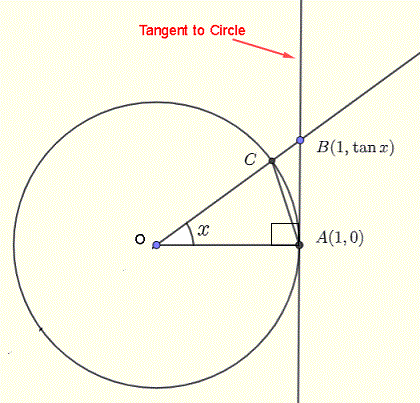
Le point \( C \) est un point du cercle trigonométrique (de rayon égal à 1) de coordonnées \( (\cos x, \sin x) \). Trouvons les aires du triangle \( OAC \), du secteur \( OAC \) et du triangle rectangle \( OAB \).
En utilisant la formule trigonométrique de l'aire d'un triangle :
\( \text{Aire du triangle } OAC = \dfrac{1}{2} \cdot OA \cdot OC \cdot \sin x = \dfrac{1}{2} \cdot 1 \cdot 1 \cdot \sin x = \dfrac{1}{2} \sin x \)
En utilisant la formule de l'aire d'un secteur circulaire :
\( \text{Aire du secteur } OAC = \dfrac{1}{2} \cdot x \cdot OC^2 = \dfrac{1}{2} x \)
Aire du triangle rectangle \( OAB \) :
\( \text{Aire du triangle rectangle } OAB = \dfrac{1}{2} \cdot (\text{base}) \cdot (\text{hauteur}) = \dfrac{1}{2} \cdot 1 \cdot \tan x = \dfrac{1}{2} \tan x \)
En comparant géométriquement les trois aires, nous pouvons écrire l'inégalité :
\[ \text{Aire du triangle } OAC < \text{Aire du secteur } OAC < \text{Aire du triangle } OAB \]Substituons les aires par leurs expressions :
\[ \dfrac{1}{2} \sin x < \dfrac{1}{2} x < \dfrac{1}{2} \tan x \]Multiplions tous les termes par \( \dfrac{2}{\sin x} \) (puisque \( \sin x > 0 \) pour \( 0 < x < \pi/2 \)) :
\[ 1 < \dfrac{x}{\sin x} < \dfrac{1}{\cos x} \]Prenons l'inverse et inversons les symboles d'inégalité :
\[ 1 > \dfrac{\sin x}{x} > \cos x \]Ce qui équivaut à :
\[ \cos x < \dfrac{\sin x}{x} < 1 \]On peut montrer que cette inéquation vaut également pour \( -\pi/2 < x < 0 \), donc l'inégalité est valable pour tout \( x \) dans un intervalle ouvert autour de \( 0 \) sauf \( x = 0 \) où \( \dfrac{\sin x}{x} \) n'est pas défini. Puisque :
\[ \lim_{x \to 0} \cos x = 1 \quad \text{et} \quad \lim_{x \to 0} 1 = 1 \]Nous pouvons appliquer le théorème des gendarmes pour obtenir :
\[ \lim_{x \to 0} \dfrac{\sin x}{x} = 1 \]Cette limite fondamentale est essentielle pour évaluer d'autres limites de fonctions trigonométriques et calculer leurs dérivées.