Des équations paramétriques sont présentées avec des exemples et leurs solutions. D'autres questions avec leurs solutions sont incluses.
Dans ce qui suit, \( C \) représente la constante d'intégration le cas échéant.
Exemples
Cliquez sur chaque exemple pour afficher sa solution détaillée étape par étape.
Exemple 1
Certaines courbes sont mieux décrites à l'aide d'équations paramétriques \( x \) et \( y \) en fonction d'un paramètre [1] [2].
Voici un exemple d'équations paramétriques \( x(t) \) et \( y(t) \) en fonction du paramètre \( t \) :
Afficher la solution et l'analyse de l'exemple 1
Le tracé de la courbe s'obtient en trouvant les coordonnées \( x \) et \( y \) pour différentes valeurs du paramètre \( t \) :

Chaque valeur de \( t \) détermine un point \( (x, y) \) tracé dans un système de coordonnées. À mesure que \( t \) varie, le point \( (x(t), y(t)) \) trace une courbe appelée courbe paramétrique. Les flèches rouges indiquent le sens d'accroissement du paramètre \( t \).

Remarque : la courbe obtenue est une partie d'une parabole que l'on peut obtenir en éliminant \( t \) :
Résolvez la première équation \( x(t) = t \) pour \( t \) : \( t = x \).
Substituez \( t \) dans la seconde équation \( y(t) = 0.5 t^2 \) :
En prenant des valeurs de \( t \) dans l'intervalle \( [0, 3] \), seule une portion de cette parabole est affichée.
Example 2
Cet exemple montre l'avantage d'utiliser des équations paramétriques simples pour décrire des courbes complexes. Les équations paramétriques ci-dessous décrivent des courbes de Lissajous utilisées en génie électrique.
Soit :
Afficher la solution et l'analyse de l'exemple 2


Trouvons une équation de la courbe en coordonnées cartésiennes en éliminant le paramètre \( t \) :
La première équation donne :
\[ \sin t = x - 1 \]En utilisant l'identité trigonométrique \( \sin(2t) = 2\sin t \cos t \), réécrivons la seconde équation :
\[ y = 2\sin t \cos t + 2 \]Puisque \( \cos t = \pm\sqrt{1 - \sin^2 t} \) :
\[ y = \pm 2\sin t \sqrt{1 - \sin^2 t} + 2 \]Substituons \( \sin t = x - 1 \) :
\[ y = \pm 2(x - 1)\sqrt{1 - (x - 1)^2} + 2 \implies y - 2 = \pm 2(x - 1)\sqrt{1 - (x - 1)^2} \]En élevant les deux côtés au carré et en simplifiant, on obtient l'équation cartésienne unique :
\[ (y - 2)^2 = 4(x - 1)^2(2x - x^2) \]Remarque : Cela démontre la simplicité des équations paramétriques pour représenter des courbes complexes qui seraient fastidieuses à décrire en coordonnées cartésiennes.
Questions
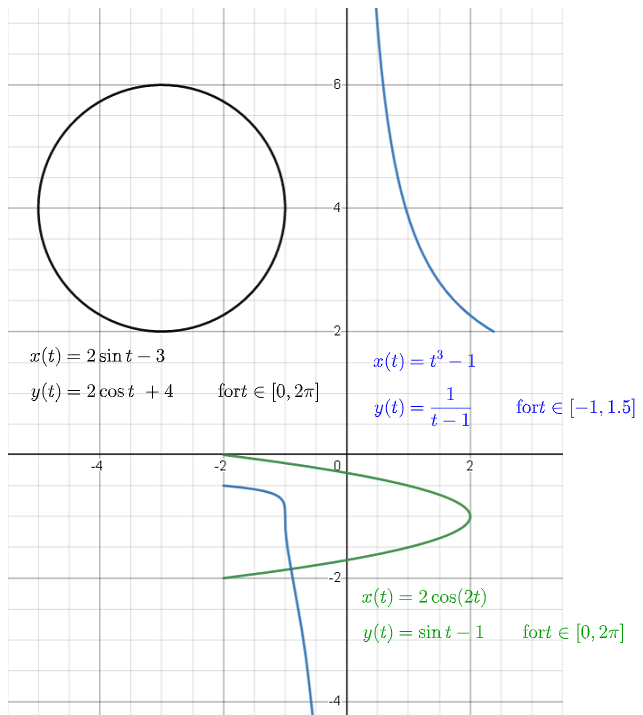
Trouvez une équation en coordonnées cartésiennes pour décrire la courbe de chaque ensemble d'équations paramétriques ci-dessous et tracez les courbes résultantes.
- \[ \left\{ \begin{aligned} x(t) &= t^3 - 1 \\ y(t) &= \dfrac{1}{t - 1} \qquad \text{pour} \; t \in [-1, 1.5] \end{aligned} \right. \]
- \[ \left\{ \begin{aligned} x(t) &= 2\sin t - 3 \\ y(t) &= 2\cos t + 4 \qquad \text{pour} \; t \in [0, 2\pi] \end{aligned} \right. \]
- \[ \left\{ \begin{aligned} x(t) &= 2\cos(2t) \\ y(t) &= \sin t - 1 \qquad \text{pour} \; t \in [0, 2\pi] \end{aligned} \right. \]
Solutions des exercices ci-dessus
Solution de la question 1
Afficher la solution de la question 1
Résolvez \( x = t^3 - 1 \) pour \( t \) :
\[ t = \sqrt[3]{x + 1} \]Substituez \( t \) dans \( y \) :
\[ \boxed{y = \dfrac{1}{\sqrt[3]{x + 1} - 1}} \]Solution de la question 2
Afficher la solution de la question 2
Réécrivez les équations sous la forme :
\[ \sin t = \dfrac{x + 3}{2}, \quad \cos t = \dfrac{y - 4}{2} \]Substituez dans l'identité \( \sin^2 t + \cos^2 t = 1 \) :
\[ \left(\dfrac{x + 3}{2}\right)^2 + \left(\dfrac{y - 4}{2}\right)^2 = 1 \]Simplifiez pour obtenir l'équation standard du cercle :
\[ \boxed{(x + 3)^2 + (y - 4)^2 = 2^2} \]Remarque : Il s'agit d'un cercle centré en \( (-3, 4) \) de rayon \( 2 \).
Solution de la question 3
Afficher la solution de la question 3
Utilisez l'identité trigonométrique \( \cos(2t) = 1 - 2\sin^2 t \) :
\[ x = 2(1 - 2\sin^2 t) \]À partir de \( y = \sin t - 1 \), nous obtenons \( \sin t = y + 1 \). Substituez ceci dans l'équation de \( x \) :
\[ \boxed{x = 2 - 4(y + 1)^2} \]Remarque : Ceci représente une parabole avec un axe horizontal et un sommet en \( (2, -1) \).
Références
- University Calculus - Early Transcendentals - Joel Hass, Maurice D. Weir, George B. Thomas, Jr., Christopher Heil - ISBN-13: 978-0134995540
- Calculus - Early Transcendentals - James Stewart - ISBN-13: 978-0-495-01166-8
- Dérivée des équations paramétriques et leurs applications
- Problèmes et tutoriels d'analyse
- Page d'accueil d'AnalyzeMath