Les dérivées des équations paramétriques sont présentées avec des exemples et leurs solutions. Des applications pour trouver les pentes des tangentes et la concavité sont également incluses. Explorez d'autres questions avec leurs solutions ci-dessous.
Dans ce qui suit, \( C \) représente la constante d'intégration le cas échéant.
Première et seconde dérivées d'équations paramétriques
Soient des équations paramétriques de la forme :
\[ \left\{ \begin{aligned} x(t) \\ y(t) \end{aligned} \right. \]quelle est la dérivée \( \dfrac{dy}{dx} \) ?
Tout d'abord, trouvez la dérivée \( \dfrac{dy}{dt} \) en utilisant la règle de dérivation en chaîne :
\[ \dfrac{dy}{dt} = \dfrac{dy}{dx} \dfrac{dx}{dt} \]En divisant les deux côtés par \( \dfrac{dx}{dt} \) et en simplifiant, on obtient :
\[ \boxed{\dfrac{dy}{dx} = \dfrac{\dfrac{dy}{dt}}{\dfrac{dx}{dt}} \qquad \text{si} \; \dfrac{dx}{dt} \ne 0} \qquad (I) \]La seconde dérivée est définie par :
\[ \dfrac{d^2 y}{dx^2} = \dfrac{d}{dx} \left(\dfrac{dy}{dx}\right) \]En remplaçant \( y \) par \( \dfrac{dy}{dx} \) dans la formule (I) ci-dessus, on obtient :
\[ \boxed{ \dfrac{d^2 y}{dx^2} = \dfrac{\dfrac{d}{dt} \left(\dfrac{dy}{dx} \right)}{\dfrac{dx}{dt}} } \qquad (II) \]Exemples et leurs solutions
Cliquez sur chaque exemple pour afficher sa solution détaillée étape par étape.
Exemple 1
Soient des équations paramétriques de la forme :
\[ \left\{ \begin{aligned} x(t) &= 2t + 1 \\ y(t) &= t^2 - 2 \end{aligned} \right. \]Quelle est la dérivée \( \dfrac{dy}{dx} \) ?
Afficher la solution de l'exemple 1
Trouvez \( \dfrac{dy}{dt} \) et \( \dfrac{dx}{dt} \) :
\[ \dfrac{dy}{dt} = 2t, \quad \dfrac{dx}{dt} = 2 \]Utilisez la formule (I) pour obtenir :
\[ \dfrac{dy}{dx} = \dfrac{\dfrac{dy}{dt}}{\dfrac{dx}{dt}} = \dfrac{2t}{2} = t \qquad (I) \]Nous pouvons également exprimer \( \dfrac{dy}{dx} \) en fonction de \( x \). Utilisez l'équation paramétrique \( x = 2t + 1 \) pour trouver \( t \) en fonction de \( x \) :
\[ t = \dfrac{x - 1}{2} \]Substituez \( t \) dans l'équation (I) :
\[ \dfrac{dy}{dx} = \dfrac{x - 1}{2} \]Exemple 2
a) Trouvez la première dérivée \( \dfrac{dy}{dx} \) et la seconde dérivée \( \dfrac{d^2 y}{dx^2} \) étant données les équations paramétriques :
\[ \left\{ \begin{aligned} x(t) &= 2(t - \sin t) \\ y(t) &= 2(1 - \cos t) \end{aligned} \right. \]Et déterminez la concavité de la courbe.
b) Utilisez un outil graphique pour vérifier la réponse concernant la concavité de la partie a).
Afficher la solution de l'exemple 2
a)
Trouvez \( \dfrac{dy}{dt} \) et \( \dfrac{dx}{dt} \) :
\[ \dfrac{dy}{dt} = 2\sin t, \quad \dfrac{dx}{dt} = 2(1 - \cos t) \]Utilisez la formule (I) pour trouver \( \dfrac{dy}{dx} \) :
\[ \dfrac{dy}{dx} = \dfrac{\dfrac{dy}{dt}}{\dfrac{dx}{dt}} = \dfrac{2\sin t}{2(1 - \cos t)} = \dfrac{\sin t}{1 - \cos t} \]Ensuite, calculez \( \dfrac{d}{dt}\left(\dfrac{dy}{dx}\right) \) :
\[ \dfrac{d}{dt} \left( \dfrac{\sin t}{1 - \cos t} \right) = \dfrac{\cos t(1 - \cos t) - \sin t(\sin t)}{(1 - \cos t)^2} = \dfrac{\cos t - \cos^2 t - \sin^2 t}{(1 - \cos t)^2} = \dfrac{\cos t - 1}{(1 - \cos t)^2} = -\dfrac{1}{1 - \cos t} = \dfrac{1}{\cos t - 1} \]Utilisez la formule (II) pour obtenir la seconde dérivée :
\[ \dfrac{d^2 y}{dx^2} = \dfrac{\dfrac{d}{dt}\left(\dfrac{dy}{dx}\right)}{\dfrac{dx}{dt}} = \dfrac{\dfrac{1}{\cos t - 1}}{2(1 - \cos t)} = -\dfrac{1}{2(\cos t - 1)^2} \]La seconde dérivée est toujours négative (sauf là où le dénominateur est égal à 0), par conséquent la courbe des équations paramétriques est concave vers le bas.
b)
Le tracé des équations paramétriques données (connu sous le nom de cycloïde) confirme que la courbe est entièrement concave vers le bas.

Exemple 3
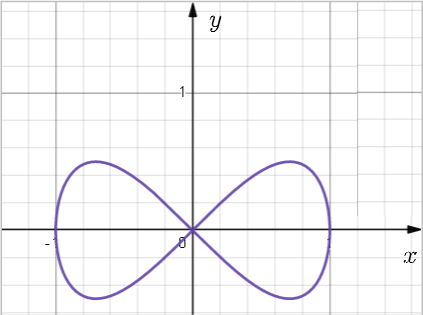
a) Tracez la courbe définie par les équations paramétriques :
\[ \left\{ \begin{aligned} x(t) &= \sin t \\ y(t) &= \sin t \cos t \end{aligned} \right., \quad t \in [0, 2\pi] \]b) Trouvez la première dérivée \( \dfrac{dy}{dx} \), les équations de la ou des tangentes au point \( (0, 0) \), et tracez-les.
Afficher la solution de l'exemple 3
a)
b)
Trouvez les dérivées \( \dfrac{dy}{dt} \) et \( \dfrac{dx}{dt} \) :
\[ \dfrac{dy}{dt} = \cos^2 t - \sin^2 t, \quad \dfrac{dx}{dt} = \cos t \]Trouvez \( \dfrac{dy}{dx} \) en utilisant la formule (I) :
\[ \dfrac{dy}{dx} = \dfrac{\cos^2 t - \sin^2 t}{\cos t} \]Trouvez la ou les valeurs de \( t \) pour lesquelles \( (x, y) = (0, 0) \) en résolvant \( \sin t = 0 \) et \( \sin t \cos t = 0 \) pour \( t \in [0, 2\pi] \) :
\[ t = 0 \quad \text{et} \quad t = \pi \]Évaluez \( \dfrac{dy}{dx} \) en \( t = 0 \) pour la première pente \( m_1 \) :
\[ m_1 = \dfrac{\cos^2 0 - \sin^2 0}{\cos 0} = 1 \]Évaluez \( \dfrac{dy}{dx} \) en \( t = \pi \) pour la seconde pente \( m_2 \) :
\[ m_2 = \dfrac{\cos^2 \pi - \sin^2 \pi}{\cos \pi} = -1 \]Équations des tangentes en \( (0, 0) \) :
\[ y = x \quad \text{et} \quad y = -x \]
Questions
Entraînez-vous à résoudre les problèmes ci-dessous. Cliquez sur chaque boîte de solution pour vérifier vos réponses.
-
Question 1
a) Étant données les équations paramétriques \( \left\{ \begin{aligned} x(t) &= \cos t + 2 \\ y(t) &= \sin t - 1 \end{aligned} \right., t \in [\pi, 2\pi] \), trouvez la dérivée \( \dfrac{dy}{dx} \) en \( t = \dfrac{3\pi}{2} \).
b) Quelle est la concavité de la courbe ?
c) Tracez la courbe et vérifiez vos réponses. -
Question 2
Une courbe est donnée en coordonnées polaires par \( r = 3 - 3\cos\theta \).
a) Trouvez la pente de la tangente à la courbe pour \( \theta = \dfrac{\pi}{4} \).
b) Trouvez \( \theta \) et \( r \) de sorte que la tangente à la courbe soit horizontale.
c) Représentez graphiquement \( r \) en coordonnées polaires et vérifiez vos réponses. -
Question 3
En coordonnées polaires, l'équation d'un cercle de rayon \( R \) centré à l'origine est \( r = R \). Trouvez les coordonnées cartésiennes de tous les points du cercle de rayon 2 centré à l'origine où les tangentes ont une pente égale à \( \dfrac{1}{2} \).
Solutions des exercices ci-dessus
Solution de la question 1
Afficher la solution de la question 1
a) Trouvez \( \dfrac{dy}{dt} \) et \( \dfrac{dx}{dt} \) :
\[ \dfrac{dy}{dt} = \cos t, \quad \dfrac{dx}{dt} = -\sin t \] \[ \dfrac{dy}{dx} = \dfrac{\cos t}{-\sin t} = -\cot t \]Évaluez en \( t = \dfrac{3\pi}{2} \) :
\[ \dfrac{dy}{dx} = -\cot\left(\dfrac{3\pi}{2}\right) = 0 \]b) Calculez la seconde dérivée \( \dfrac{d^2 y}{dx^2} \) :
\[ \dfrac{d^2 y}{dx^2} = \dfrac{\dfrac{d}{dt}(-\cot t)}{-\sin t} = \dfrac{\csc^2 t}{-\sin t} = -\csc^3 t \]Puisque \( \csc t = \dfrac{1}{\sin t} \) est négative sur \( (\pi, 2\pi) \), la seconde dérivée \( -\csc^3 t \) est positive, ce qui signifie que la courbe est concave vers le haut sur \( (\pi, 2\pi) \).

Solution de la question 2
Afficher la solution de la question 2
a) En utilisant la conversion des coordonnées polaires en cartésiennes :
\[ x(\theta) = (3 - 3\cos\theta)\cos\theta, \quad y(\theta) = (3 - 3\cos\theta)\sin\theta \]Calcul des dérivées par rapport à \( \theta \) :
\[ \dfrac{dy}{d\theta} = 3\sin^2\theta + \cos\theta(3 - 3\cos\theta), \quad \dfrac{dx}{d\theta} = 3\sin(2\theta) - 3\sin\theta \]À \( \theta = \dfrac{\pi}{4} \), la substitution des valeurs donne une pente \( m = \sqrt{2} + 1 \approx 2,41 \).
b) Pour une tangente horizontale, posez \( \dfrac{dy}{d\theta} = 0 \) (avec \( \dfrac{dx}{d\theta} \neq 0 \)) :
\[ 3\sin^2\theta + 3\cos\theta - 3\cos^2\theta = 0 \implies 2\cos^2\theta - \cos\theta - 1 = 0 \]La résolution donne \( \theta = \dfrac{2\pi}{3} \) et \( \theta = \dfrac{4\pi}{3} \) (en excluant \( \theta = 0 \) où le dénominateur est nul). Les rayons correspondants sont \( r = 4,5 \).

Solution de la question 3
Afficher la solution de la question 3
Équations paramétriques pour le cercle \( r = 2 \) :
\[ x(\theta) = 2\cos\theta, \quad y(\theta) = 2\sin\theta \]La dérivée est \( \dfrac{dy}{dx} = -\cot\theta \).
Posez la pente égale à \( \dfrac{1}{2} \) :
\[ -\cot\theta = \dfrac{1}{2} \implies \tan\theta = -2 \]Recherche des angles dans \( [0, 2\pi] \) :
\[ \theta_1 \approx 2,68 \text{ rad} \, (153,55^\circ), \quad \theta_2 \approx 5,82 \text{ rad} \, (333,46^\circ) \]Évaluation des coordonnées cartésiennes :
\[ (2\cos\theta_1, 2\sin\theta_1) \approx (-1,79, 0,89) \] \[ (2\cos\theta_2, 2\sin\theta_2) \approx (1,79, -0,89) \]